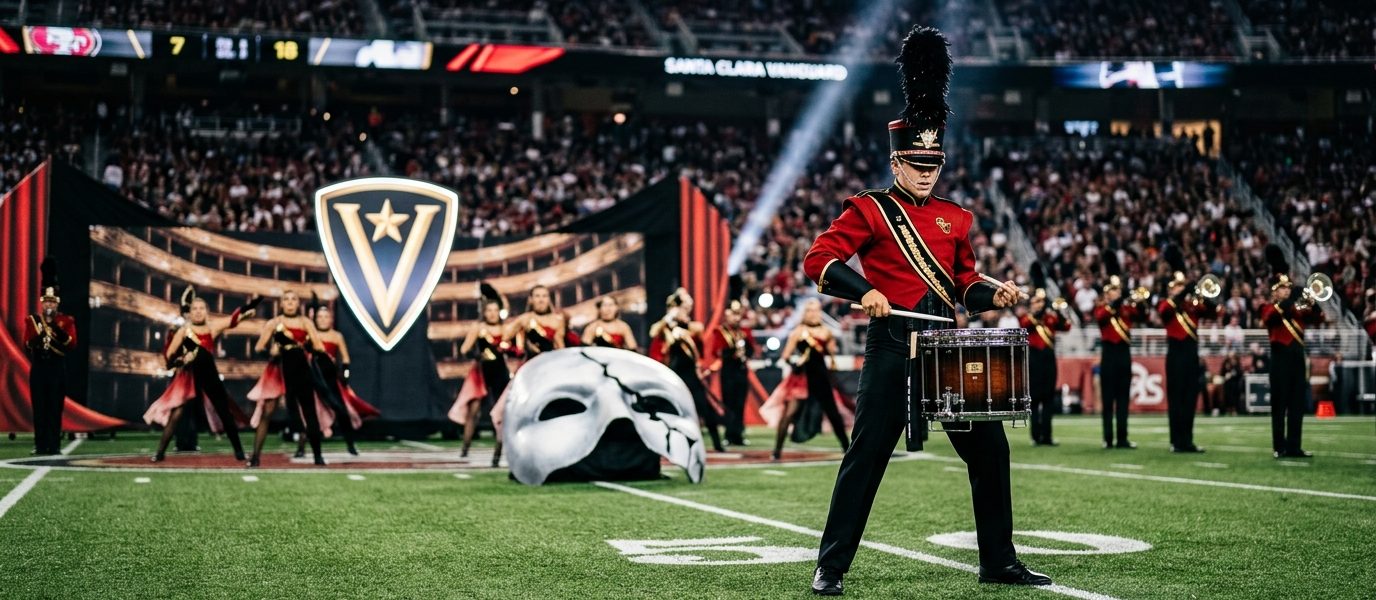
The summer of 1989 gave drum corps fans something they’d never seen before. Santa Clara Vanguard stepped onto the field with Andrew Lloyd Webber’s Phantom of the Opera, and the activity would never be the same. This wasn’t just another show with a popular theme. It was a complete theatrical experience that pushed the boundaries of what a drum corps could achieve on a football field.
Santa Clara Vanguard’s 1989 Phantom of the Opera production revolutionized drum corps by blending theatrical staging with musical excellence. The show featured innovative visual design, powerful brass arrangements, and dramatic storytelling that earned a second-place finish and influenced decades of future productions. Its impact on modern show design remains visible in today’s competitive landscape.
What Made This Production Revolutionary
Santa Clara Vanguard didn’t just play the music. They lived it.
The corps transformed the football field into the Paris Opera House. Members became characters. The guard told the story of Christine and the Phantom through movement that felt more like ballet than traditional flag work. Every visual element served the narrative.
Designer Pete Emmons created staging that audiences had rarely seen in drum corps. The Phantom character appeared throughout the show, lurking in shadows, creating tension. The organ prop became a focal point during “Music of the Night.” These weren’t gimmicks. They were essential storytelling tools.
The brass arrangements by Myron Rosander captured the drama of Webber’s score while maintaining the power expected from a championship-level corps. The ballad moment during “All I Ask of You” showcased control and musicality that contrasted beautifully with the explosive opener.
Here’s what set this production apart from other shows that season:
- Full character development throughout the entire program
- Integrated props that enhanced rather than distracted from the performance
- Seamless transitions between musical movements that maintained narrative flow
- Color guard choreography that told a complete story independent of the brass line
- Staging choices that created depth and perspective on a flat field
The Musical Architecture Behind the Performance
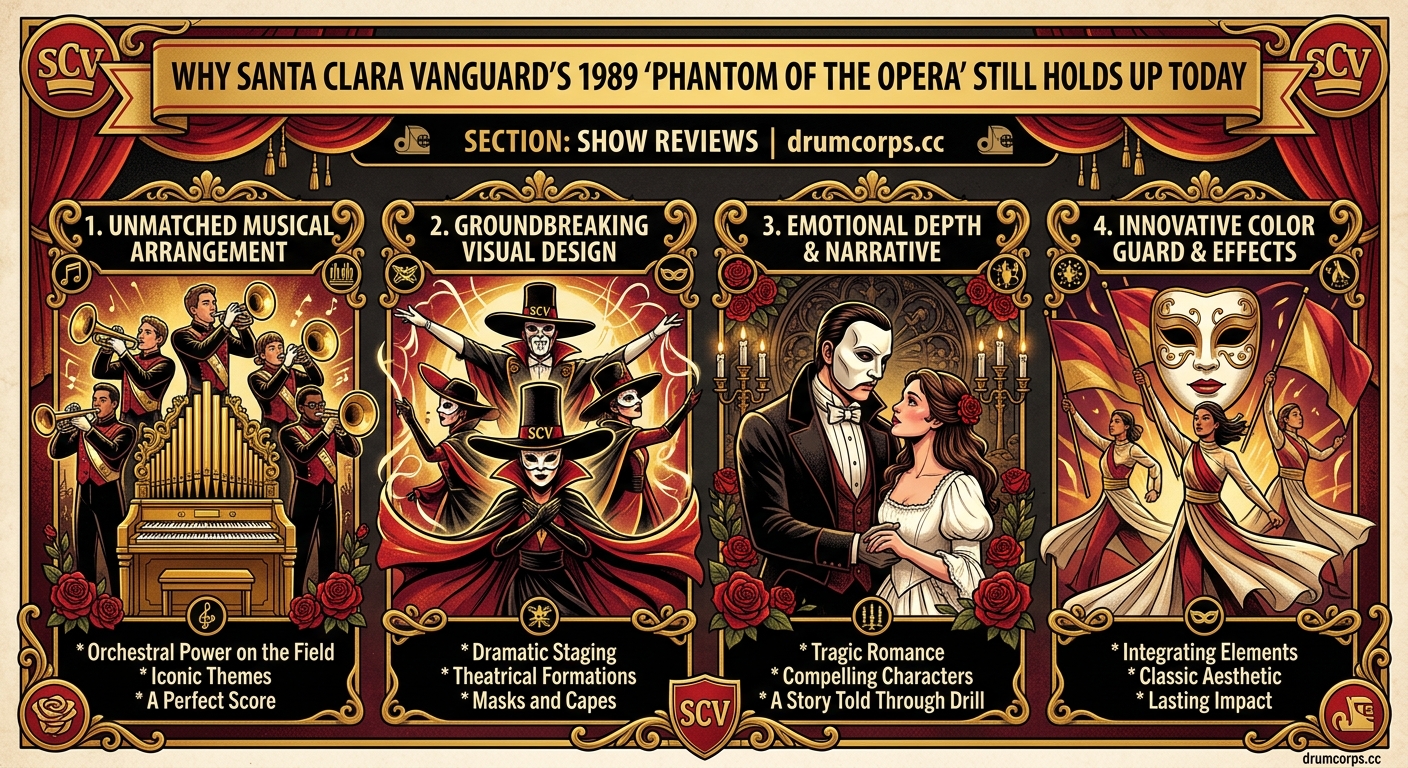
The show opened with the iconic chandelier crash from the overture. Right from the first note, you knew this wasn’t a typical drum corps opener. The brass hit with power, but also with theatrical timing that matched the drama of the moment.
“Music of the Night” became the emotional center of the production. The corps slowed down. They created space. The soloist work during this section showed restraint that many corps still struggle to achieve today. This wasn’t about volume. It was about drawing the audience into the Phantom’s world.
The percussion section, under the direction of Jim Casella, provided more than just rhythmic foundation. They created atmosphere. The timpani work during dramatic moments added weight. The pit percussion added texture that supported the theatrical nature of the show without overwhelming the brass.
“The 1989 Vanguard show proved that drum corps could be more than athletic excellence and musical precision. It could be art that moved people emotionally.” – Former DCI judge and brass arranger
The closer brought everything together. “Point of No Return” built tension systematically. The visual design accelerated. The brass pushed harder. The guard work became more frantic. Then the final impact moment delivered exactly what the audience needed.
Breaking Down the Visual Design Elements
The staging required precision that went beyond typical drill execution. Members had to hit marks while maintaining character. They had to perform technically demanding drill while telling a story with their body language.
Here’s how the visual program built throughout the show:
- Opening impact established the opera house setting through architectural forms
- Character introduction through isolated staging and spotlight moments
- Relationship development between Christine and the Phantom using spatial proximity
- Climactic confrontation using aggressive drill moves and compressed spacing
- Resolution through final tableaux that left the story’s ending ambiguous
The color guard faced unique challenges. They weren’t just performing equipment work. They were actors. The Christine character had to convey innocence, fear, desire, and ultimately strength. The guard members playing supporting roles had to react to the main narrative while executing demanding choreography.
| Visual Element | Traditional Approach | Vanguard 1989 Approach |
|---|---|---|
| Drill Design | Geometric patterns for visual impact | Staging that supports narrative flow |
| Guard Work | Equipment-focused choreography | Character-driven movement with equipment as props |
| Body Movement | Uniform carriage across all members | Individualized character work within ensemble |
| Spacing | Consistent intervals for clean lines | Varied spacing to create dramatic relationships |
| Transitions | Efficient movement between forms | Theatrical entrances and exits |
Why This Show Still Influences Modern Productions
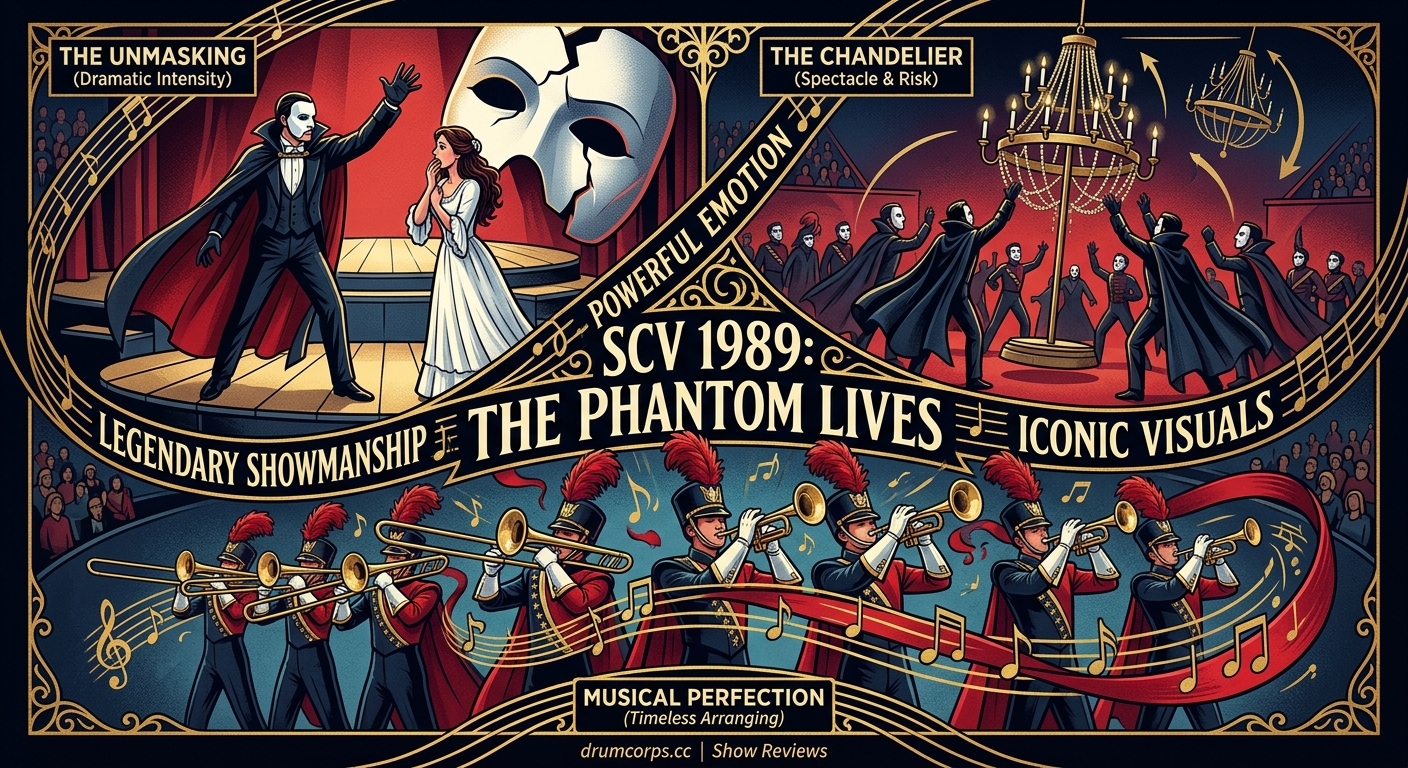
Walk into any DCI finals today and you’ll see the legacy of this production. Corps routinely use props, character development, and narrative structure. But in 1989, this was radical.
The show finished second to the Blue Devils that year. Some judges struggled with how to score theatrical elements that didn’t fit traditional caption sheets. But audiences loved it. The standing ovations were immediate and sustained.
Other corps took notice. Within a few years, theatrical productions became more common. The Cadets started telling stories. Phantom Regiment leaned into their classical themes with more dramatic staging. The entire activity shifted toward shows that engaged audiences emotionally, not just technically.
The influence extends to how corps approach visual storytelling today. Modern designers cite this show when discussing the balance between athletic demand and artistic expression.
The Technical Execution That Made It Work
Theatrical ambition means nothing without execution. Santa Clara Vanguard delivered both.
The brass line maintained tone quality through demanding staging. They played exposed passages while moving through complex drill. The mellophone soloist during “All I Ask of You” had to deliver a beautiful, controlled sound while standing alone in front of the entire corps. That requires exceptional breath support and mental toughness.
The percussion section faced similar challenges. Playing musically while maintaining the theatrical energy of the show required discipline. The front ensemble had to balance supporting the brass with creating atmospheric moments that enhanced the storytelling.
Common mistakes that would have ruined this production:
- Overacting that breaks the fourth wall and reminds audiences they’re watching a competition
- Inconsistent character work where members drop their roles during difficult drill moves
- Musical sacrifices where theatrical elements compromise sound quality
- Prop work that becomes more important than the actual performance
- Visual design that confuses rather than clarifies the narrative
The corps avoided all of these pitfalls. They maintained musical excellence while pushing visual boundaries. That’s why the show still holds up when you watch it today.
How the Show Changed Championship Expectations
Before 1989, most championship-level shows followed a formula. Strong opener. Technical middle movement. Powerful ballad. Explosive closer. The music might have a theme, but it didn’t necessarily tell a story.
Vanguard proved you could do both. You could tell a compelling story and still compete at the highest level. You could take artistic risks and still medal at finals.
The show also changed how designers thought about programming. Instead of selecting music based purely on technical demand or crowd appeal, they started asking whether pieces could work together narratively. Could this ballad follow this opener in a way that makes emotional sense? Does this closer resolve the themes we’ve established?
These questions seem obvious now. They weren’t in 1989.
The production also influenced how other legendary shows approached classical repertoire. Corps realized that familiar music could be recontextualized through theatrical presentation.
What Today’s Performers Can Learn From This Show
Modern drum corps members can study this production for lessons that remain relevant. The balance between technical execution and artistic expression hasn’t changed. If anything, it’s become more demanding.
The show demonstrates how to maintain character while executing difficult drill. Watch how members stay in role even during the most challenging moments. Their faces, their body language, their energy all serve the story. That level of commitment separates good performances from legendary ones.
The brass arrangements show how to build dynamics that serve musicality rather than just showcasing volume. The softest moments in this show are just as impressive as the loudest. Learning to control articulation without sacrificing sound quality remains essential for any brass player.
The visual design teaches spacing awareness. Members had to know exactly where they were in relation to others to create the staging effects. That spatial awareness comes from consistent practice of fundamental marching technique, even when you’re focused on character work.
The Lasting Impact on Competitive Drum Corps
Thirty-five years later, this show still generates discussion. Fans debate whether it should have won. Designers analyze its structure. New members discover it and realize how much of modern drum corps traces back to this production.
The show proved that artistic risk could coexist with competitive success. It showed that audiences craved emotional engagement alongside technical excellence. It demonstrated that familiar music could be transformed through creative staging and thoughtful design.
Every time a corps puts a prop on the field, they’re walking a path Vanguard helped clear. Every time a guard member plays a character instead of just performing equipment work, they’re building on this foundation. Every time a show tells a story that moves audiences to tears, it’s because productions like this one proved it was possible.
The 1989 Santa Clara Vanguard didn’t just perform Phantom of the Opera. They changed what drum corps could be. They expanded the artistic possibilities of the activity while maintaining the competitive excellence that defines championship-level performance.
Why This Show Remains a Masterclass in Design
Watching this production today, you notice things that seemed revolutionary in 1989 but feel foundational now. That’s the mark of truly influential work. It becomes so integrated into the activity that we forget there was a time before it existed.
The show works because every element serves the whole. The drill supports the music. The music supports the story. The story gives meaning to the drill. Nothing exists in isolation. Everything connects.
That’s the lesson modern designers still study. You can have the most technically demanding drill ever written, but if it doesn’t serve a purpose, it’s just movement. You can have beautiful music, but if the visual program fights against it, you’ve created conflict instead of art.
Santa Clara Vanguard’s 1989 Phantom of the Opera showed the activity what integration really means. They created a complete theatrical experience that happened to take place on a football field during a drum corps competition. The fact that it still captivates audiences decades later proves they got it right.
If you’re designing a show, performing in one, or just watching from the stands, this production offers lessons worth studying. It reminds us that drum corps can be technically excellent and artistically meaningful at the same time. It doesn’t have to be one or the other. The best shows, the ones that endure, find a way to be both.