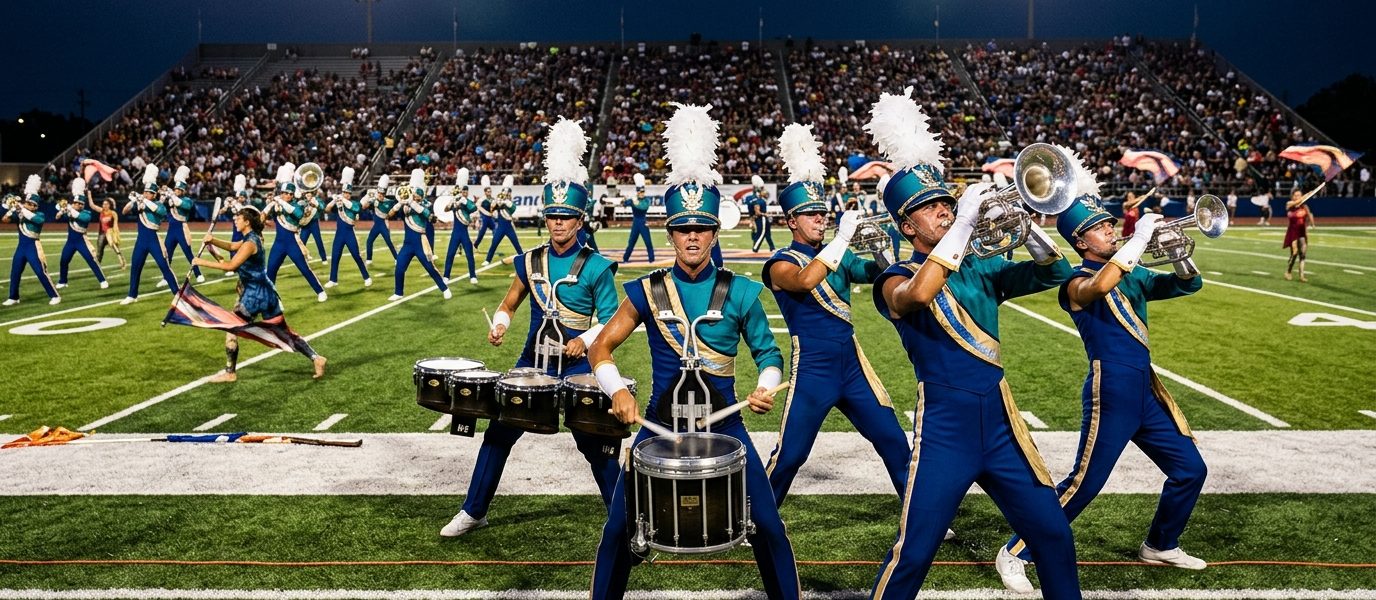
The 1980s changed drum corps forever. Corps that had marched in traditional military style suddenly embraced synthesizers, amplified front ensembles, and theatrical design concepts that would have seemed impossible just years earlier. The decade saw legendary rivalries, rule changes that sparked heated debates, and performances that still resonate with fans today.
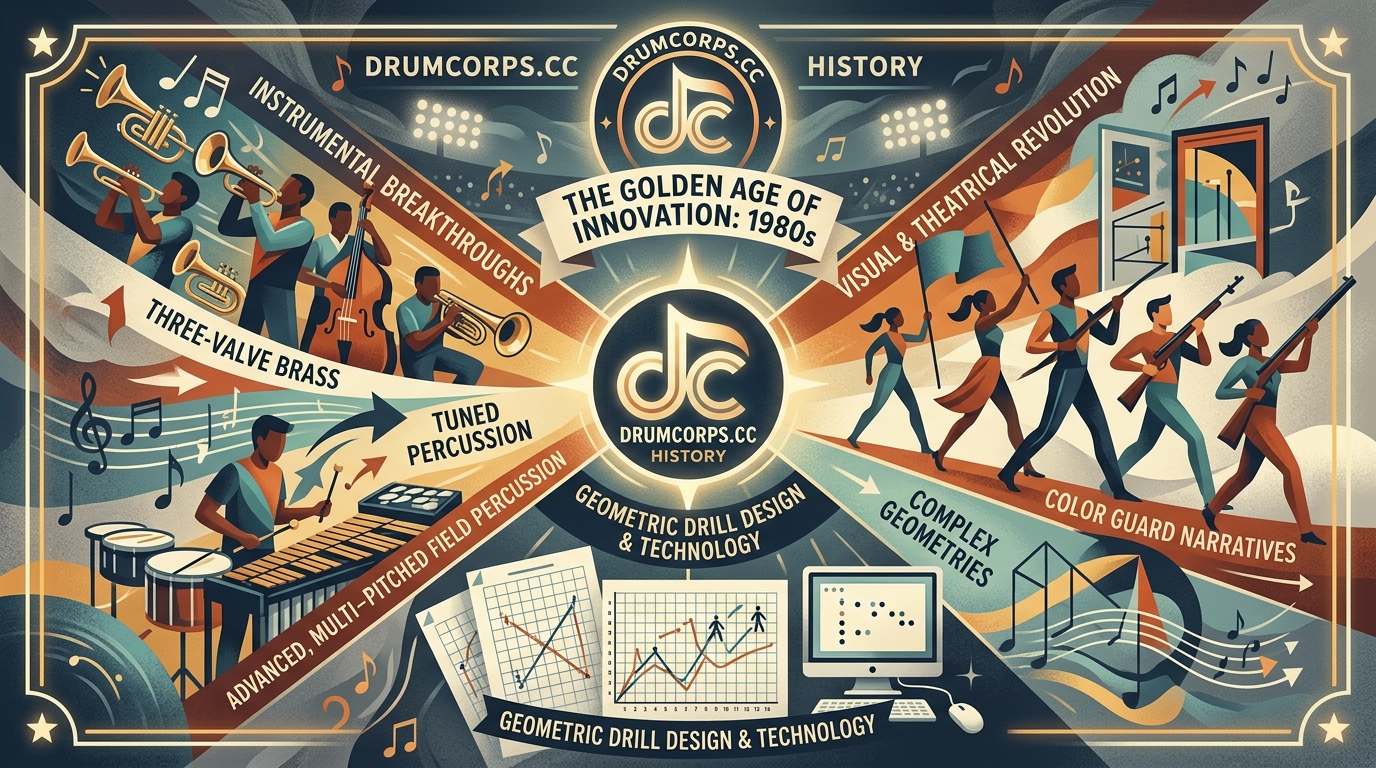
The 1980s transformed drum corps through electronic instruments, amplified pit percussion, sophisticated visual design, and expanded musical repertoire. These innovations created the modern drum corps template we recognize today, though they sparked controversy among traditionalists who valued acoustic purity and military precision over theatrical presentation and electronic enhancement.
The electronics revolution changed everything
Before 1982, drum corps competitions were entirely acoustic. Brass, percussion, and nothing else.
Then Drum Corps International allowed synthesizers and electronic keyboards in the front ensemble. The change was instant and dramatic.
Santa Clara Vanguard won the 1983 championship with a show featuring prominent synthesizer parts. The Cadets used electronics to create atmospheric soundscapes. Blue Devils integrated keyboards into their jazz-influenced arrangements.
Not everyone celebrated. Traditionalists argued that electronics violated the spirit of drum corps. They believed the activity should showcase human performance, not pre-programmed sounds.
The debate raged in parking lots and magazine letters sections. But the change stuck.
By 1985, nearly every competitive corps featured synthesizers. Arrangers now had access to string sounds, organ tones, and atmospheric effects that brass and percussion alone could never produce.
The front ensemble itself grew larger. What had been a small battery of mallet instruments became a full keyboard section. Some corps rolled out elaborate electronic setups that required dedicated tech crews.
Visual design became theatrical
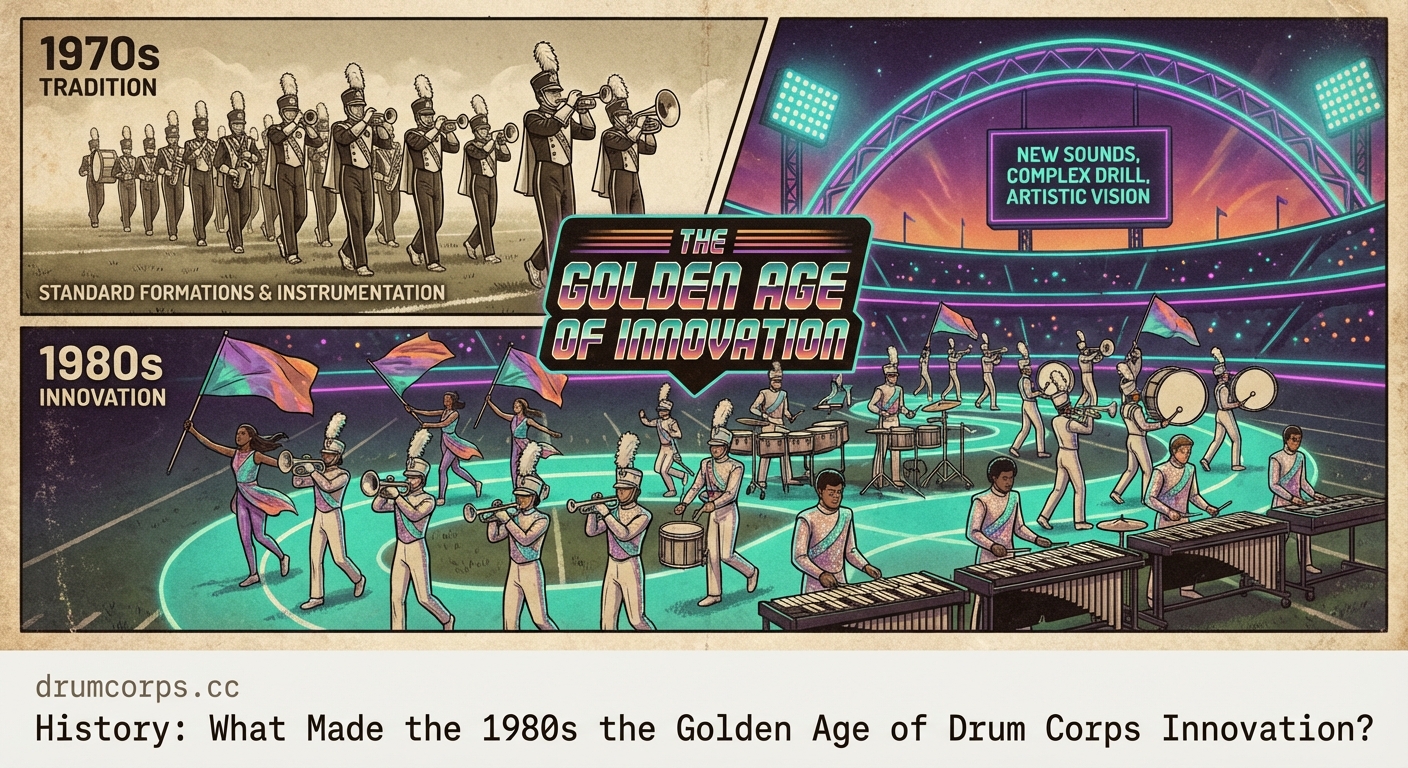
Early 1980s drill still emphasized geometric precision. Corps formed perfect circles, lines, and blocks.
Mid-decade, that started changing.
The Cavaliers introduced asymmetrical forms and unexpected staging. Star of Indiana hired professional theater designers. Santa Clara Vanguard created shows with narrative arcs and character development.
The field became a stage. Performers weren’t just marching musicians anymore. They were actors telling stories through movement and sound.
This shift required new skills:
- Corps members learned basic acting techniques to convey emotion and character
- Design teams studied theater, film, and contemporary dance for inspiration
- Instructors developed new training methods that combined marching fundamentals with expressive movement
The change wasn’t universal. Some corps maintained traditional approaches. But the trend toward theatrical presentation became dominant.
Judges adapted their criteria. Visual scores now rewarded creativity and emotional impact, not just technical precision.
The guard became essential
Color guard had always been part of drum corps. But in the 1980s, the guard evolved from decorative element to essential component.
Guards got bigger. Ten or twelve members became twenty or more. Equipment diversified beyond flags to include rifles, sabers, and custom props.
“The guard in the 1980s stopped being an accessory and became the visual heart of the show. We weren’t just adding color anymore. We were telling the story.” — Former DCI judge and visual designer
Garfield Cadets (later just The Cadets) pushed guard innovation aggressively. Their 1983 show featured extensive weapon work. Their 1987 production used the guard to create visual metaphors that reinforced the musical themes.
Santa Clara Vanguard integrated guard movements with brass and percussion staging. The entire corps moved as one visual unit.
This integration required tighter collaboration between caption heads. Brass arrangers, percussion writers, and visual designers had to coordinate every moment.
Amplification arrived and stayed
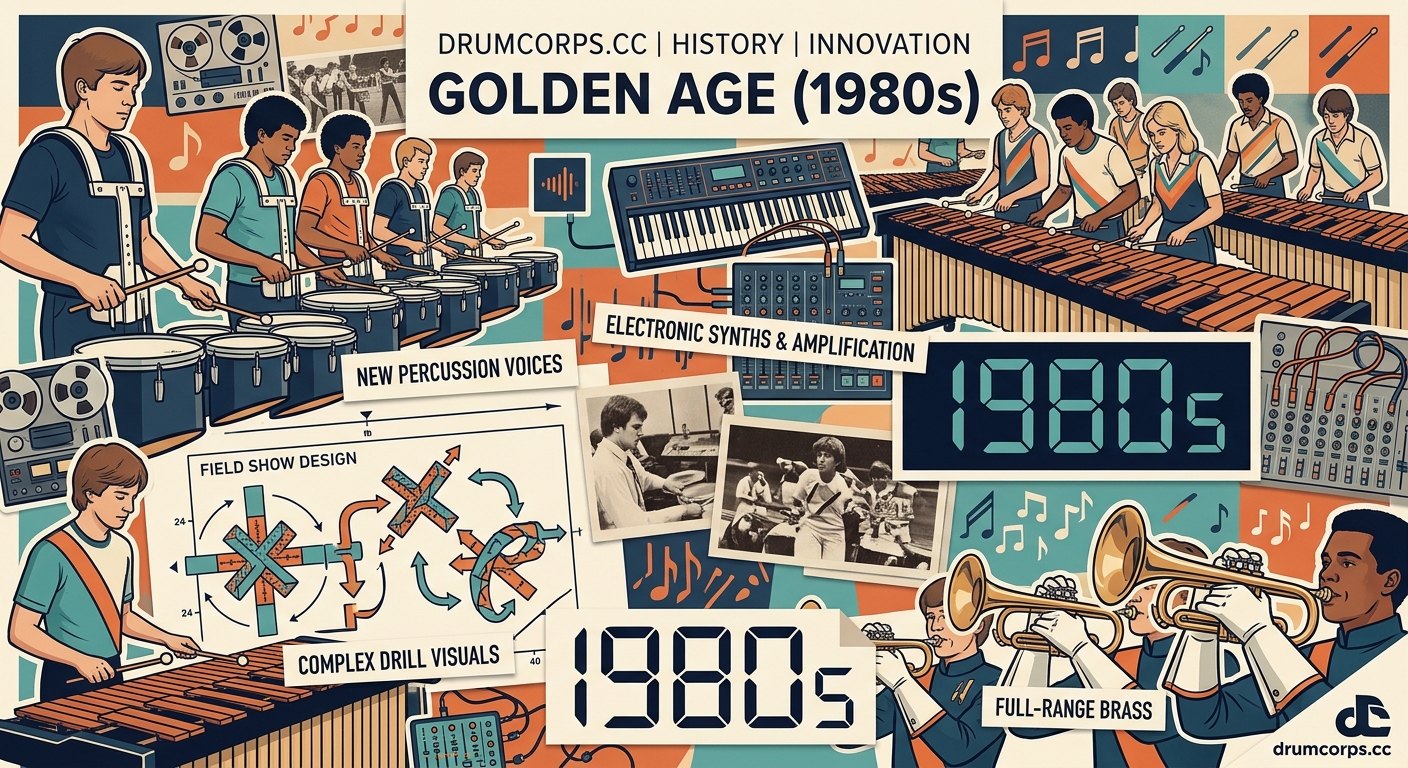
The introduction of amplification might be the most controversial change of the decade.
In 1986, DCI allowed limited amplification for the front ensemble. Marimba and vibraphone sounds could now project across football stadiums.
Supporters argued this leveled the playing field. Acoustic mallet instruments simply couldn’t compete with 60-piece horn lines in outdoor venues.
Critics saw it as another step away from pure performance. If you amplified the pit, why not the horns? Where would it end?
The slippery slope argument had merit. Over subsequent decades, amplification expanded. But in the 1980s, it remained limited to keyboard and mallet percussion.
The change affected arranging immediately. Percussion writers could now feature delicate marimba passages that would have been inaudible before. Keyboard parts became more prominent in the overall sound mix.
Sound engineers became essential staff members. Balancing amplified and acoustic sources required expertise that most corps had to develop from scratch.
Musical repertoire expanded dramatically
Early drum corps relied heavily on classical transcriptions and traditional march arrangements. The 1980s opened the repertoire wide.
Jazz became common. Blue Devils built their identity around swing and bebop. Their 1982 show “Ain’t Misbehavin'” featured sophisticated jazz harmonies and improvisation-style solos.
Rock and pop music appeared. Though still arranged for brass and percussion, shows incorporated recognizable contemporary songs.
Original compositions increased. Professional composers wrote specifically for drum corps, creating works that used the ensemble’s unique capabilities.
| Musical Era | Common Repertoire | Arranging Approach |
|---|---|---|
| Pre-1980 | Classical transcriptions, military marches | Faithful to original, emphasis on power |
| Early 1980s | Classical, some jazz standards | Beginning to adapt arrangements for drum corps idiom |
| Mid-1980s | Jazz, classical, original works | Custom arrangements exploiting electronics and expanded percussion |
| Late 1980s | All genres including rock, world music | Fully integrated designs with music serving visual concepts |
The expanded repertoire attracted new audiences. People who found classical transcriptions boring might connect with jazz or contemporary music.
It also attracted different performers. Musicians interested in jazz or contemporary styles now saw drum corps as relevant to their interests.
Common mistakes corps made during the transition
The rush to embrace innovation led to predictable problems:
- Overusing electronics: Some corps added synthesizers without musical purpose, creating cluttered arrangements
- Sacrificing fundamentals: Theatrical concepts sometimes overshadowed basic marching and playing technique
- Inconsistent integration: Early attempts at unified design often resulted in music and visual elements that contradicted each other
- Technology failures: Electronic equipment malfunctioned in outdoor conditions, ruining otherwise solid performances
- Ignoring audience comprehension: Some shows became so abstract that audiences couldn’t follow the intended narrative
The most successful corps balanced innovation with fundamentals. They added new elements without abandoning the technical excellence that defined great drum corps.
The competitive landscape shifted
The 1980s saw intense rivalry between distinct design philosophies.
Traditional corps like the Cavaliers maintained emphasis on precision drill and powerful brass sound. Innovative corps like Santa Clara Vanguard and Garfield Cadets pushed theatrical concepts and electronic integration.
Both approaches won championships. The Cavaliers took titles in 1984, 1985, 1986, and 1987. Santa Clara Vanguard won in 1980, 1981, and 1989. Blue Devils claimed 1982, 1984, and 1986.
The variety proved the activity could support multiple successful approaches. You didn’t have to follow one formula.
Regional differences emerged. East Coast corps often favored power and precision. West Coast corps leaned toward musical sophistication and visual creativity.
These distinctions weren’t absolute. But they reflected different philosophies about what drum corps should be.
Training methods evolved
The innovations required new teaching approaches.
Corps extended their seasons. What had been eight-week summer tours became ten or twelve weeks. Some corps added spring training camps.
Specialized instructors became standard. Instead of one brass instructor, corps hired separate coaches for each section. Visual programs employed multiple choreographers.
Video analysis became common. Corps recorded rehearsals and performances, then studied the footage to identify problems.
Physical conditioning programs expanded. The increased demands of theatrical movement required better fitness than traditional marching.
Mental preparation received new attention. Sports psychology techniques helped performers handle pressure and maintain focus during long, demanding shows.
The financial model changed
All these innovations cost money. A lot of money.
Electronics required purchase and maintenance. Amplification needed sound systems and engineers. Extended seasons meant higher travel and housing costs. Specialized staff commanded professional salaries.
Corps budgets grew dramatically. Organizations that had operated on modest fundraising now needed sophisticated development programs.
Some corps couldn’t keep up. Several well-known organizations folded or went inactive during the decade.
Others found creative solutions:
- Corporate sponsorships became common
- Tour schedules maximized revenue from shows and competitions
- Merchandise sales expanded beyond basic souvenirs
- Alumni networks provided financial support
The financial pressure created a divide between well-funded corps and struggling organizations. The gap would only widen in subsequent decades.
Looking back at what the decade built
The 1980s established the template for modern drum corps. Electronics, amplification, theatrical design, and expanded repertoire all became standard.
The changes weren’t without cost. Some of the raw power and simplicity of earlier eras disappeared. The activity became more expensive and exclusive.
But the innovations also brought new creative possibilities. Shows became more sophisticated. The artistic ceiling rose.
For those who marched or watched during this decade, the memories remain vivid. The sounds, the shows, the rivalries. The 1980s created drum corps moments that still inspire fans and performers decades later.
The debate about tradition versus innovation continues. But the 1980s proved that drum corps could evolve dramatically while maintaining its essential character. The activity survived radical change and emerged stronger, more diverse, and more artistically ambitious than ever before.