Your lips are burning. Your sound is cracking. And there’s still two hours left in the block.
Lip fatigue hits every brass player eventually, but it doesn’t have to end your rehearsal early or wreck your tone. The difference between players who power through full days and those who fade after an hour comes down to technique, preparation, and understanding how your embouchure actually works.
Preventing lip fatigue requires balanced mouthpiece pressure, strategic rest periods, proper breathing support, and smart warmup routines. Focus on efficiency over force, take micro-breaks between repetitions, and build endurance gradually through structured practice. Most fatigue comes from tension and poor air support, not weak muscles. Address the root causes and your chops will last all day.
Understanding what actually causes lip fatigue
Your lips get tired because they’re doing too much work. That sounds obvious, but most players don’t realize they’re making their embouchure compensate for problems elsewhere.
Excessive mouthpiece pressure is the biggest culprit. When you press harder to hit high notes or play louder, you restrict blood flow to your lips. Less blood means less oxygen. Less oxygen means faster fatigue.
Poor air support forces your lips to do the heavy lifting. If you’re not sending enough fast air through the horn, your embouchure has to squeeze and pinch to create the resistance needed for sound. That’s exhausting.
Tension in your face, neck, and shoulders transfers directly to your lips. When you’re tight everywhere else, your embouchure can’t function efficiently.
And sometimes you’re just playing too much without rest. Your lips are muscles. They need recovery time just like your legs after a long run.
Building a foundation with proper breathing technique
Your air does most of the work. Your lips just guide it.
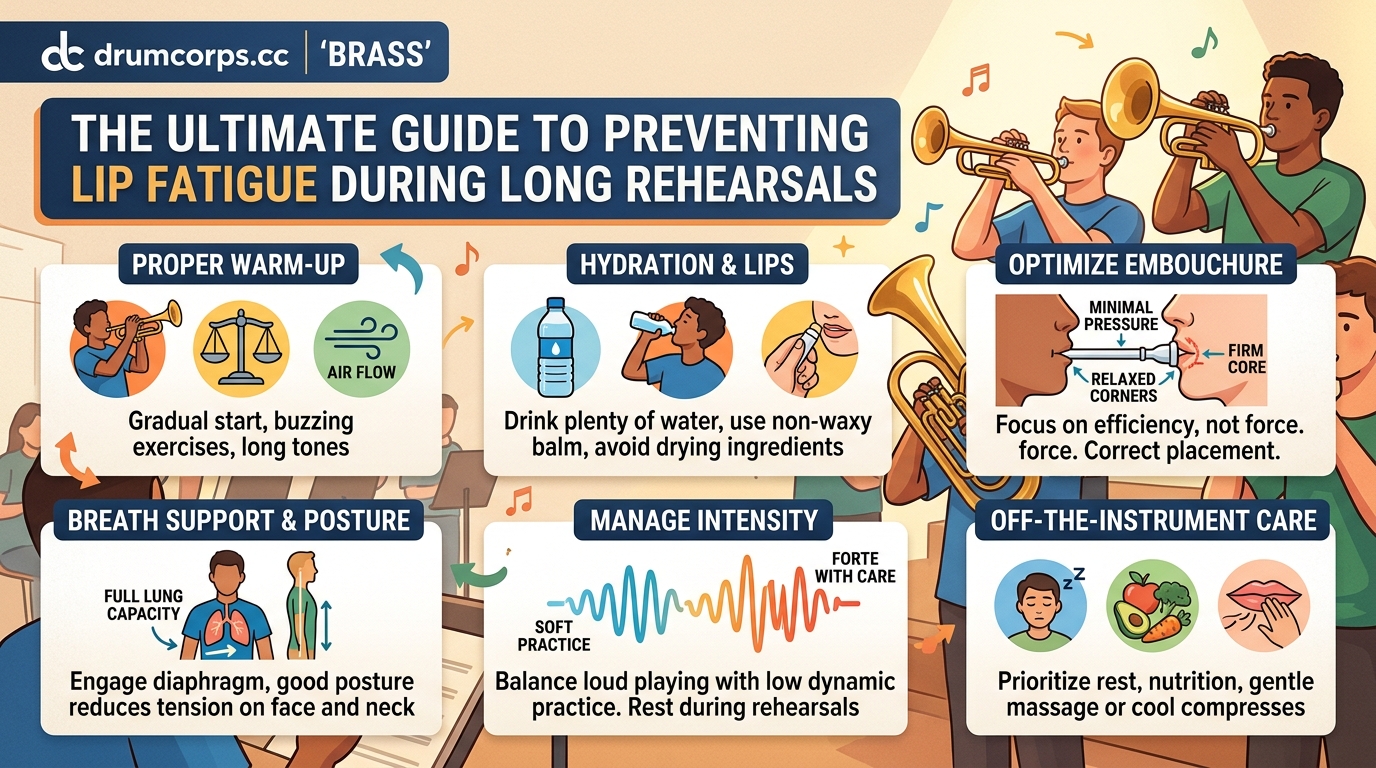
Start every practice session with breathing exercises that strengthen your support. Take full, deep breaths that expand your lower ribs and back. Your shoulders shouldn’t move.
When you play, think about blowing through the horn, not at it. The air should feel like it’s coming from deep in your core, not from your chest or throat.
Fast air prevents fatigue better than anything else. A focused, compressed airstream means your lips don’t have to work as hard to create vibration. Practice long tones with the goal of using as little mouthpiece pressure as possible while maintaining a full sound.
“If your chops are tired after 30 minutes, you’re not breathing correctly. Fix your air first, then worry about everything else.” – University brass instructor with 20 years of teaching experience
Smart warmup strategies that protect your endurance
A good warmup prepares your lips for work without exhausting them before the real rehearsal starts.
Never start cold. Play soft, middle register notes for at least five minutes before attempting anything demanding. Your lips need blood flow and gentle stretching before they can handle intensity.
Your warmup routine should gradually increase in range and volume. Don’t jump straight to high notes or loud dynamics. Build up slowly over 15 to 20 minutes.
Include buzzing exercises on your mouthpiece alone. This isolates your embouchure and helps you feel what efficient vibration should be like. If buzzing feels tense or forced, your playing will too.
Rest as much as you play during warmups. Play for 30 seconds, rest for 30 seconds. This pattern trains your lips to recover between phrases, which is exactly what you’ll need during long rehearsals.
The rest technique that doubles your endurance
Strategic rest is not weakness. It’s smart playing.
Take micro-breaks between every repetition during sectionals. Put the horn down for 10 to 15 seconds. Let your lips breathe. Let blood flow return to normal.
During full ensemble rehearsals, rest whenever you’re not playing. Don’t hold the horn up to your face during rests or GP blocks. Every second of unnecessary contact adds up.
When you do rest, keep your lips loose and relaxed. Don’t press them together or purse them. Let them hang naturally. Some players gently massage their lips or do small buzzing motions without the mouthpiece to keep circulation going.
If you feel fatigue building during a run, take an early rest rather than pushing through. Playing through fatigue creates bad habits and makes recovery take longer.
Mouthpiece pressure management techniques
Less pressure equals more endurance. Always.
Hold your horn with your left hand only during practice. Let your right hand float near the horn without supporting it. This forces you to find the minimum pressure needed to create a seal.
Practice in front of a mirror. Watch for white spots around your mouthpiece. If you see them, you’re pressing too hard. The rim should sit gently on your lips, not crush them.
For high notes, think about firming your corners and increasing air speed rather than pressing harder. The mouthpiece pressure should stay relatively constant across your entire range.
Some players benefit from a lighter mouthpiece. If your current mouthpiece is heavy, the weight alone can create extra pressure over long sessions. Talk to your instructor before making changes, but don’t dismiss the idea.
Practice session structure for maximum efficiency
How you organize your practice time matters as much as what you practice.
Follow this pattern for individual sessions:
- Warmup for 15 to 20 minutes with soft, easy playing and plenty of rest
- Work on technical material for 20 to 30 minutes with frequent breaks
- Take a full 10 minute break away from your instrument
- Return for musical material and repertoire for another 20 to 30 minutes
- Cool down with soft, relaxing long tones for 5 to 10 minutes
Never practice for more than 45 minutes without a real break. Your lips need time to recover, and your brain needs time to process what you’ve learned.
Building an effective practice routine means knowing when to stop. If your sound starts deteriorating or your range drops, you’re done for that session. Playing through fatigue only teaches your body to play badly.
Physical conditioning beyond the horn
Your whole body affects your endurance.
Stay hydrated. Dehydrated lips fatigue faster and recover slower. Drink water throughout the day, not just during rehearsal.
Get enough sleep. Tired muscles don’t perform well, and your embouchure muscles are no exception. Seven to eight hours makes a real difference.
Facial exercises can help, but don’t overdo them. Simple resistance exercises like pressing your lips together against your fingers for 10 seconds, repeated a few times, can build strength. But these should supplement playing, not replace it.
Avoid excessive talking or singing right before important rehearsals. Your facial muscles need to be fresh.
Common mistakes that guarantee fatigue
These habits will destroy your endurance every time.
Playing too loud too often. Forte and fortissimo playing is exhausting. If you’re always at maximum volume, you’ll always be tired. Learn to play with dynamic variety and save your loudest playing for when it matters.
Skipping rest days. Your lips need recovery time. If you play hard every single day without breaks, you’ll plateau or regress. Take at least one full day off per week.
Using too much face and not enough air. Squeezing, pinching, and smiling into high notes creates massive tension. Focus on breath support and let your embouchure stay relatively relaxed.
Practicing repertoire before fundamentals. If you jump straight into challenging music without warming up properly, you’ll fatigue faster and sound worse.
Equipment considerations that affect endurance
Sometimes your gear is working against you.
Mouthpiece fit matters. If your mouthpiece is too small, you’ll have to work harder to get a full sound. If it’s too large, you’ll struggle with control and fatigue trying to manage it. Work with a teacher to find the right size for your face and playing style.
Horn weight and balance affect how much pressure you naturally apply. A poorly balanced instrument will cause you to compensate with extra mouthpiece pressure. Check your hand position and consider using a neck strap for heavier instruments.
Proper instrument maintenance ensures your horn plays freely. If your valves are sluggish or your slides are sticky, you’ll use extra effort to play. Keep everything clean and lubricated.
Recovery strategies for when fatigue hits
You can’t always prevent fatigue, but you can manage it.
If your lips are fried after a long rehearsal, ice them for 10 to 15 minutes. This reduces inflammation and speeds recovery. Don’t ice for longer than 20 minutes at a time.
Gentle lip buzzing without the mouthpiece can help restore circulation. Just light, easy buzzing for a minute or two. Nothing strenuous.
Give yourself extra rest time before the next session. If you pushed hard today, take tomorrow completely off or do only light fundamentals.
Don’t try to play through severe fatigue. If your lips are swollen, painful, or numb, stop immediately. Continuing will cause damage and extend your recovery time.
Comparing effective and ineffective approaches
| Technique | Helps Endurance | Hurts Endurance |
|---|---|---|
| Mouthpiece pressure | Light, consistent contact | Heavy pressing, especially in upper register |
| Air support | Deep breathing, fast air stream | Shallow chest breathing, weak support |
| Rest periods | Frequent short breaks | Playing continuously without stopping |
| Practice volume | Varied dynamics, mostly moderate | Constant loud playing |
| Warmup routine | Gradual, 15-20 minutes | Rushed, jumping to demanding material |
| Practice duration | 30-45 minute blocks with breaks | 2+ hours straight through |
Long term endurance development
Building serious stamina takes months, not days.
Increase your practice time gradually. Add five minutes per week to your sessions. Your lips need time to adapt to increased workload.
Track your progress. Note how long you can play before fatigue sets in. As you improve your technique and build strength, that time should increase steadily.
Be patient with plateaus. Some weeks you won’t see improvement. That’s normal. Keep working on fundamentals and the endurance will come.
Focus on efficiency over power. The goal is not to develop super-strong lips that can muscle through anything. The goal is to develop smart technique that uses minimal effort for maximum result.
Making it through all day rehearsals
Full day rehearsals require special strategies.
Front-load your effort. Your lips are freshest in the morning. Save easier material for later in the day when fatigue is highest.
Take every break seriously. Even five minutes of rest can make a huge difference. Don’t be the player who keeps noodling during breaks.
Eat properly throughout the day. Your muscles need fuel. Low blood sugar affects your endurance and focus.
Mental practice techniques can help during breaks. Visualizing passages and fingerings gives your lips rest while keeping your mind engaged.
Adapting these techniques to your instrument
Different brass instruments have different endurance challenges.
Trumpet players deal with the most pressure and the highest range. Focus especially on reducing mouthpiece pressure and developing efficient air use in the upper register.
Trombone players have the advantage of a larger mouthpiece but face endurance issues during loud, aggressive passages. Work on maintaining relaxed corners even during forte playing.
Euphonium and tuba players use more air and have larger mouthpieces, which can actually reduce some fatigue issues. But the sheer volume of air required can be exhausting. Breathing exercises are critical.
French horn players face unique challenges with the small mouthpiece and demanding range. Extra attention to rest and recovery is essential.
Your endurance starts today
You don’t need to overhaul everything at once.
Pick two or three techniques from this guide and focus on them this week. Maybe it’s reducing mouthpiece pressure and taking more frequent breaks. Or improving your breathing and restructuring your practice sessions.
Pay attention to what your body tells you. If something hurts, stop. If a technique makes you more tired, adjust it.
Your lips will get stronger. Your endurance will improve. But only if you practice smart, rest appropriately, and give your body time to adapt. Start building those habits now, and you’ll be the player who sounds great in the last block while everyone else is struggling.