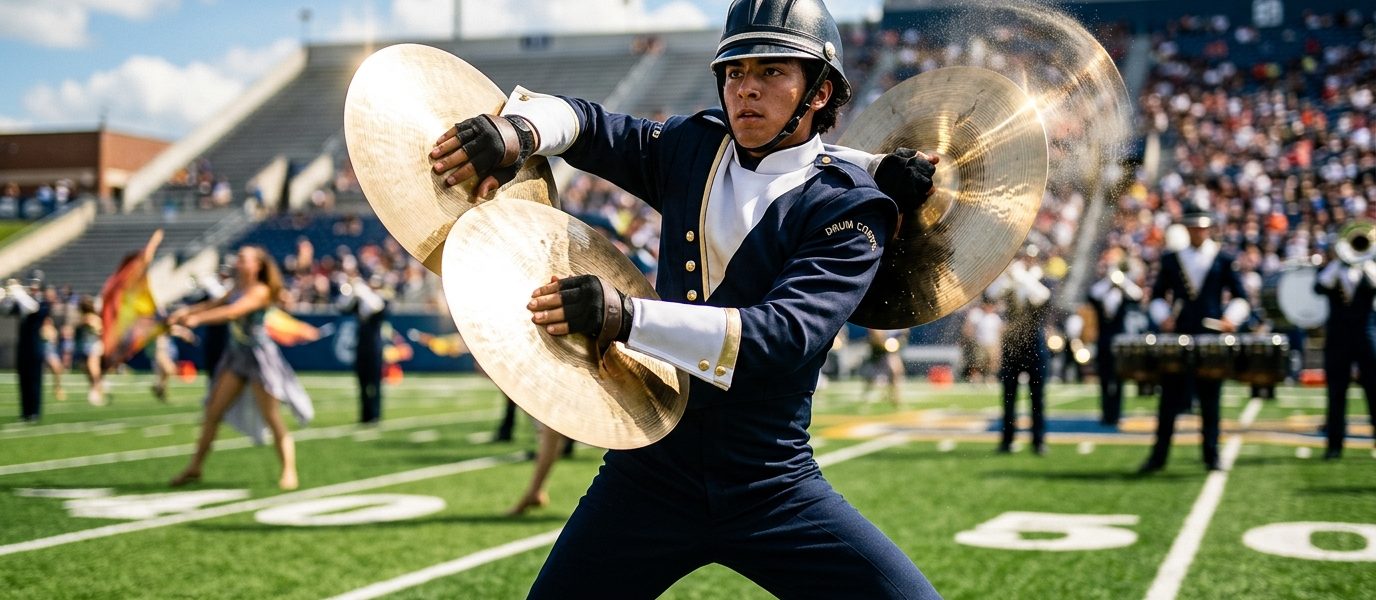
Cymbals are one of the most dramatic instruments in any ensemble. They punctuate climactic moments, add shimmer to ballads, and create visual excitement that audiences remember long after the final note fades. But learning to play them well takes more than just smashing two pieces of bronze together.
This guide to cymbals covers everything from basic grip techniques and crash fundamentals to advanced visual presentation and maintenance. You’ll learn how to produce clean, resonant sounds, avoid common mistakes, and develop the physical skills needed for confident performance in marching band or concert settings. Whether you’re picking up cymbals for the first time or refining your technique, this resource provides practical steps to improve your playing.
Understanding cymbal types and their roles
Not all cymbals are created equal. Different styles serve different purposes across musical contexts.
Concert crash cymbals typically range from 16 to 20 inches in diameter. They produce the classic orchestral crash sound you hear in symphonies and wind ensembles. These cymbals are heavier and thicker than their marching counterparts, designed for controlled dynamics in acoustic concert halls.
Marching cymbals are built for outdoor projection and visual impact. They’re usually 18 to 20 inches, with some lines using even larger plates. The alloy tends to be brighter and more cutting, helping the sound carry across football fields and stadium environments.
Suspended cymbals hang from a stand and get struck with mallets or sticks. They’re common in concert percussion setups and provide sustained washes of sound. These aren’t typically used in traditional cymbal line work, but understanding their role helps you appreciate the full cymbal family.
Hand cymbals in drum corps and marching band are your primary focus if you’re reading this. They require specific techniques for crashes, sizzles, and visual choreography that we’ll cover in detail.
Proper grip and hand position fundamentals
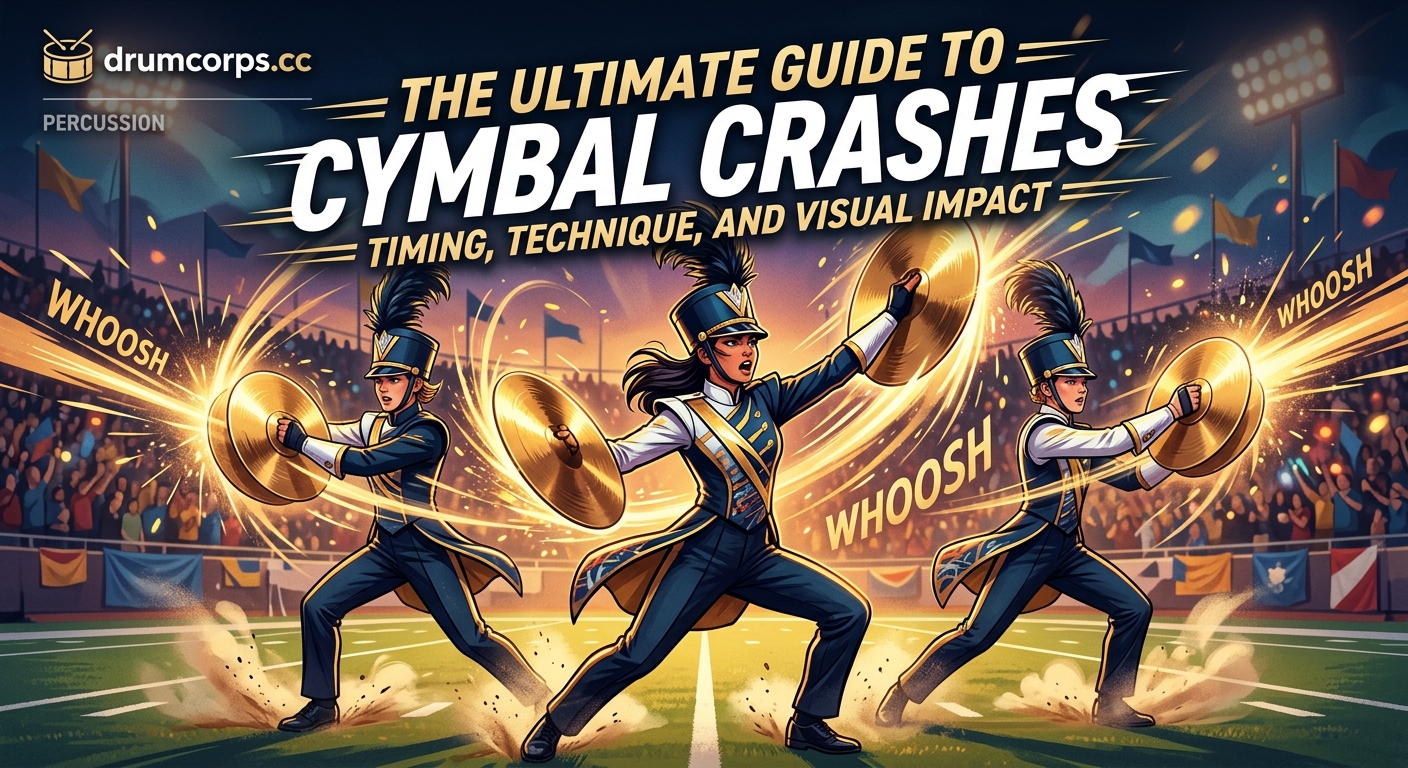
Your grip determines everything about your sound quality and control.
Start by threading the leather strap through your hand. The strap should pass between your thumb and index finger, loop around your palm, and exit between your pinky and ring finger. This creates a secure anchor point that won’t slip during performance.
Your fingers should curl naturally around the strap, not clench it. Tension is the enemy of good cymbal playing. A relaxed grip allows the cymbals to vibrate freely and produce a full, resonant tone.
The pad of your thumb rests against the inside of the cymbal bell. This contact point gives you control over the cymbal’s angle and position. Your other fingers provide support but shouldn’t grip tightly.
Hold the cymbals at roughly chest height when at rest. This neutral position allows for efficient movement in any direction. Your elbows should be slightly bent, not locked straight or tucked tight against your body.
“The biggest mistake new cymbal players make is gripping too hard. You want to guide the cymbals, not strangle them. Think of holding a bird: firm enough that it won’t fly away, gentle enough that you won’t hurt it.”
Practice holding your cymbals while watching yourself in a mirror. Your shoulders should be relaxed and level. Any visible tension in your neck, shoulders, or forearms means you need to loosen up.
Executing clean crashes with proper technique
The crash is your bread and butter. Getting it right takes practice and attention to detail.
The basic crash motion
- Start with cymbals at your prep position, usually chest height with plates parallel to the ground
- Move both cymbals toward each other in smooth, controlled arcs
- Contact should occur at the edge of the plates, not at the center
- Follow through after contact, allowing the cymbals to pass each other slightly
- Finish in your follow-through position with plates separated and angled to let them ring
The angle of approach matters tremendously. Imagine the cymbals meeting at about a 45-degree angle to each other. This creates a glancing blow that produces a clean, singing tone. Flat, head-on crashes sound choked and dead.
Your arms should move symmetrically. Both cymbals travel the same distance. This keeps your body centered and produces an even sound. If one cymbal does all the traveling, you’ll create an unbalanced crash that lacks fullness.
Speed and distance determine volume. Faster motion and longer travel distance create louder crashes. For softer dynamics, reduce both factors while maintaining proper technique. The angle and follow-through stay the same regardless of volume.
Common crash mistakes and fixes
| Mistake | What It Sounds Like | How to Fix |
|---|---|---|
| Flat, head-on contact | Choked, short duration | Angle cymbals 45 degrees, glancing contact |
| Gripping too tight | Thin, pinched tone | Relax grip, let cymbals vibrate freely |
| No follow-through | Abrupt, cut-off sound | Continue motion after contact |
| Asymmetric motion | Unbalanced, weak crash | Move both cymbals equal distances |
| Contact at bell | Clunky, unmusical sound | Aim for edge contact only |
Developing timing and rhythmic precision
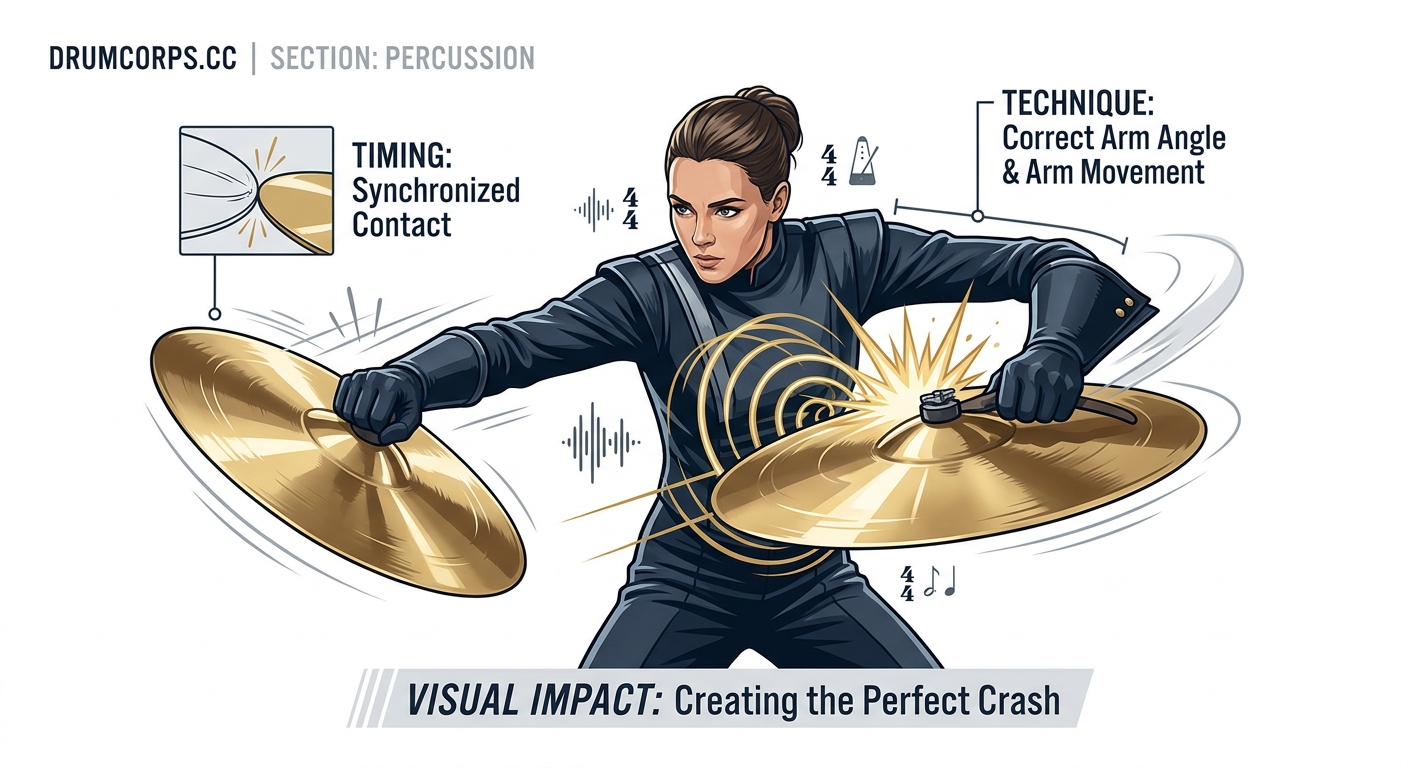
Cymbal parts often feature long periods of rest followed by single, exposed notes. Missing your entrance is not an option.
Count religiously during rests. Internal counting is a skill that requires as much practice as the physical motions. Sing your part, tap your foot, or use any method that helps you internalize the rhythm.
Visual cues from your section leader or drum major are lifelines. Learn to use your peripheral vision to catch cues without turning your head. This maintains your visual presentation while keeping you locked in with the ensemble.
Breathing with the music helps your timing feel natural. Take a prep breath before your entrance. This physical cue connects your body to the musical phrase and helps you move with intention rather than reacting late.
Recording your rehearsals reveals timing issues you might not notice in the moment. Listen back and compare your crashes to the rest of the battery. Are you early? Late? Right on top? Honest self-assessment drives improvement faster than anything else, similar to how building a structured practice routine helps you identify specific areas needing work.
Visual presentation and body technique
Cymbals are a visual instrument as much as a musical one. Your body language communicates energy and precision to the audience.
Body positioning basics
- Keep your shoulders square to the audience or your designated facing
- Maintain consistent cymbal height throughout your performance
- Lock your core muscles to stabilize your upper body during crashes
- Use your legs and posture to create a strong, grounded appearance
- Keep your head up and eyes forward, projecting confidence
Your prep positions should be clean and consistent with your section. If everyone’s cymbals are at different heights or angles, the visual line looks messy. Spend time in sectionals matching each other exactly.
Movement between positions should be deliberate and controlled. Sloppy transitions undermine the impact of your crashes. Practice moving from prep to crash to recovery as one smooth sequence.
Facial expression matters more than you think. A blank stare or visible strain detracts from your performance. Find a focused, engaged expression that matches the music’s character. This takes conscious effort at first but becomes natural with repetition.
Specialized techniques for advanced players
Once you’ve mastered basic crashes, these techniques add variety to your playing.
Sizzle crashes produce a sustained, shimmering sound by maintaining contact between the cymbals after the initial crash. Instead of separating the plates, you keep them together with light pressure and a slight circular motion. This technique requires excellent control and a relaxed grip.
Choke cuts stop the cymbal’s vibration immediately after a crash. You pull the cymbals against your body or chest to dampen them. The timing of the choke is critical. It must happen precisely on the cutoff to match the rest of the ensemble.
Slide techniques involve dragging one cymbal across the other to create a rising or falling pitch effect. The motion should be smooth and controlled, maintaining consistent pressure throughout. This technique appears in contemporary marching arrangements and adds textural variety.
Hi-hat patterns using crash cymbals mimic drumset hi-hat rhythms. You hold the cymbals in a partially closed position and tap them together in rhythmic patterns. This requires significant endurance and precise muscle control.
Practice these techniques slowly at first. Speed comes after you’ve established correct form. Rushing into advanced skills with poor fundamentals leads to bad habits that are hard to break later.
Physical conditioning and injury prevention
Playing cymbals is more physically demanding than it looks. Your shoulders, forearms, and core all work constantly during performance.
Shoulder strength and flexibility are essential. Simple exercises like arm circles, shoulder shrugs, and resistance band work build the endurance you need for long rehearsals. Spend five minutes on shoulder conditioning before and after practice.
Grip strength prevents fatigue and maintains control. Squeeze a stress ball or use grip strengtheners during downtime. Your forearms should feel worked but not strained after rehearsal.
Proper posture prevents back pain and maintains your visual presentation. Engage your core muscles to support your upper body. Avoid leaning or slouching, which strains your lower back over time.
Listen to your body. Pain is different from fatigue. Sharp, shooting pain or persistent discomfort means something is wrong. Address issues early before they become serious injuries. Rest and proper form prevent most problems.
Cymbal care and maintenance
Your instruments need regular attention to perform their best.
Clean your cymbals after every performance. Fingerprints, sweat, and dirt accumulate on the bronze and affect the sound. Use a soft cloth and cymbal cleaner specifically designed for the purpose. Avoid household cleaners that can damage the finish.
Check your straps regularly for wear. Leather dries out and cracks over time. Replace straps before they fail during a performance. Keep spare straps in your equipment bag.
Store cymbals properly to prevent damage. Never stack them directly on top of each other without padding. Use cymbal bags or cases that protect the edges and prevent warping.
Inspect the bells for cracks or damage. Small cracks can spread and eventually ruin a cymbal. Catching problems early sometimes allows for repair, though badly damaged cymbals usually need replacement.
Polish maintains appearance but doesn’t improve sound. Some players prefer the darker, oxidized look of unpolished bronze. Others like the bright, shiny finish of freshly polished cymbals. Either approach is fine as long as you’re removing dirt and oils.
Learning from the best ensembles
Watching high-level cymbal lines teaches you things you can’t get from written instruction alone.
Study drum corps cymbal features on video. Watch how elite players prep their crashes, maintain visual consistency, and execute complex choreography. Pay attention to their body language and stage presence.
Notice the difference between concert and marching styles. Concert cymbal players in professional orchestras demonstrate ultimate control and dynamic range. Their technique translates to marching contexts even though the visual demands differ.
Attend live performances when possible. Seeing cymbals in person gives you a better sense of sound projection and visual impact than recordings can capture. Notice how the sound carries in different venues and outdoor settings.
Building your skills through structured practice
Improvement happens through focused, intentional repetition.
Start each practice session with fundamentals. Play single crashes at different dynamics. Focus on tone quality and consistency. This is your equivalent of a brass player’s long tones or a snare drummer’s clean articulation work.
Record yourself regularly. Video captures both sound and visual elements. Compare your recordings to professional examples. Identify specific areas where your technique differs and work on those gaps.
Practice with a metronome to build timing precision. Set the metronome to different tempos and practice your crashes on specific beats. This builds the internal clock you need for exposed entrances.
Work on endurance separately from technique. Hold your cymbals at performance height for extended periods. This builds the shoulder strength and stamina you need for full shows.
Visualize your performance away from the cymbals. Mental practice reinforces muscle memory and helps you prepare for high-pressure situations. Picture yourself executing perfect crashes in front of an audience.
Putting it all together on the field
Everything you’ve learned comes together during actual performance.
Your section is your support system. Stay connected with your fellow cymbal players. Match their energy, timing, and visual presentation. A unified cymbal line creates far more impact than individual players, no matter how skilled.
Trust your preparation when performance anxiety kicks in. Your muscle memory knows what to do. Focus on breathing and staying present in the moment rather than worrying about what might go wrong.
Commit fully to every crash. Tentative playing looks and sounds weak. Even if you’re not completely confident, perform with conviction. Audiences respond to energy and commitment.
Recover from mistakes without dwelling on them. Everyone misses a note or flubs a visual occasionally. Acknowledge it internally, then immediately refocus on the next moment. Your ability to move past errors separates good performers from great ones.
Making every crash count
Cymbals give you the power to punctuate the most important moments in any musical performance. That responsibility requires technical skill, physical conditioning, and artistic sensitivity. The techniques in this guide to cymbals provide a foundation, but your personal growth as a player comes from consistent practice and thoughtful self-assessment.
Start with the basics. Master your grip, perfect your crash technique, and build the physical stamina your instrument demands. Then layer on the visual presentation and specialized techniques that make cymbal playing an art form. Whether you’re marching on a football field or performing in a concert hall, these skills will serve you well. Pick up your cymbals and get to work. Your next great crash is waiting.