
Your section leader calls the opener for the hundredth time this week. Your feet know exactly where to go. Your arms snap into position without conscious thought. Your horn angle matches the rest of your section perfectly. That’s not magic. That’s muscle memory doing exactly what you trained it to do.
Muscle memory training builds neural pathways through deliberate repetition, allowing marchers to perform complex movements automatically. Effective training requires focused practice sessions, proper technique from the start, adequate rest periods, and progressive difficulty increases. Understanding the science helps performers master routines faster and retain them longer, making the difference between good execution and championship-level performance.
What Actually Happens in Your Brain During Repetition
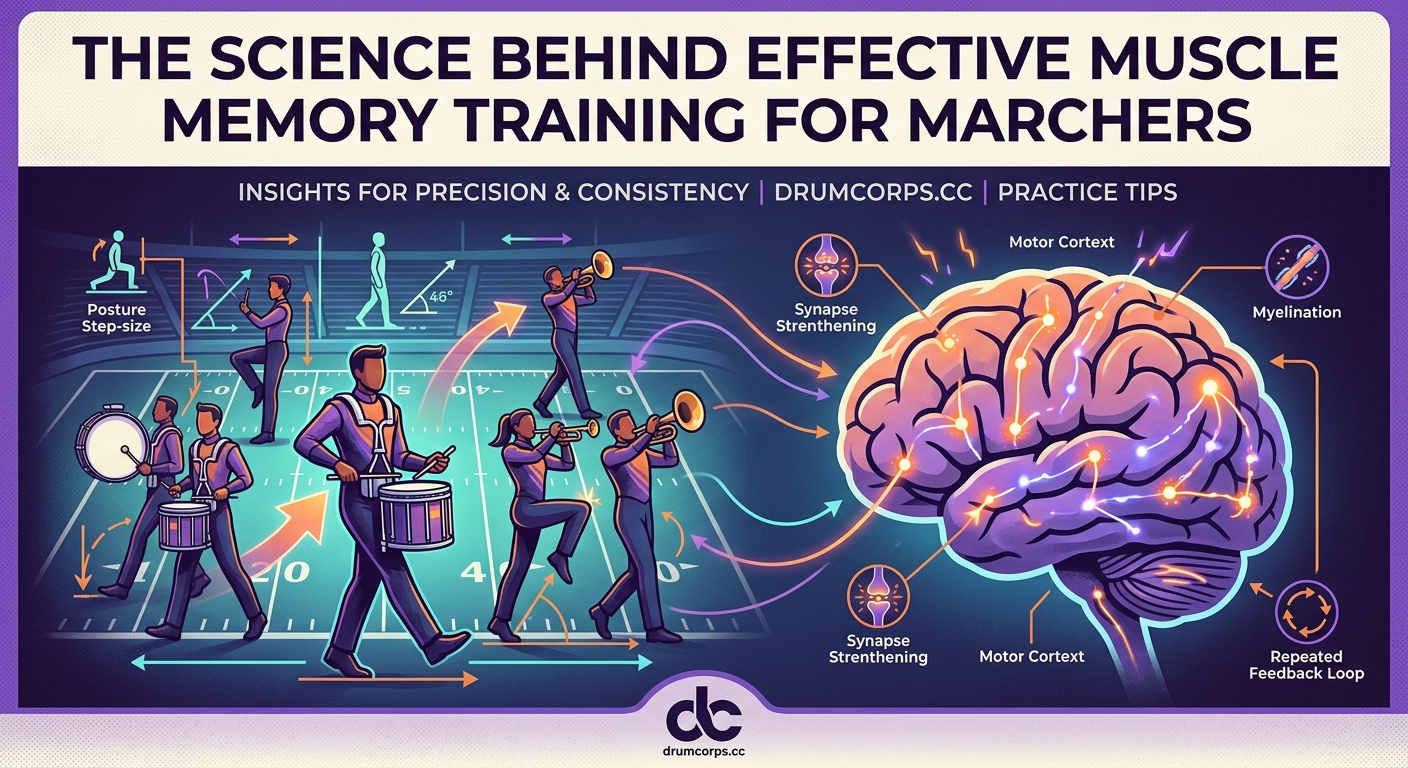
Your brain doesn’t store movements in your muscles. The term “muscle memory” is actually a shortcut for describing how your central nervous system learns and automates physical tasks.
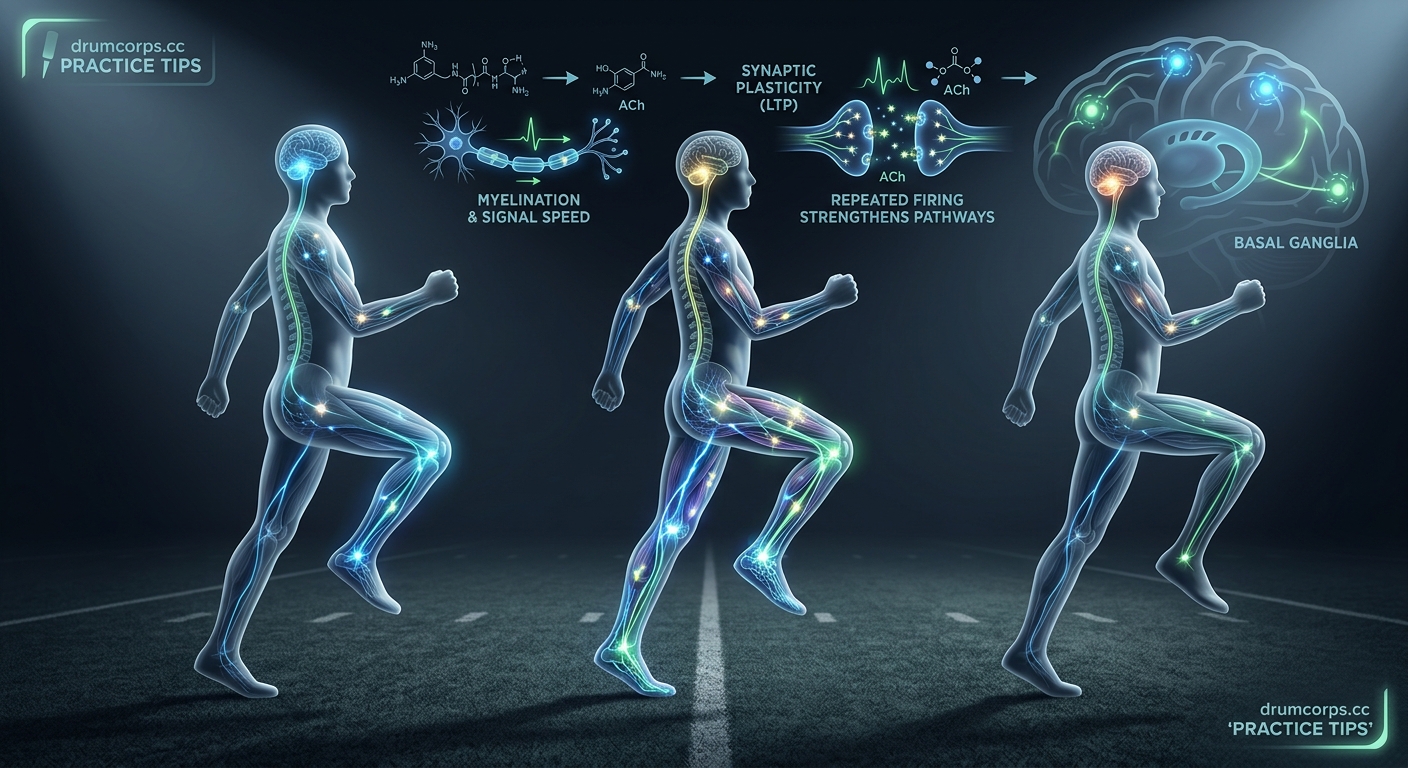
Every time you repeat a movement, your brain strengthens specific neural connections. Think of it like wearing a path through grass. The first time through, you barely leave a mark. After a hundred trips, you’ve created a clear trail that’s easy to follow without thinking about it.
Motor neurons fire in specific patterns when you march, spin a flag, or play an exercise. With enough repetition, these patterns become so efficient that your brain can execute them with minimal conscious input. That’s why you can nail a backward march while focusing on your music or maintain perfect posture while remembering drill coordinates.
The cerebellum plays a huge role here. This part of your brain coordinates timing and precision. As you practice, it builds increasingly detailed models of each movement. Your basal ganglia also get involved, handling the habit formation side of things.
Research shows that sleep matters just as much as practice. Your brain consolidates motor learning during deep sleep cycles. That’s why cramming eight hours of practice into one day doesn’t work as well as spreading it across multiple days with rest in between.
The Four Stages Every Marcher Goes Through
Learning any new movement pattern follows a predictable progression. Understanding these stages helps you train smarter.
Stage one is cognitive. You’re thinking through every step. Where does my foot go? How high should my knee come up? What’s the count? This stage feels clunky and slow because your prefrontal cortex is working overtime to process every detail.
Stage two is associative. You’re starting to link movements together into sequences. You still need to think about what you’re doing, but pieces of the movement start feeling more natural. Mistakes become less frequent.
Stage three is autonomous. The movement happens automatically. You can perform it while thinking about something else entirely. This is where most performers want to live during a show.
Stage four is refinement. You can execute the movement perfectly under pressure and adapt it on the fly if needed. This is championship-level muscle memory.
Most marchers rush through stages one and two. They want to get to automatic execution as fast as possible. But skipping careful attention in early stages means you’re automating sloppy technique. How to build a perfect 30-minute individual practice routine can help you structure practice to move through these stages properly.
Building Better Pathways Through Deliberate Practice
Not all repetition creates equal results. Mindless reps build weak neural pathways. Deliberate practice builds highways.
Deliberate practice means full attention on the task. You’re not just going through the motions. You’re actively monitoring your form, timing, and execution. You notice when something feels off and correct it immediately.
Here’s how to structure deliberate practice sessions:
- Isolate the specific movement you want to improve. Don’t run the entire show when you need to fix one transition.
- Practice at a tempo where you can execute perfectly. Speed comes after accuracy.
- Add one variable at a time. Master the footwork, then add the horn angle, then add the playing.
- Record yourself regularly. Your perception of your movement doesn’t always match reality.
- Take breaks before fatigue sets in. Tired practice reinforces tired technique.
- Gradually increase difficulty by adding speed, complexity, or environmental challenges.
The spacing of your practice sessions matters enormously. Three 20-minute sessions spread across a day beat one 60-minute marathon. Your brain needs time to process and consolidate what you’ve learned.
“The difference between a good corps and a great corps isn’t how many hours they practice. It’s how intentionally they practice those hours. Every rep either builds the habit you want or the habit you don’t.” – Caption head with 15 years of experience
Common Training Mistakes That Slow Progress
Marchers make predictable errors that undermine their muscle memory development. Recognizing these mistakes helps you avoid them.
Practicing mistakes is the biggest problem. Every time you execute a movement incorrectly, you’re strengthening the wrong neural pathway. If you can’t do it right at 80 beats per minute, you definitely can’t do it right at 140. Slow down.
Inconsistent technique confuses your nervous system. If you march with different posture every time, your brain can’t build a reliable pattern. Consistency in how you execute movements is just as important as how many times you execute them.
Skipping fundamentals to work on show music seems efficient but backfires. Strong basics make everything else easier. Weak basics make everything else harder. The corps that spend serious time on block fundamentals in June always look cleaner in August.
Not enough rest prevents consolidation. Your brain needs downtime to process what you’ve practiced. Overtraining leads to diminishing returns and increased injury risk.
| Effective Practice | Ineffective Practice |
|---|---|
| Focused attention on one element | Mindlessly running through sequences |
| Practicing at a manageable tempo | Always practicing at performance speed |
| Immediate correction of errors | Letting mistakes slide |
| Regular rest and recovery | Pushing through exhaustion |
| Progressive difficulty increases | Jumping to advanced moves too soon |
| Consistent daily sessions | Sporadic marathon practices |
Why Some Movements Stick Faster Than Others
You’ve probably noticed that certain moves click immediately while others take weeks to feel natural. Several factors influence how quickly your brain automates a movement.
Complexity matters obviously. A basic forward march involves fewer variables than a backward march with a rifle toss and a horn snap. More variables mean more neural connections to build.
Similarity to existing patterns speeds things up. If you played basketball, your brain already has models for lateral movement that transfer to marching. If you’ve never done anything athletic, you’re building from scratch.
Proprioception varies between individuals. Some people have naturally better awareness of where their body is in space. This skill can improve with training, but starting points differ.
Age plays a role but not how most people think. Younger brains form new neural connections faster, but older performers often learn more efficiently because they have better focus and self-awareness. The advantage goes both ways.
Motivation and attention might be the biggest factors. When you care deeply about mastering a movement, your brain prioritizes building those pathways. Half-hearted practice produces half-hearted results.
The movements that challenge you most are often the ones that will make the biggest difference in your overall performance. How to fix your backward marching before your next competition addresses one of the most common trouble spots for marchers.
The Role of Mental Practice in Physical Performance
Your brain can strengthen motor pathways without physical movement. Mental rehearsal activates many of the same neural networks as actual practice.
Studies with athletes show that visualization combined with physical practice produces better results than physical practice alone. The key is making your mental practice as detailed and realistic as possible.
When you visualize, don’t just picture yourself performing. Feel the movements. Imagine the sensation of your foot hitting the ground. Feel the weight of your horn. Hear the music. Engage as many senses as possible.
Mental practice works especially well for:
- Learning new drill before you step on the field
- Rehearsing difficult transitions
- Maintaining skills during injury recovery
- Preparing for performance under pressure
- Reviewing choreography away from rehearsal
This doesn’t replace physical practice. But 10 minutes of focused visualization can make your next physical practice session significantly more productive. Your brain arrives ready to execute patterns it has already rehearsed mentally.
How Different Practice Types Build Different Skills
Varied practice approaches serve different purposes in muscle memory development. Smart performers use multiple methods strategically.
Blocked practice means repeating the same movement over and over. This builds the basic neural pathway quickly. It’s perfect for learning a new skill or drilling fundamentals. Do 50 reps of the same eight counts until it feels automatic.
Random practice mixes different movements in unpredictable order. This builds adaptability and strengthens retention. After you’ve learned several moves in blocked practice, randomizing them forces your brain to work harder to retrieve the right pattern. That extra work makes the memory stick better.
Contextual practice means rehearsing under conditions that match performance. Practice in uniform. Practice when you’re tired. Practice with distractions. Your brain learns to execute the movement regardless of circumstances.
Part practice breaks complex sequences into smaller chunks. Learn the footwork separately from the visual. Master each piece, then combine them. This works well for extremely complex moves.
Whole practice runs the entire sequence start to finish. This builds flow and helps you understand how individual moves connect. It’s essential for timing and musicality.
The best training programs use all these approaches at different times. Early in the season, blocked practice dominates. As skills develop, random and contextual practice take over.
Connecting Movement Memory to Musical Memory
Marching arts demand simultaneous mastery of physical movement and musical performance. Your brain has to juggle both, and they compete for the same cognitive resources early in learning.
The goal is automating both systems so they run in parallel without conscious management. When your feet know where to go automatically, your brain has bandwidth for musical expression. When your music is solid, you can focus on cleaning visual execution.
This is why how to eliminate rim clicks and achieve clean snare articulation matters so much. Technical mastery frees mental space for artistry.
Integrate music and movement gradually. Master the drill without playing. Master the music while standing still. Then combine them slowly, giving your brain time to coordinate both systems.
Some performers find that music helps their feet. The rhythm provides a framework that makes drill easier to remember. Others find that movement helps their playing. The physical motion grounds them in the music.
Pay attention to which connections work for your brain. Use those associations intentionally. If a specific lick always happens at a particular drill set, link them consciously in your mind. Your brain will bundle them together, making both easier to recall.
Maintaining Skills During the Off Season
Muscle memory degrades without use, but it doesn’t disappear as fast as you might think. Neural pathways weaken when neglected, but they never fully vanish.
That’s why returning skills feel easier than learning them initially. Your brain is reactivating existing pathways rather than building new ones from scratch. Veterans can shake off rust in a few weeks that took months to build originally.
To maintain skills during off season:
- Run through basic exercises weekly, even for just 15 minutes
- Visualize complex sequences regularly
- Stay physically active to maintain general coordination
- Practice related skills that use similar movement patterns
- Review video of your performances to keep mental models fresh
Even minimal maintenance makes a huge difference. One short practice session per week preserves most of your muscle memory. Zero practice for six months means starting over nearly from scratch.
The performers who stay sharp year-round have massive advantages when spring training starts. They spend June and July refining instead of relearning. That extra time for artistry and polish shows in August.
Recognizing When You’ve Hit a Plateau
Progress isn’t linear. You’ll improve rapidly at first, then hit periods where nothing seems to get better despite continued practice.
Plateaus happen for several reasons. Sometimes your brain needs time to consolidate existing skills before adding new ones. Sometimes you’ve automated bad habits that need to be broken and rebuilt. Sometimes you’re practicing the wrong things.
Signs you’re on a plateau:
- Consistent mistakes that don’t improve despite attention
- Feeling like you’re working harder but not seeing results
- Performance quality varies wildly from rep to rep
- Techniques that used to feel natural suddenly feel awkward
Breaking through requires changing your approach. If blocked practice isn’t working, try random practice. If drilling at full speed isn’t helping, slow way down and focus on precision. If solo practice has stalled, work with a partner who can provide external feedback.
Sometimes the solution is rest. A few days away from intense practice lets your nervous system reset. You’ll often come back sharper than when you left.
How Bluecoats 2014 ‘Tilt’ redefined modern drum corps design shows what’s possible when performers push through plateaus to reach new levels of physical and musical integration.
The Connection Between Physical Fitness and Motor Learning
General fitness directly impacts how efficiently your brain builds motor patterns. Cardiovascular health, strength, and flexibility all play roles.
Better cardiovascular fitness means better oxygen delivery to your brain. Your neurons literally work better when they have adequate fuel. Marchers who can handle the physical demands of rehearsal without getting winded learn faster because their brains aren’t competing with exhausted muscles for resources.
Core strength matters more than most performers realize. A stable core provides the foundation for precise movement. When your torso is solid, your brain can focus on coordinating limbs instead of fighting to maintain balance.
Flexibility prevents compensation patterns. If your hip flexors are tight, your brain has to route around that limitation, creating inefficient movement patterns. Better flexibility means cleaner, more economical movements that are easier to automate.
How to build rock-solid breath support for high brass endurance addresses the physical conditioning side that supports better motor learning for brass players.
Using Feedback Loops to Accelerate Learning
Your brain needs accurate information about performance to adjust and improve. The faster and more precise your feedback, the faster you learn.
Internal feedback comes from your own sensory systems. You feel when your weight is too far forward. You hear when your timing is off. You see when your horn angle doesn’t match the person next to you. Developing better internal awareness is one of the most valuable skills you can build.
External feedback comes from coaches, video, and peers. This catches things your internal systems miss. You can’t see your own back, but a video camera can. You might not notice a subtle timing issue that a trained instructor spots immediately.
The best feedback is:
- Immediate (right after the rep, not three days later)
- Specific (exactly what to change, not vague criticism)
- Actionable (clear steps to improve, not just problem identification)
- Balanced (acknowledging what’s working along with what needs work)
Create feedback loops in your individual practice. Set up your phone to record. Practice in front of a mirror. Ask a friend to watch and comment. The more information your brain receives about performance quality, the faster it can adjust.
Performing Under Pressure Without Losing Technique
Championship performances happen when muscle memory holds up under stress. Your brain needs to execute automated patterns even when adrenaline is flooding your system.
Stress affects motor control. Your heart rate spikes. Your breathing changes. Your attention narrows. Movements that felt automatic in practice can fall apart in competition if you haven’t trained for pressure.
The solution is practicing under simulated pressure conditions. Run your show when you’re exhausted. Perform for audiences before competition. Create consequences for mistakes during rehearsal. Your brain needs to learn that the automated patterns work even when conditions aren’t perfect.
Breathing techniques help manage performance anxiety. Controlled breathing activates your parasympathetic nervous system, counteracting stress responses. A few deep breaths before stepping on the field can make a measurable difference in execution quality.
Mental routines provide anchors. Develop a consistent pre-performance ritual. Your brain associates this routine with successful execution. The familiarity helps trigger the right motor patterns even when nerves are high.
The performers who look effortless under pressure aren’t naturally calm. They’ve trained their muscle memory to function regardless of their mental state. That’s a skill you build through deliberate practice under varied conditions.
Why Your Training Method Matters More Than Training Volume
Ten hours of unfocused practice builds weaker skills than three hours of deliberate, structured work. Quality beats quantity every time.
Your nervous system has limits on how much new motor learning it can process in a day. After a certain point, additional practice produces diminishing returns or even negative results. Tired practice ingrains tired technique.
The most effective training programs balance intensity with recovery. They structure sessions to maximize attention and minimize fatigue. They use variety to keep the brain engaged without overwhelming it.
Smart performers also recognize individual differences. Some people need more repetitions to automate a skill. Others need more time between practice sessions for consolidation. Pay attention to what works for your nervous system rather than blindly following someone else’s program.
How to build a perfect 30-minute individual practice routine offers a framework for structuring efficient practice sessions that maximize motor learning without wasting time.
Making Muscle Memory Stick for the Long Term
Short-term motor learning and long-term retention require different approaches. Getting a movement to feel automatic this week doesn’t guarantee you’ll remember it next month.
Long-term retention improves with:
- Distributed practice over time rather than massed practice in one session
- Regular retrieval of the skill, even after it feels mastered
- Connection to meaningful context (why this movement matters in the show)
- Variation in practice conditions to build robust neural pathways
- Adequate sleep to allow memory consolidation
The skills you use regularly stay sharp indefinitely. The skills you learn once and never revisit fade quickly. This is why fundamentals matter so much. Corps that drill basics constantly throughout the season maintain cleaner technique than corps that drill basics only in spring training.
Testing yourself strengthens retention more than additional practice. Run the drill from memory without music. Perform the visual without the counts. These retrieval attempts force your brain to actively reconstruct the motor pattern, which strengthens the underlying memory.
Turning Science Into Better Performances
Understanding muscle memory training helps you practice smarter, not just harder. Your brain builds neural pathways through deliberate repetition, consolidates them during rest, and strengthens them through varied practice under realistic conditions.
The performers who master complex choreography fastest aren’t necessarily the most talented. They’re the ones who structure their training to align with how the nervous system actually learns. They practice with full attention. They sleep adequately. They push hard but recover fully. They use feedback to adjust quickly.
You already have everything you need to build championship-level muscle memory. You just need to apply these principles consistently. Start with one change to your practice routine this week. Notice what improves. Build from there.
Your body will learn what you teach it. Make sure you’re teaching it excellence.