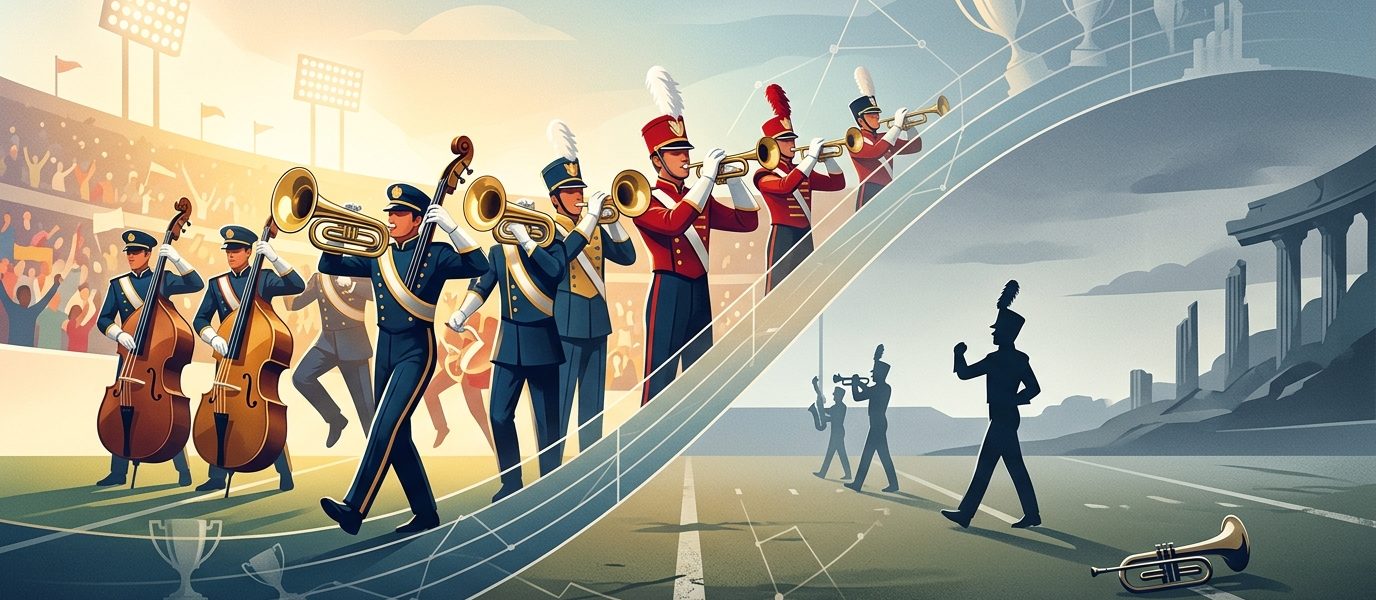
The American Midwest didn’t just participate in drum corps history. It wrote the rulebook, crowned the champions, and broke the hearts of generations who watched their beloved organizations rise to glory and fade into memory.
Midwest drum corps dominated competitive marching music from the 1950s through the early 2000s, producing legendary organizations like the Cavaliers, Phantom Regiment, and Madison Scouts. These powerhouses shaped modern design philosophy, musical standards, and visual innovation before economic pressures and geographic shifts changed the activity’s landscape. Their legacy continues to influence today’s top corps.
The Golden Triangle of Midwest Drum Corps Power
Three cities formed the foundation of drum corps excellence in the Midwest. Chicago, Wisconsin, and the broader Great Lakes region produced more championship titles than any other geographic area in the activity’s history.
Chicago alone birthed multiple dynasties. The Cavaliers emerged from the city’s northwest side in 1948. The Blue Stars started on the south side. These weren’t just youth organizations. They were community institutions with deep ties to local churches, VFW posts, and neighborhood pride.
Wisconsin became synonymous with drum corps tradition through the Madison Scouts. Founded in 1938, they established a reputation for clean brass lines and precise drill execution that influenced corps across the continent.
The geographic concentration wasn’t accidental. Industrial prosperity in the post-war Midwest created middle-class communities with disposable income and civic pride. Parents could afford instruments and tour fees. Cities had the infrastructure to support rehearsal facilities and local competitions.
“The Midwest built drum corps on factory wages and Friday night football culture. When those economic foundations shifted, so did the balance of power in the activity.” – Former DCI judge and historian
Why Midwest Corps Dominated the Championship Years
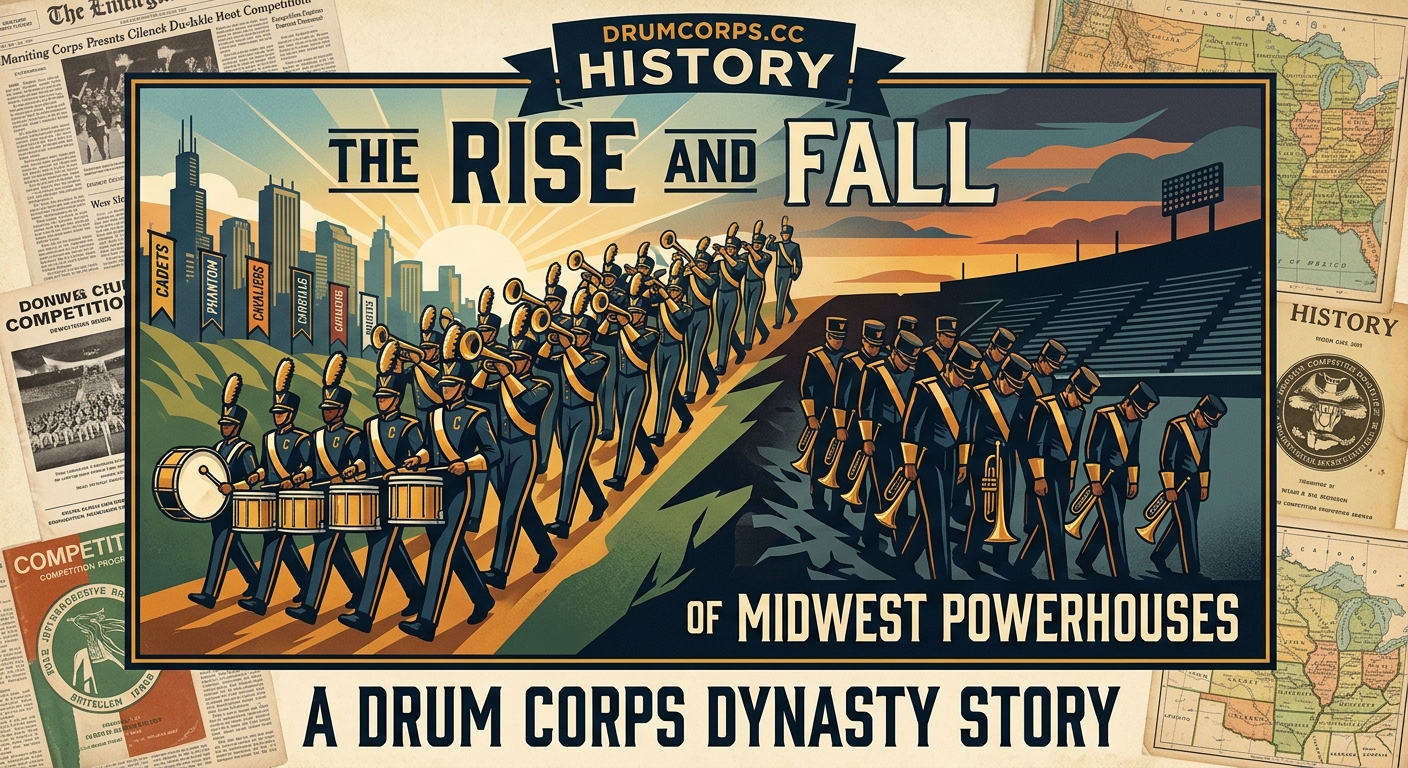
Between 1972 and 2000, Midwest organizations claimed over 60% of DCI World Championship titles. That dominance wasn’t luck. It was systematic excellence built on specific advantages.
Training infrastructure advantages:
- Year-round indoor rehearsal facilities in school gymnasiums
- Access to college marching band directors as instructors
- Proximity to instrument manufacturers and repair specialists
- Dense population centers for recruiting talented members
- Established feeder programs through high school bands
The Cavaliers perfected the training model that others tried to replicate. They held monthly camps during the off-season when other corps went dormant. They invested in professional brass arrangers before it became standard practice. They treated competitive marching like an athletic program, not a summer hobby.
Phantom Regiment brought classical music sophistication to the field. Their brass arrangers understood orchestral phrasing and dynamic contrast in ways that set new musical standards. When they performed Tchaikovsky or Rachmaninoff, audiences heard concert hall quality on a football field.
Madison Scouts maintained traditions that connected members to decades of alumni. Their signature “You’ll Never Walk Alone” closer became a cultural touchstone that transcended competitive scores. Alumni from the 1960s could watch the 1990s corps and recognize the same musical DNA.
The Rise: Building Midwest Dynasties
Understanding how these organizations achieved dynasty status requires examining their development across decades, not just championship seasons.
1. Establish Deep Community Roots
Successful Midwest corps didn’t start as competitive organizations. They began as youth development programs sponsored by civic groups. The Cavaliers started as a Boy Scout drum and bugle corps. Phantom Regiment emerged from a Rockford, Illinois VFW post.
Community sponsorship provided financial stability and volunteer labor. Parents ran bingo nights to fund tour buses. Local businesses donated rehearsal space. Alumni networks created mentorship pipelines that kept institutional knowledge alive across generations.
2. Develop Signature Musical Identity
Championship corps didn’t chase trends. They established recognizable musical personalities that audiences could identify within the first eight counts.
The Cavaliers built their identity on technical precision and aggressive brass attacks. Phantom Regiment owned dark, powerful classical repertoire. Madison Scouts became known for traditional American music and patriotic themes.
This identity clarity helped with recruiting. Brass players who wanted to perform Mahler knew to audition for Phantom. Those seeking cutting-edge drill design looked to the Cavaliers.
3. Create Sustainable Financial Models
Midwest dynasties survived because they built diverse revenue streams beyond membership fees.
| Revenue Source | Percentage of Budget | Sustainability Factor |
|---|---|---|
| Member tuition and fees | 35-45% | Dependent on enrollment |
| Alumni donations | 20-30% | Grows with success history |
| Local fundraising events | 15-25% | Requires volunteer capacity |
| Corporate sponsorships | 10-15% | Tied to regional economy |
| Merchandise and licensing | 5-10% | Scales with brand recognition |
The most successful organizations cultivated alumni networks that provided both financial support and professional expertise. A Cavaliers alumnus who became an accountant handled the books. A Madison Scouts veteran who worked in marketing managed sponsorship relationships.
4. Invest in Staff Development
Midwest powerhouses recognized that member talent alone didn’t create championships. They needed exceptional instructors who could teach, design, and inspire.
Corps like the Cavaliers paid competitive salaries to attract top brass arrangers and visual designers. They provided professional development opportunities for young instructors who showed potential. Many of today’s most respected designers got their start on Midwest corps staff.
This investment created institutional excellence that survived member turnover. When an age-out class graduated, the teaching systems remained consistent.
The Peak: Championship Seasons That Defined Eras
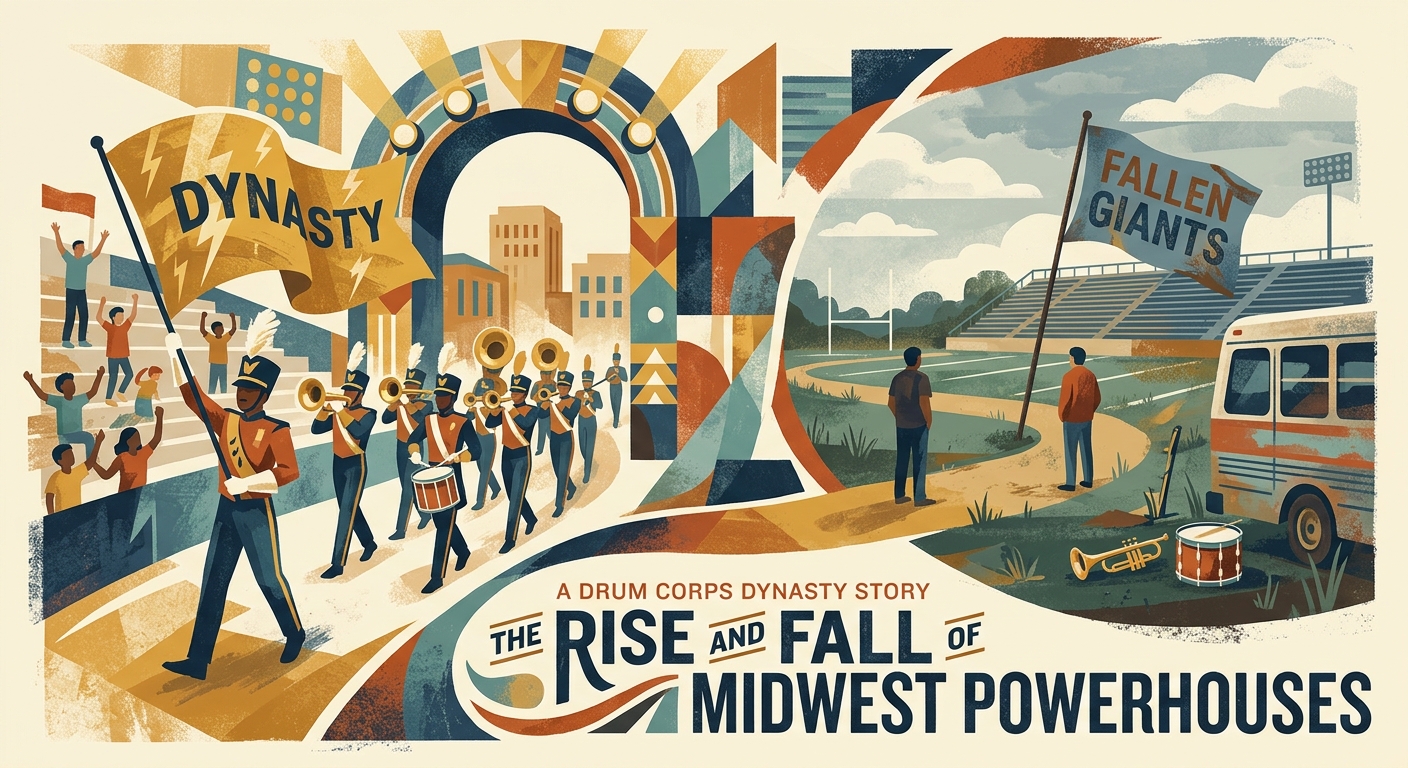
Certain seasons crystallized Midwest dominance and changed how the entire activity approached design and performance.
The 1980s belonged to Midwest innovation. What made the 1980s the golden age of drum corps innovation traces how corps from this region pioneered asymmetrical drill, complex brass harmonies, and theatrical staging that modern corps still reference.
The Cavaliers’ 1995 season showcased technical execution that seemed impossible. Their drill writing pushed the boundaries of what 150 performers could achieve while maintaining musical quality. Judges had to recalibrate scoring systems because the corps exceeded the standards used to evaluate them.
Phantom Regiment’s 1996 championship demonstrated that classical music could compete with contemporary repertoire. Their performance of “A Defiant Heart” proved that emotional depth and musical sophistication could outscore flashier concepts.
Madison Scouts’ 1988 title run exemplified traditional American drum corps values. Clean brass, precise marching, and patriotic programming connected with audiences and judges who valued fundamental excellence over conceptual innovation.
These seasons didn’t just win trophies. They established design philosophies that influenced corps for decades. Modern shows still reference the Cavaliers’ drill vocabulary and Phantom’s approach to musical phrasing.
The Shift: When Geography Stopped Guaranteeing Success
The late 1990s marked the beginning of Midwest decline. Several factors converged to erode the region’s competitive advantages.
Economic restructuring hit hard. Manufacturing jobs that supported middle-class families disappeared. Parents who once afforded $3,000 tour fees now struggled with basic expenses. Talented students who would have marched drum corps instead took summer jobs to help family finances.
Demographic changes reduced the talent pool. Midwest cities lost population to Sun Belt migration. High schools that once had 200-piece marching bands now fielded 80 members. The recruiting pipeline that fed drum corps dried up.
Competitive balance shifted west and south. California and Texas corps invested heavily in facilities and instruction. The Blue Devils, Santa Clara Vanguard, and later Carolina Crown built programs that matched or exceeded Midwest standards. Geographic diversity in championship placements became the new normal.
Tour logistics became more expensive. Rising fuel costs hit Midwest corps harder because they faced longer distances to western competitions. A California corps could hit multiple shows within a few hundred miles. A Wisconsin corps burned thousands in diesel just reaching the first weekend of tour.
The Cavaliers adapted by maintaining championship-level standards through the 2000s. They won titles in 2000, 2001, 2002, 2004, 2006, and 2007. But other Midwest powerhouses struggled to keep pace with better-funded programs from other regions.
The Fall: When Dynasties Couldn’t Sustain Excellence
Some Midwest corps didn’t just decline. They disappeared entirely or merged with other struggling organizations.
The Bluecoats faced near-extinction in the early 2000s before restructuring saved the organization. They relocated from Canton, Ohio to a more sustainable operational model and eventually became championship contenders again. Their 2014 show how Bluecoats 2014 ‘Tilt’ redefined modern drum corps design proved that Midwest corps could still innovate when given resources.
Other organizations weren’t as fortunate. The Glassmen, Sky Ryders, and Suncoast Sound all folded or merged after years of financial struggle. These weren’t failures of talent or dedication. They were casualties of economic forces beyond their control.
Common factors in Midwest corps decline:
- Inability to compete with corporate-style fundraising from larger markets
- Loss of volunteer base as communities aged and young families moved away
- Difficulty recruiting top instructors who could earn more in other regions
- Facility costs that consumed budgets without improving competitive results
- Alumni fatigue from decades of financial rescue campaigns
The emotional toll on communities was profound. Generations of families had built identities around these organizations. Watching them struggle or fold felt like losing a piece of cultural heritage.
What Midwest Corps Got Right That Others Still Copy
Despite competitive decline, Midwest drum corps established standards that remain industry benchmarks.
Their approach to brass education created pedagogical methods now used worldwide. The concept of structured warm-up routines, sectional rehearsal techniques, and individual accountability systems all trace back to Midwest corps innovation. Members who want to improve their sound quality still benefit from how to build rock-solid breath support for high brass endurance techniques pioneered in Chicago and Wisconsin rehearsal halls.
Visual programs developed in the Midwest established the foundation for modern drill writing. The concept of body carriage, step technique, and equipment integration all evolved through Midwest experimentation. Today’s performers who struggle with fundamentals can trace solutions back to methods refined by 7 legendary drum corps that shaped the activity’s evolution, many of them Midwest organizations.
The alumni culture that Midwest corps cultivated became a model for sustainable organizations. Creating lifelong connections between members and their corps experience generates the volunteer labor and financial support that keeps programs alive during difficult years.
The Lasting Legacy Beyond Championship Trophies
Measuring Midwest impact solely through competitive results misses the broader influence these organizations had on American music education and youth development.
Thousands of music educators got their start in Midwest drum corps. They carried pedagogical approaches learned on tour back into their classrooms. The emphasis on technical fundamentals, ensemble listening, and performance discipline shaped how multiple generations of students learned music.
The professional marching music industry owes its existence to Midwest innovation. Instrument manufacturers, uniform companies, and design firms all developed products and services to meet demands created by competitive drum corps. Many of these businesses started in or near Midwest corps hubs.
Cultural impact extended beyond music. Drum corps taught leadership, work ethic, and resilience to teenagers who might not have learned those skills elsewhere. Alumni credit their corps experience with shaping career success, relationship skills, and personal values decades after aging out.
Where Former Powerhouses Stand Today
Some Midwest corps maintained competitive relevance through strategic adaptation. Others found success outside championship placement by focusing on member experience and community impact.
The Cavaliers continue competing at World Class level, though championship titles became less frequent after 2007. They invested in facilities, modernized fundraising, and expanded their brand through educational programs.
Phantom Regiment faced financial crisis in the 2010s but restructured and returned to competitive form. Their commitment to classical repertoire remains distinctive in an era of eclectic programming.
Madison Scouts struggled with declining enrollment and financial challenges but maintained operations through alumni support and community partnerships. Their traditional identity still resonates with members seeking connection to drum corps heritage.
The Bluecoats transformed from struggling regional corps to championship contender through bold design choices and aggressive fundraising. Their success proves that Midwest organizations can compete when they adapt to modern realities while maintaining core values.
Lessons From the Midwest Dynasty Era
The rise and fall of Midwest drum corps powerhouses offers insights relevant to any competitive activity dependent on community support and volunteer labor.
Success requires more than talent. The most gifted performers can’t overcome structural disadvantages in funding, facilities, and geographic location. Sustainable excellence demands investment in infrastructure, not just instruction.
Identity matters more during decline than growth. When resources become scarce, organizations with clear values and strong community connections survive longer than those chasing trends or championship scores.
Economic forces shape competitive outcomes. Judges don’t award points for financial struggle, but budget constraints directly impact design quality, instruction hours, and member recruitment. Regional economic health predicts competitive success more accurately than most people acknowledge.
Adaptation beats tradition when circumstances change. Corps that clung to “the way we’ve always done it” disappeared. Those that honored their heritage while embracing necessary changes found paths to survival and renewal.
The story of Midwest drum corps isn’t just about competitive marching music. It reflects broader American narratives about industrial decline, demographic shifts, and the challenge of maintaining cultural institutions when economic foundations erode.
Why This History Still Matters to Today’s Activity
Understanding drum corps history midwest provides context for current competitive dynamics and organizational challenges.
When fans debate why certain regions dominate championship placements, the answer often traces back to advantages and disadvantages established decades ago. California corps benefit from year-round outdoor rehearsal weather and proximity to entertainment industry professionals. Texas organizations leverage robust high school marching band programs and corporate sponsorship opportunities. These advantages mirror what Midwest corps once enjoyed.
Modern corps facing financial pressure can learn from both the successes and failures of Midwest dynasties. The fundraising models, alumni engagement strategies, and community partnership approaches developed in Chicago and Wisconsin still work when adapted to current conditions.
Members who want to understand why their corps does things certain ways often find answers in Midwest innovation. The brass warm-up your section runs probably evolved from Cavaliers pedagogy. The drill fundamentals your visual staff teaches likely trace to Madison Scouts technique. The concept of corps family and alumni connection comes directly from Midwest organizational culture.
The activity’s current challenges around accessibility, geographic equity, and financial sustainability aren’t new. Midwest corps confronted similar issues and found various solutions. Some worked. Others failed. All offer lessons worth studying.
The Dynasty Spirit Lives On
The Midwest may no longer dominate championship placements, but the values and standards established by its greatest corps continue shaping the activity.
Every time a brass line achieves perfect unison on a sustained chord, that’s Midwest pedagogy at work. When a drill designer creates a form that’s both visually stunning and technically achievable, they’re building on foundations laid in Chicago and Wisconsin. When alumni travel across the country to support their corps, they’re honoring a tradition that Midwest organizations perfected.
The buildings may be older, the budgets tighter, and the championships less frequent. But the commitment to excellence, the emphasis on fundamentals, and the belief that young people deserve transformative experiences remain as strong as ever in Midwest drum corps.
These organizations taught generations that greatness isn’t just about winning. It’s about pursuing excellence with integrity, supporting each other through challenges, and building something bigger than yourself. Those lessons endure long after the last note fades and the championship banners come down.
For anyone who ever marched, taught, or supported a Midwest drum corps, the dynasty era represents more than competitive success. It’s proof that ordinary communities can create extraordinary achievements when they invest in young people and commit to shared excellence.