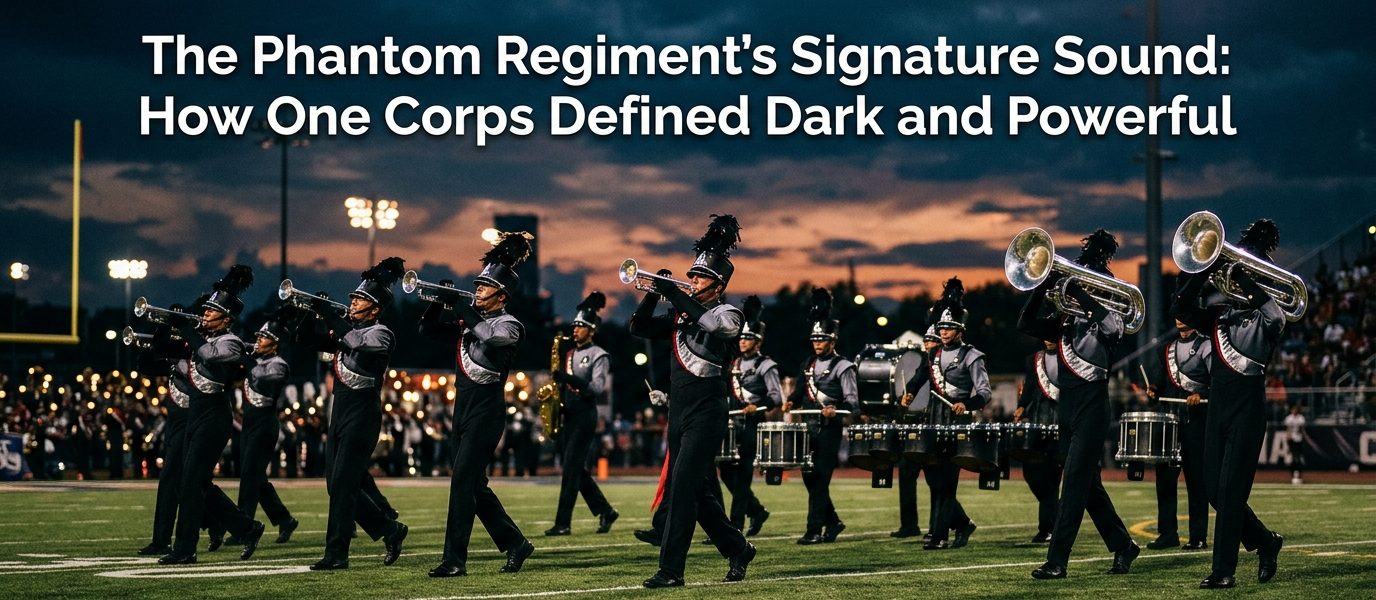
When you hear that first sustained chord ringing across a football field, deep and resonant with a hint of shadow, you know it’s Phantom Regiment. No other corps in DCI history has built such a consistent, recognizable sonic identity. Their sound doesn’t just fill a stadium. It commands it.
Phantom Regiment’s signature sound combines rich, dark brass tones with powerful low voices, precise articulation, and emotionally intense musical choices. Their approach prioritizes depth over brightness, control over volume, and musical storytelling through tone color. This distinctive style has influenced drum corps brass pedagogy for over four decades and remains instantly recognizable to fans worldwide.
What Makes the Phantom Regiment Sound Different
Most corps aim for a bright, cutting tone that projects cleanly across a field. Phantom Regiment took the opposite path.
They built their identity around warmth and weight. Their brass section sounds darker, richer, and more orchestral than most competitors. The mellophone line often carries the emotional core of their arrangements, singing with a depth that feels almost vocal.
The low brass section provides the foundation. Baritones and euphoniums don’t just support the melody. They create harmonic complexity that gives every chord a sense of gravity. The contra line adds punch without sacrificing tonal beauty.
This approach requires serious breath support and control. Players can’t rely on brightness to cut through. They need rock-solid breath support for high brass endurance to maintain that rich core sound from the opening push to finals week.
The Historical Roots of Their Musical Identity
Phantom Regiment didn’t stumble into this sound by accident. They cultivated it deliberately starting in the late 1970s and early 1980s.
The corps drew inspiration from classical music and orchestral traditions. While other groups leaned into jazz and contemporary styles, Phantom programmed Mahler, Shostakovich, and Holst. These composers demanded a different tonal approach.
Their 1989 show “Phantom of the Opera” cemented the dark aesthetic. The arrangement required brooding, theatrical brass playing. The horn line delivered with a tone that matched the gothic drama of the production.
By the 1990s, this sound became their calling card. Shows like “The Defiant Ones” in 1993 and “A Drum Corps Fan’s Dream” in 1996 showcased the maturity of their approach. The brass didn’t just play notes. They painted emotional landscapes.
Core Techniques That Create the Signature Tone
Building the Phantom Regiment sound requires specific technical choices. These techniques separate their approach from brighter, more aggressive styles.
Air Flow and Embouchure
Players focus on a relaxed, open throat and steady air stream. The embouchure stays firm but not tight. This balance allows the natural resonance of the instrument to bloom fully.
Tension kills warmth. Regiment brass staff emphasize essential breathing exercises every brass player should master to develop the control needed for their style.
Articulation Style
Their tonguing style favors legato phrasing over aggressive attacks. Even marcato passages maintain a connected, singing quality. The tongue placement stays forward and light, avoiding harsh consonants that brighten the tone.
Releases matter as much as attacks. Notes taper naturally rather than cutting off abruptly. This creates the flowing, orchestral quality that defines their ballads.
Instrument Setup
Equipment choices support the tonal goal. Many Regiment brass players use larger bore instruments when possible. Mouthpiece selection leans toward deeper cups that enhance warmth.
The visual staff coordinates with brass pedagogy to ensure playing posture supports optimal air flow. Horn angles and body position directly affect tone quality on the move.
Musical Programming Choices That Reinforce Their Identity
The Phantom Regiment sound doesn’t exist in isolation. Their show design and repertoire selection reinforce the dark, powerful aesthetic year after year.
Repertoire characteristics:
- Classical and romantic era composers
- Minor keys and modal harmonies
- Emotionally intense themes (war, loss, triumph)
- Orchestral transcriptions over jazz arrangements
- Dramatic dynamic contrasts
Their arrangers understand how to voice chords for maximum depth. The middle voices (second and third mellophones, baritones) receive melodic and harmonic material that would be buried in brighter ensembles.
The percussion section complements rather than competes with the brass. Battery writing emphasizes clarity and precision without overwhelming the horn line’s emotional storytelling.
How to Recognize the Phantom Sound in Competition
Even without seeing uniforms, you can identify Phantom Regiment by ear. Here’s what to listen for during a performance.
-
Check the opening sustain. Most Regiment shows begin with a held chord. Listen for depth and blend rather than piercing brightness.
-
Focus on the mellophone section. Their mellophones often carry the melodic weight. The tone should sound almost French horn-like in color.
-
Notice the low brass presence. Baritones and euphs won’t hide in the background. They provide harmonic richness that you can feel in your chest.
The table below contrasts common approaches to help you distinguish the Phantom Regiment sound from other styles:
| Element | Phantom Regiment Approach | Typical Bright Corps Approach | Common Mistake to Avoid |
|---|---|---|---|
| Tone Color | Dark, warm, orchestral | Bright, cutting, contemporary | Forcing darkness through tension |
| Dynamic Range | Wide contrast, controlled power | Consistent forte presence | Sacrificing tone for volume |
| Articulation | Connected, singing style | Crisp, separated attacks | Over-tonguing that thins the sound |
| Low Brass Role | Harmonic foundation, melodic voice | Rhythmic support, bass line | Burying middle voices in arrangements |
| Emotional Character | Dramatic, introspective, intense | Energetic, exciting, athletic | Confusing darkness with heaviness |
Building This Sound in Your Own Playing
You don’t need to march with Phantom Regiment to develop elements of their approach. These techniques improve any brass player’s tonal palette.
Start with long tones in the middle register. Focus on creating the richest, warmest sound possible without forcing. Record yourself and listen critically. Does your tone have depth, or does it sound thin and bright?
Work on breath control through sustained phrases. Pick a lyrical excerpt from a Regiment show and play it at half tempo. Maintain consistent tone color throughout each phrase without wavering or brightening.
Practice dynamic control without changing tone quality. Many players brighten as they get louder. The Regiment approach keeps the same dark core across the entire dynamic range. This takes serious air support and embouchure stability.
Building a perfect 30-minute individual practice routine around these concepts will develop the skills faster than unfocused repetition.
“The Phantom Regiment sound is about emotional honesty through the instrument. We’re not trying to be the loudest or the brightest. We want every note to mean something, to carry weight and intention. That requires technical mastery in service of musical storytelling.” – Former Phantom Regiment brass caption head
The Evolution of Their Sound Through Iconic Shows
Certain productions showcase the development and refinement of the Phantom Regiment sound over decades.
1989: Phantom of the Opera established the dark, theatrical foundation. The brass section had to match the drama of the source material. They succeeded by embracing a tone that felt gothic and powerful.
1996: A Drum Corps Fan’s Dream demonstrated complete mastery. The show featured classic drum corps repertoire reimagined through their sonic lens. Traditional tunes sounded completely transformed.
2008: Spartacus brought raw power to the dark sound. The low brass writing was particularly aggressive, proving that darkness doesn’t mean softness. The corps won their first DCI championship with this production.
2011: Juliet showed the lyrical side of their approach. The ballad featured some of the most beautiful brass playing in DCI history. The mellophone solo remains a masterclass in tone production.
Each of these shows built on the foundation while pushing the boundaries of what their signature sound could express.
How Regiment’s Approach Influenced the Activity
The Phantom Regiment sound didn’t just define one corps. It changed how the entire activity thinks about brass tone.
Before Regiment proved otherwise, many believed bright, cutting tones were necessary for outdoor projection. They demonstrated that warmth and depth could carry just as effectively with proper technique.
Other corps began exploring darker tonal palettes in specific shows or movements. While few committed to it as completely as Regiment, the option became part of the design toolkit.
Brass pedagogues across the activity incorporated Regiment techniques into their teaching. Even corps with different overall aesthetics use their long tone exercises and breath control methods.
The contrast between Regiment’s dark power and groups like the Blue Devils’ clean, contemporary approach gives fans stylistic variety. Both approaches are valid. Both require world-class execution.
Common Challenges When Developing This Style
Players attempting to adopt Phantom Regiment techniques often run into predictable problems. Recognizing these pitfalls helps you avoid them.
Forcing darkness through tension. The biggest mistake is tightening the embouchure or throat to darken the sound. This creates a choked, pinched tone that lacks resonance. True warmth comes from relaxation and proper air flow.
Losing projection outdoors. Some players assume dark equals quiet. Regiment brass projects powerfully across a football field. The key is maintaining core support and resonance while avoiding brightness.
Inconsistent tone color. Switching between dark and bright sounds within a phrase sounds amateurish. Commit to one tonal approach throughout a musical statement. Consistency matters more than the specific color choice.
Neglecting articulation clarity. Legato phrasing doesn’t mean sloppy tonguing. Regiment players articulate with precision. The attacks are simply less aggressive than in brighter styles.
Working with an experienced brass instructor helps identify and correct these issues faster than self-teaching.
The Role of Visual Design in Supporting the Sound
Phantom Regiment’s visual program always complements their sonic identity. The two elements work together to create a unified artistic statement.
Uniforms feature darker colors, often black with silver or red accents. This visual darkness mirrors the tonal darkness. The overall effect feels cohesive and intentional.
Drill design often emphasizes power and drama over speed and complexity. Forms develop slowly, building tension. This gives the brass section space to breathe and phrase musically.
The guard uses equipment and costuming that reinforces the show’s emotional themes. Everything on the field serves the music’s dramatic intent.
This integration of visual and musical elements shows why modern drum corps design requires careful coordination between all caption heads.
Why This Sound Resonates With Audiences
The Phantom Regiment sound connects emotionally in ways that purely technical excellence cannot match.
There’s something primal about rich, dark brass tones. They feel substantial and serious. When Regiment plays a sustained chord in a ballad, audiences physically feel it.
The emotional intensity of their musical choices gives fans something to connect with beyond athletic achievement. You don’t just admire the difficulty. You feel the story they’re telling.
This approach also ages well. Regiment shows from the 1990s still sound musically valid today. Trends in brightness and articulation style date faster than fundamental tonal beauty.
Long-time fans often cite specific Regiment moments as their most memorable drum corps experiences. A perfectly executed ballad hit or a powerful closer can stick with you for years.
Bringing It All Together on the Field
Understanding the Phantom Regiment sound means recognizing it as a complete artistic choice, not just a technical approach. Every element supports the same goal: emotional communication through dark, powerful brass playing.
The sound developed over decades through consistent artistic vision. It requires technical mastery, musical maturity, and complete commitment from every brass player. You can’t fake this approach or apply it superficially.
Whether you’re a performer looking to expand your tonal palette or a fan wanting to appreciate what makes Regiment special, focus on the intentionality behind every choice. Nothing happens by accident. Every note serves the emotional arc of the show.
Listen to their championship performances with fresh ears. Pay attention to the middle voices. Notice how dynamics build and release. Feel the weight of those low brass chords. That’s the Phantom Regiment sound, and it remains one of drum corps’ most distinctive and powerful artistic achievements.