You’re halfway through your first full ensemble block when your director calls out a drill coordinate that lands between yard lines. Suddenly, you realize your step size matters more than you thought. Whether you march 8 to 5 or 6 to 5 determines how you’ll hit that exact spot on the field, and understanding both systems can make or break your visual performance.
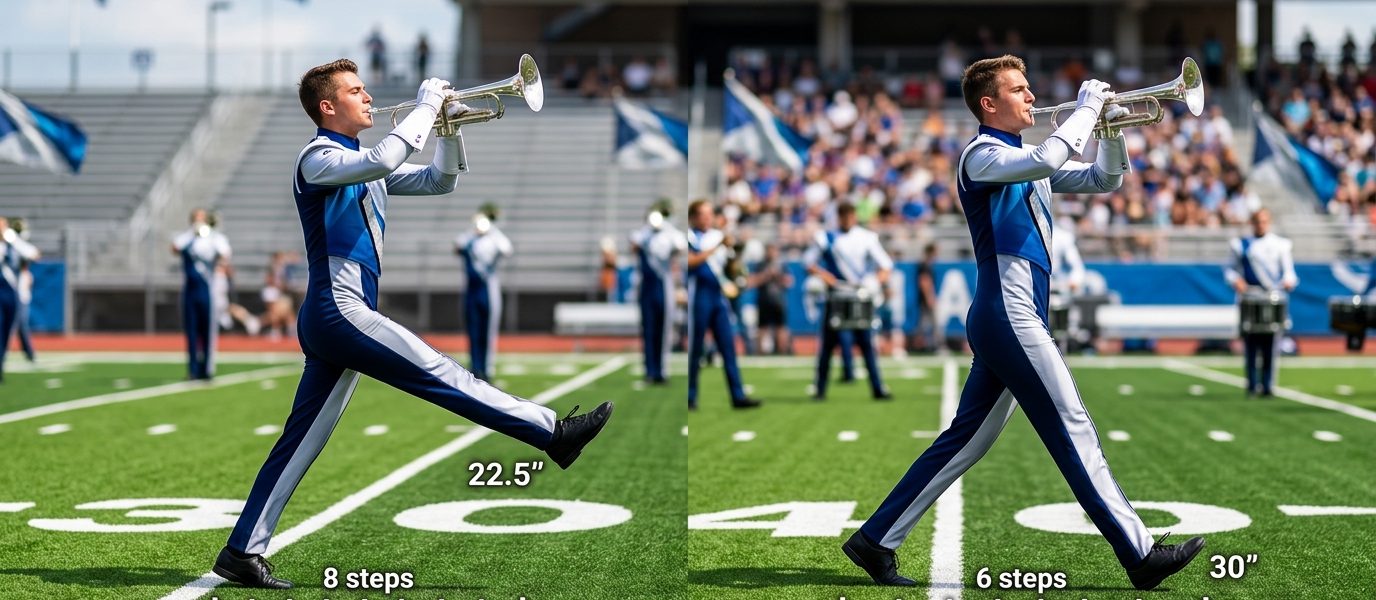
The 8 to 5 marching style uses 22.5-inch steps to cover five yards in eight steps, while 6 to 5 uses 30-inch steps to cover the same distance in six steps. Your choice depends on your ensemble’s tempo preferences, visual design complexity, and physical capabilities. Most high school bands use 8 to 5 for its manageability, while many college and drum corps programs prefer 6 to 5 for its efficiency and visual impact.
What the numbers actually mean
The terms “8 to 5” and “6 to 5” describe how many steps it takes to cover five yards on a football field.
In 8 to 5 marching, you take eight steps to travel five yards. That works out to 22.5 inches per step.
In 6 to 5 marching, you take six steps to cover the same five yards. Each step measures 30 inches.
The difference might seem small on paper, but it changes everything about how you move across the field. Your stride length affects your balance, your tempo ceiling, and how precisely you can hit drill coordinates.
Step size breakdown by style
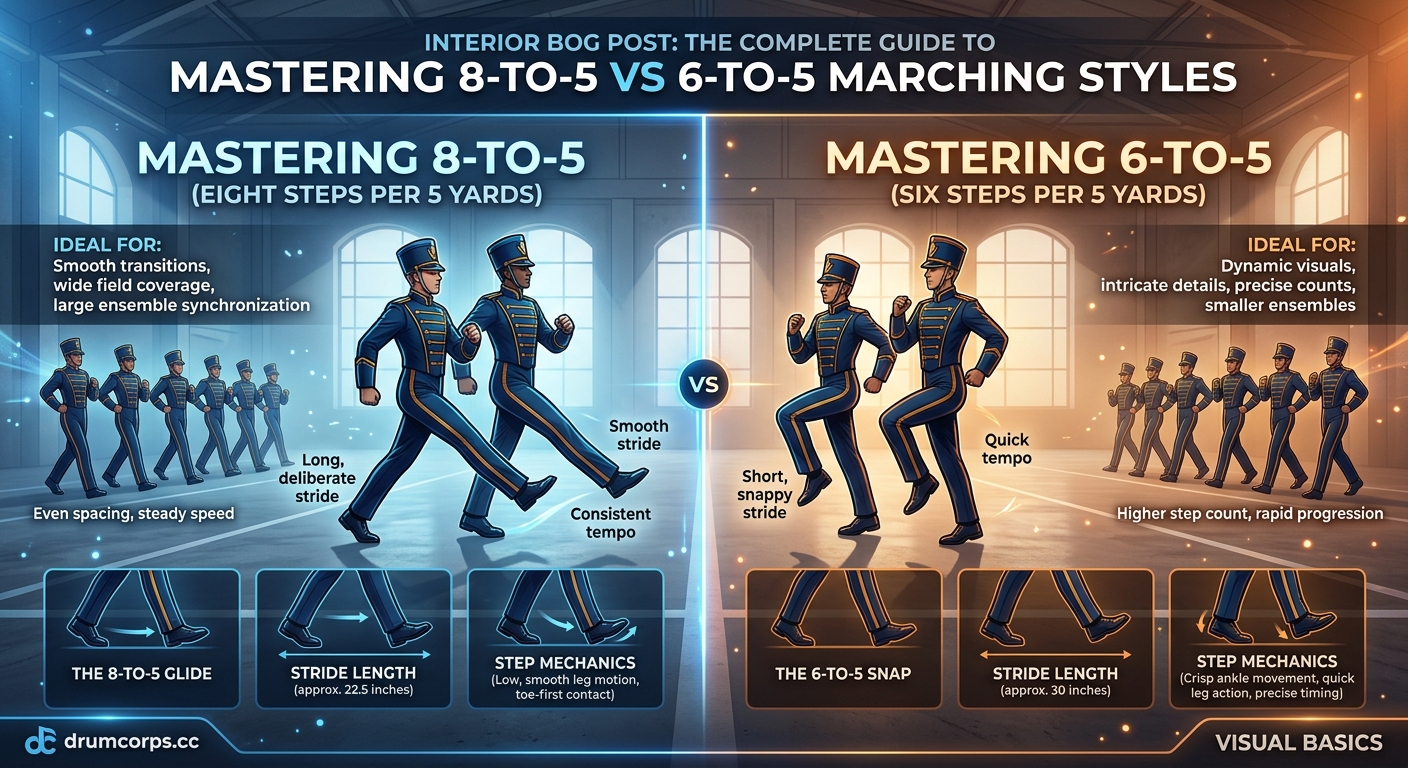
Understanding the exact measurements helps you train your muscle memory correctly.
| Style | Steps per 5 Yards | Inches per Step | Steps per Yard |
|---|---|---|---|
| 8 to 5 | 8 | 22.5 | 1.6 |
| 6 to 5 | 6 | 30 | 1.2 |
| 12 to 5 | 12 | 15 | 2.4 |
| 16 to 5 | 16 | 11.25 | 3.2 |
Most programs stick with 8 to 5 or 6 to 5, but some groups use 12 to 5 for slower tempos or 16 to 5 for extremely detailed choreography.
The step size you choose determines your maximum sustainable tempo. Larger steps at faster tempos create more physical stress and make it harder to maintain body control.
Why high school bands prefer 8 to 5
Smaller step sizes offer better control for developing marchers.
A 22.5-inch step feels more natural for most high schoolers, especially freshmen and sophomores still building leg strength. The shorter stride reduces strain on hip flexors and makes it easier to maintain proper posture throughout a full show.
Tempo flexibility matters too. With 8 to 5, you can comfortably march at 160 to 180 beats per minute without overextending. That range covers most contemporary wind ensemble and popular music arrangements.
Drill writing becomes more forgiving. When you need to adjust spacing or fix a form that doesn’t quite fit the field, having more steps per yard gives you finer control over positioning.
“We switched from 6 to 5 to 8 to 5 after watching too many kids struggle with endurance in the fourth quarter of our show. The change improved our visual consistency immediately.” — Visual caption head, Texas 6A program
Learning 5 body alignment drills that transform your marching posture becomes easier when you’re not fighting against an oversized step.
When 6 to 5 makes more sense
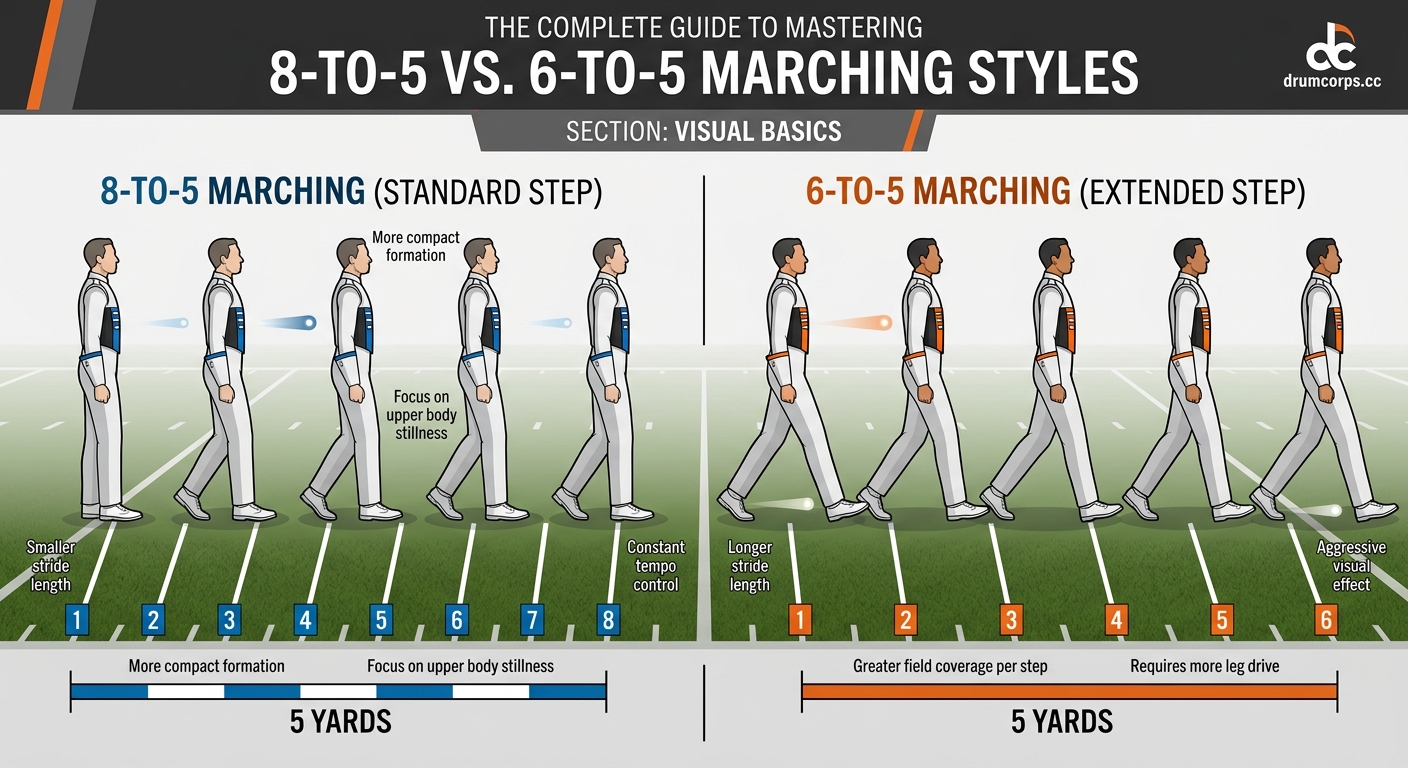
Larger steps create visual impact and cover ground efficiently.
College programs and drum corps often choose 6 to 5 because it allows for more dynamic drill designs. You can execute larger moves in less time, creating dramatic visual moments that wow audiences and judges.
The efficiency factor matters during long shows. Fewer steps to cover the same distance means less physical repetition. For a 10-minute show, that difference adds up to thousands fewer steps.
Advanced marchers can handle the physical demands. By the time you’re marching at the college or world-class level, you’ve built the strength and technique to sustain 30-inch steps at 140 to 160 BPM.
Some programs use 6 to 5 specifically for its clean mathematical properties. Drill coordinates fall on whole numbers more often, reducing the need for fractional step adjustments.
How to train your body for each style
Switching between styles requires deliberate muscle memory work.
For 8 to 5 training:
- Mark two points exactly 22.5 inches apart using tape on your practice floor
- Practice stepping from mark to mark with a metronome at 120 BPM
- Gradually increase tempo by 4 BPM increments until you reach your show tempo
- Add backwards and sideways variations once you’ve mastered forward motion
- Film yourself from the side to check for consistent step size
For 6 to 5 training:
- Set up markers 30 inches apart in a straight line
- Begin at 100 BPM to establish the larger stride pattern
- Focus on maintaining upper body stability as your legs extend
- Increase tempo slowly, never sacrificing form for speed
- Practice the complete guide to practicing visuals without a field to reinforce proper technique
Common mistakes happen when marchers try to rush the transition. Your body needs time to reprogram the motor patterns.
Tempo considerations for each system
Your show’s musical demands influence which style works better.
8 to 5 tempo sweet spots:
– Ballads: 80 to 100 BPM
– Mid-tempo sections: 120 to 140 BPM
– Up-tempo passages: 160 to 180 BPM
– Maximum sustainable: 200 BPM for short bursts
6 to 5 tempo sweet spots:
– Ballads: 70 to 90 BPM
– Mid-tempo sections: 100 to 130 BPM
– Up-tempo passages: 140 to 160 BPM
– Maximum sustainable: 180 BPM for short bursts
Notice that 6 to 5 generally operates at lower tempos for the same musical feel. The larger step size creates more visual motion per beat, so you don’t need as much tempo to achieve impact.
Some programs use hybrid approaches, switching between styles for different movements. A ballad might use 8 to 5 for intricate body work, while the closer uses 6 to 5 for powerful drill moves.
Drill design differences
Your marching style shapes what’s possible on the field.
With 8 to 5, drill writers can create tighter spacing and more intricate forms. The smaller step increment allows for precise adjustments that would be impossible with larger steps.
Forms that require members to land on specific hash marks or yard lines work more cleanly in 8 to 5. You have more granular control over final positions.
6 to 5 excels at sweeping movements and rapid transitions. Large-scale drill maneuvers like company fronts, pinwheels, and diagonal company fronts look more dramatic when executed with bigger steps.
Some common drill moves by preferred style:
Better in 8 to 5:
– Follow-the-leader patterns through tight spaces
– Rapid direction changes with minimal travel
– Detailed scatter formations
– Close-interval dress and cover
Better in 6 to 5:
– Large-scale rotations
– Fast-moving diagonals across the entire field
– Expansive opening and closing forms
– High-step or jazz runs for visual effect
Understanding what judges actually look for during visual ensemble scoring helps you choose the style that best showcases your program’s strengths.
Physical demands and injury prevention
Different step sizes stress your body in different ways.
The 8 to 5 system distributes impact across more steps, reducing the force on each individual stride. This makes it gentler on knees and ankles over the course of a full season.
However, the higher step count means more repetitive motion. Hip flexors and quadriceps face more total contractions during a show, which can lead to overuse injuries if you don’t maintain proper conditioning.
The 6 to 5 system requires more power per step. Your glutes, hamstrings, and calves work harder to propel you through the longer stride. This builds strength but increases acute injury risk if you haven’t prepared properly.
Injury prevention checklist for 8 to 5:
– Strengthen hip flexors with resistance band exercises
– Focus on ankle stability work
– Maintain flexibility in calves and hamstrings
– Monitor for shin splints from high step counts
Injury prevention checklist for 6 to 5:
– Build posterior chain strength (glutes and hamstrings)
– Develop core stability for balance during long strides
– Practice landing mechanics to reduce knee stress
– Allow adequate recovery time between full runs
Proper conditioning matters regardless of style. Working on how to build rock-solid breath support for high brass endurance helps you maintain control during physically demanding drill.
Making the switch mid-season
Sometimes circumstances force a style change after you’ve already started learning drill.
This happens when a new staff member arrives with different preferences, or when your ensemble struggles with the originally planned system. The transition requires careful planning to avoid confusion and injury.
Give yourself at least three weeks to retrain muscle memory. Rushing the change leads to inconsistent step sizes and sloppy drill execution.
Week 1: Basics only. No drill, just step training at slow tempos.
Week 2: Simple drill forms with the new step size. Straight lines, basic geometric shapes.
Week 3: Integrate the new technique into actual show drill at reduced tempo.
Mark your practice field with temporary guides showing the new step increments. Visual references help your brain and body sync up faster.
Expect some members to adapt faster than others. Veterans who’ve marched multiple seasons might struggle more than rookies because they have to unlearn ingrained patterns.
Which style fits your program best
The right choice depends on your specific situation.
Choose 8 to 5 if you:
– Have a young or inexperienced ensemble
– Want maximum drill design flexibility
– Plan to perform at faster tempos (160+ BPM)
– Need easier coordination between sections
– Have limited rehearsal time to perfect technique
Choose 6 to 5 if you:
– Have physically mature, experienced marchers
– Want dramatic visual impact with sweeping movements
– Perform primarily at moderate tempos (120 to 150 BPM)
– Have the rehearsal time to perfect larger step technique
– Want to align with college or drum corps standards
Some programs start freshmen on 8 to 5 and transition to 6 to 5 by junior or senior year. This progressive approach builds strength and technique gradually.
Geographic trends exist too. Certain regions favor one style over the other based on local competitive standards and judging preferences. Check what successful programs in your area use.
Combining styles strategically
Advanced programs sometimes use both systems within a single show.
This hybrid approach lets you match marching style to musical and visual demands. A delicate woodwind feature might use 8 to 5 for precise, controlled movement, while a brass-heavy power moment switches to 6 to 5 for maximum impact.
The transitions between styles need clear marking in drill charts and extra rehearsal attention. Members must know exactly when the switch happens and practice those moments repeatedly.
Some programs use 8 to 5 as their default and switch to 6 to 5 only for specific effects like high-step sequences or jazz runs. This gives you the benefits of both systems without the complexity of constant switching.
Others use different styles for different sections. The battery might march 6 to 5 for visual impact while winds use 8 to 5 for better control during technical passages.
Just remember that complexity has costs. Every additional variable in your visual program requires more rehearsal time and increases the risk of execution errors.
Common mistakes in both systems
Knowing what to avoid saves time and frustration.
| Mistake | 8 to 5 | 6 to 5 |
|---|---|---|
| Rushing tempo | Steps shrink below 22.5″ | Steps shrink below 30″ |
| Poor posture | Forward lean from small steps | Backward lean from overreaching |
| Inconsistent sizing | Varies by 2-3 inches per step | Varies by 4-6 inches per step |
| Tempo ceiling | Pushing past 200 BPM | Pushing past 180 BPM |
| Fatigue response | Shuffling instead of stepping | Collapsing stride length |
The fix for most of these problems involves slowing down and focusing on fundamentals. Use a metronome during individual practice and have someone film you from multiple angles.
Members often underestimate their step size in both systems. What feels like 22.5 inches might actually be 19 inches. Regular measurement checks keep everyone honest.
Working on how to fix the 3 most common marching posture mistakes in under a week addresses many of these issues before they become ingrained habits.
Getting your ensemble on the same page
Consistency across the entire group matters more than individual perfection.
Start every season with step size calibration. Have each member measure and practice their steps with a partner checking accuracy. This baseline work prevents problems later.
Create visual references on your practice field. Paint or tape lines at the correct intervals so members can self-check during basics block.
Use section leaders to monitor and correct step size during drill rehearsal. They can spot inconsistencies faster than a director watching from the tower.
Film rehearsals regularly and review footage with the ensemble. Seeing themselves on video helps members recognize when their steps drift from the target size.
Build step size checks into your how to build a perfect 30-minute individual practice routine so members maintain consistency between full ensemble rehearsals.
Finding your stride and owning it
Whether you march 8 to 5 or 6 to 5, commitment to the system matters more than which one you choose.
Both styles produce championship-level results when executed with precision and consistency. The bands that struggle are the ones that never fully commit to either approach, leaving members confused about expectations.
Take the time to understand the mathematics, train your body properly, and practice until the step size becomes automatic. Your visual performance will improve, your drill will clean up faster, and you’ll spend less time fixing spacing issues.
The marching style you choose becomes part of your program’s identity. Own it, perfect it, and use it to tell your musical story with clarity and impact.