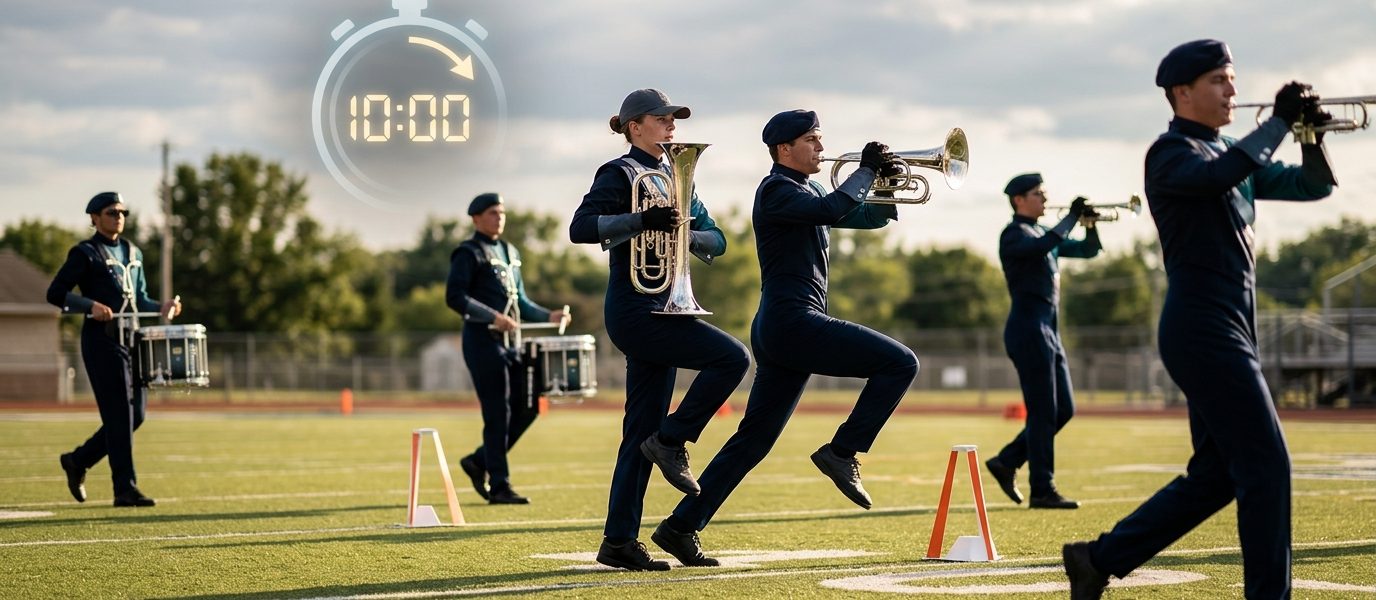
You step backstage. Your heart pounds. Your muscles feel tight. You have ten minutes before the lights come up.
What you do in those final moments determines whether you nail every rep or stumble through sections you’ve practiced a thousand times. A solid pre show warmup routine doesn’t just loosen your body. It locks in your focus, steadies your breathing, and bridges the gap between rehearsal mode and performance mode.
A 10 minute pre show warmup routine combines physical activation, breath control, mental rehearsal, and technical checks to prevent visual breaks and performance errors. This system works for marchers, vocalists, speakers, and any performer who needs reliable execution under pressure. Follow the sequence in order, adapt intensity to your role, and you’ll step onstage ready to perform at your peak.
Why the Last 10 Minutes Matter Most
You’ve spent weeks preparing. You’ve drilled the choreography. You’ve memorized every cue.
But your body doesn’t automatically switch from backstage chatter to performance precision. Your muscles need activation. Your nervous system needs grounding. Your brain needs a clear runway to execute what you’ve trained.
The performers who look effortless onstage aren’t winging it. They’re following a repeatable warmup sequence that primes every system. This routine works because it addresses three layers: physical readiness, mental clarity, and technical confidence.
When you skip the warmup, you’re asking cold muscles to hit full range of motion. You’re forcing shallow breaths to support sustained output. You’re hoping muscle memory kicks in without giving it a proper cue.
That’s when breaks happen. That’s when you miss marks. That’s when the show feels harder than rehearsal ever did.
The Complete 10 Minute Sequence
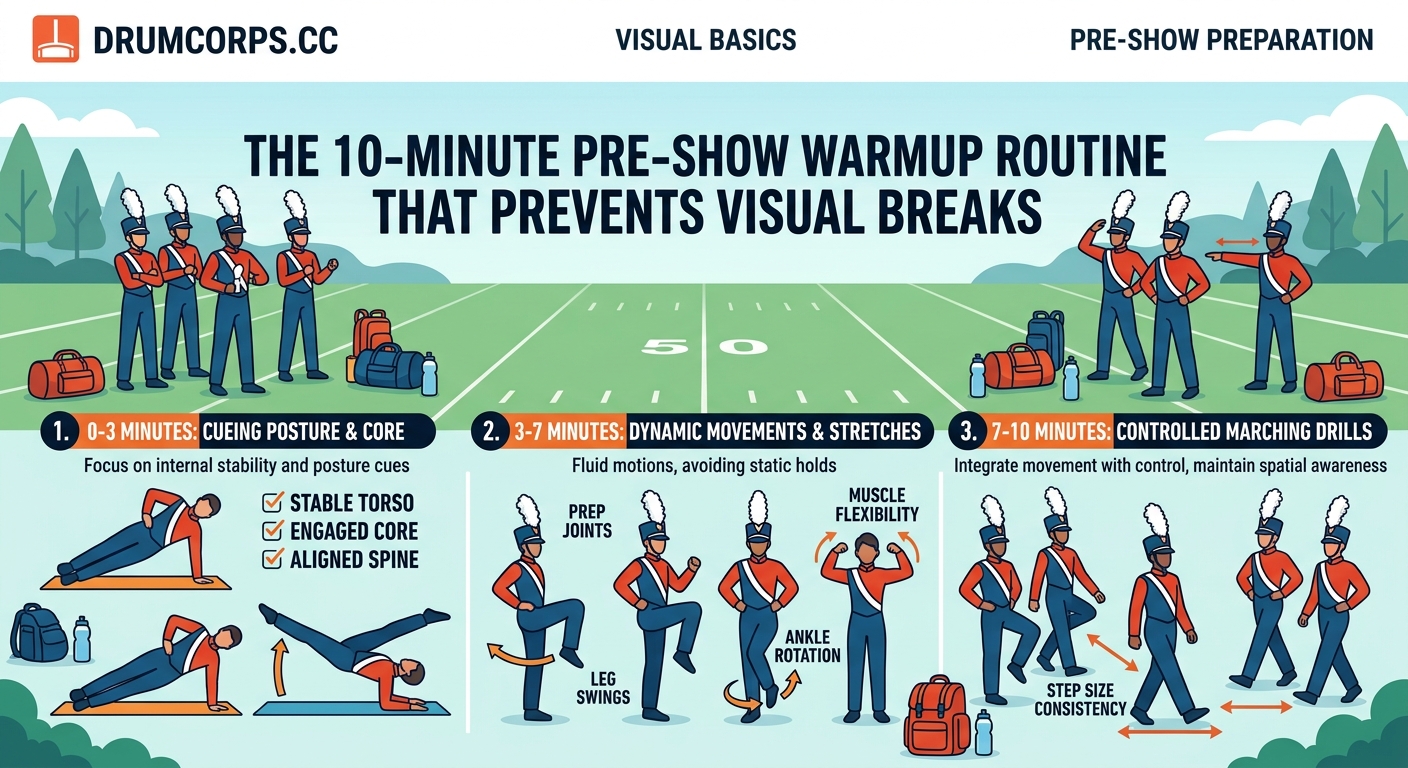
This routine follows a specific order. Each phase builds on the previous one. Don’t skip steps or rearrange them.
Minutes 1 to 2: Whole Body Activation
Start with movement that raises your heart rate without exhausting you.
Do 20 jumping jacks or jog in place for 30 seconds. Roll your shoulders forward ten times, then backward ten times. Swing your arms across your chest, alternating sides. Rotate your hips in large circles, five each direction.
This phase wakes up your cardiovascular system and lubricates major joints. You’re not stretching yet. You’re signaling to your body that it’s time to perform.
If you’re in a cramped backstage area, march in place with high knees. If you’re outdoors in the cold, add extra time here. Your goal is to feel warm, not winded.
Minutes 3 to 4: Targeted Stretching and Mobility
Now that you’re warm, address the specific ranges of motion your performance demands.
For marchers, focus on hip flexors, hamstrings, and ankles. Do walking lunges for 30 seconds. Hold a standing quad stretch for 15 seconds per leg. Roll through your ankles in both directions.
For brass players, add shoulder rolls and neck tilts. For vocalists, do gentle neck stretches and shoulder shrugs.
Avoid static stretching that leaves you feeling loose and unstable. You want mobility, not flexibility overload. If you’re working on how to fix your backward marching before your next competition, spend extra time on ankle mobility and hip rotation.
Minutes 5 to 6: Breath Control and Centering
Your breathing pattern determines your performance quality.
Stand with feet shoulder width apart. Place one hand on your stomach. Inhale slowly through your nose for four counts, feeling your belly expand. Hold for two counts. Exhale through your mouth for six counts.
Repeat this cycle five times. This activates your diaphragm and calms your nervous system. For brass players, this phase is critical. Strong breath support prevents tone breaks and endurance issues. If you need more depth here, the techniques in how to build rock-solid breath support for high brass endurance apply to all performers.
After controlled breathing, do three sharp exhales. Push all the air out forcefully. This clears residual tension and resets your respiratory rhythm.
Minutes 7 to 8: Technical Rehearsal at Half Speed
Run through the most demanding 15 seconds of your show at 50% intensity.
If you’re a marcher, walk through your trickiest visual transition. If you’re a vocalist, sing the highest phrase at moderate volume. If you’re a speaker, recite your opening lines at conversational pace.
This phase connects your warmed up body to the specific skills you’re about to use. Your brain rehearses the neural pathways. Your muscles remember the sequence. You’re not performing yet. You’re reminding your system what’s coming.
Focus on clean execution, not full power. Sloppy warmup reps train sloppy performance habits. If you notice a technical issue, address it now. Adjust your grip, your posture, or your breath timing.
Minutes 9 to 10: Mental Rehearsal and Final Checks
Close your eyes. Visualize yourself executing your opening sequence perfectly.
See the field or stage. Hear the first notes. Feel your body moving with precision. Walk through the entire opening in your mind, step by step. This mental rehearsal activates the same brain regions as physical practice.
After 60 seconds of visualization, do your final technical checks. Adjust your uniform. Test your equipment. Confirm your water bottle is accessible if you need it during breaks.
Take three more deep breaths. Shake out any remaining tension in your hands and feet. You’re ready.
Common Mistakes That Sabotage Your Warmup
Even experienced performers fall into these traps.
| Mistake | Why It Hurts | Fix |
|---|---|---|
| Starting with static stretching | Cold muscles don’t respond well to deep stretching | Always activate first, then stretch |
| Skipping breath work | Shallow breathing under stress causes fatigue and breaks | Dedicate two full minutes to controlled breathing |
| Practicing at full intensity | You’ll peak before the show starts | Keep warmup intensity at 50 to 70% |
| Socializing during warmup time | Your brain stays in conversation mode | Find a quiet corner and focus inward |
| Rushing through the sequence | You miss the neural preparation that prevents errors | Set a timer and honor each phase |
The biggest mistake is inconsistency. If you only warm up before competitions, your body won’t trust the routine. Practice this sequence before rehearsals too. Make it automatic.
Adapting the Routine to Your Role
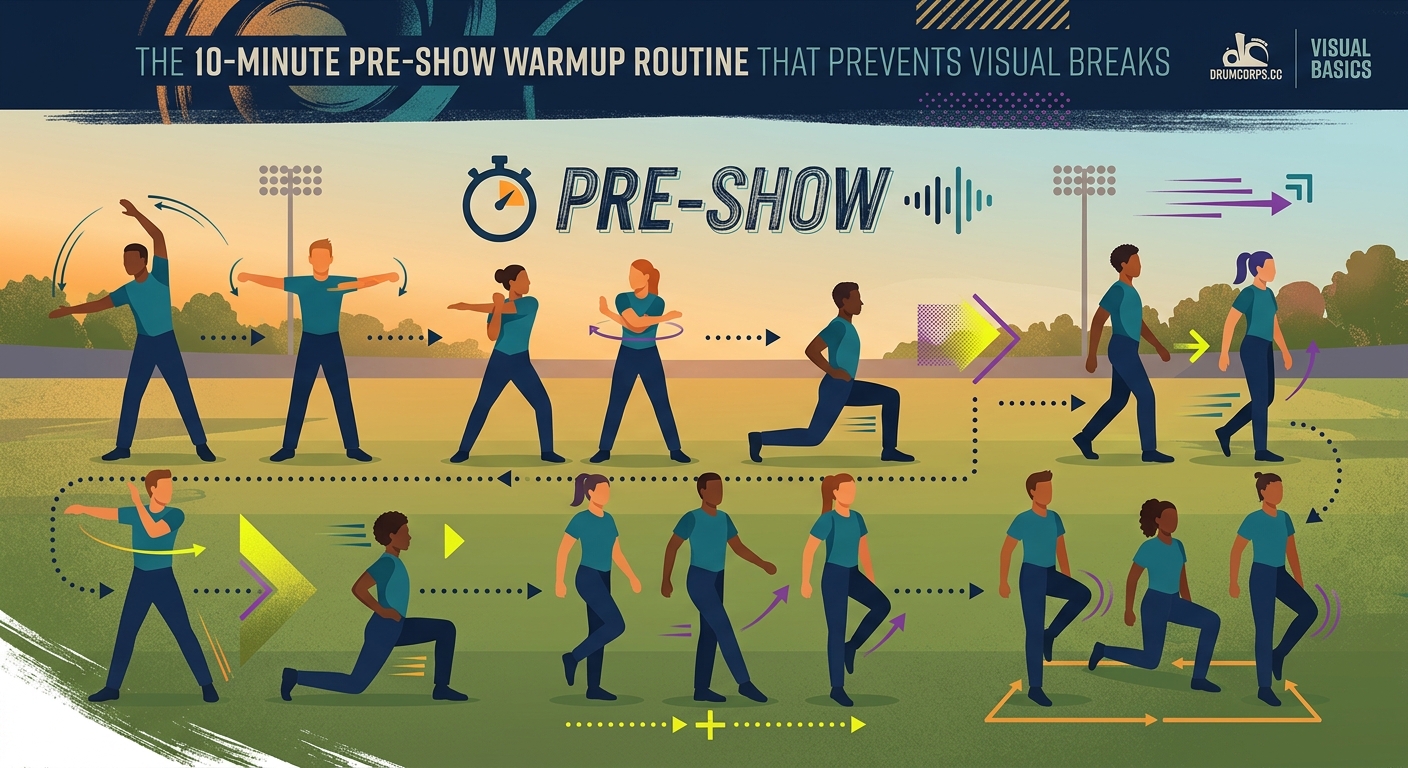
This framework works for any performer, but the details shift based on your specific demands.
For marchers:
– Add extra ankle and hip mobility
– Include balance work on one foot
– Rehearse your most complex foot pattern at half speed
For brass players:
– Extend breath work to three minutes
– Do lip buzzing exercises before technical rehearsal
– Check valve oil and slide grease during final checks
For vocalists:
– Add facial stretches and jaw releases
– Hum scales during breath work
– Sip room temperature water, never cold
For speakers:
– Practice tongue twisters during minutes 7 to 8
– Rehearse your opening line with full vocal projection
– Review your notes during final checks
For percussionists:
– Focus on wrist and forearm mobility
– Do grip strength squeezes
– Play your opening phrase on a practice pad
If you’re working on how to eliminate rim clicks and achieve clean snare articulation, use minutes 7 to 8 to address grip tension and stick height.
Building This Routine Into Your Performance Schedule
Timing matters. Start your warmup exactly 10 minutes before your scheduled performance time.
If you’re early to the venue, do a light version 30 minutes out, then repeat the full sequence when you’re 10 minutes away. Never warm up more than 15 minutes before you perform. Your body will cool down and you’ll lose the readiness you built.
Create a physical checklist card that fits in your uniform pocket:
- Activation (2 min)
- Stretch (2 min)
- Breathe (2 min)
- Technical (2 min)
- Mental (2 min)
Check off each phase as you complete it. This keeps you honest when nerves try to rush you.
If you’re performing multiple shows in one day, adjust the routine. Before show two, reduce activation time to one minute since you’re already warm. Add an extra minute to breath work and mental rehearsal instead.
“The performers who look most relaxed onstage are the ones who followed the most structured warmup. Confidence comes from preparation, and preparation includes those final 10 minutes.” — Veteran drum corps instructor
Troubleshooting Performance Day Challenges
Real venues throw curveballs. Here’s how to adapt without losing effectiveness.
Limited space: If you’re stuck in a crowded hallway, do the routine vertically. Replace jumping jacks with calf raises. Do arm circles instead of full body movements. The sequence matters more than the specific exercises.
Extreme weather: In heat, add hydration checks between each phase. In cold, double your activation time and keep moving until the moment you step onstage. In rain, find any covered area and prioritize staying dry during breath work.
Equipment issues: If you discover a problem during final checks, fix it immediately even if it cuts into your mental rehearsal time. A working instrument beats perfect visualization.
Late schedule changes: If your call time moves up, do a condensed version. Spend 30 seconds on each phase. Never skip breath work or mental rehearsal. Those two phases prevent the most common performance errors.
Nerves that won’t settle: Add box breathing between minutes 6 and 7. Inhale for four, hold for four, exhale for four, hold for four. Repeat three times. This physiologically calms your nervous system.
Connecting Warmup to Your Broader Practice System
This 10 minute routine works best when it’s part of a larger preparation structure.
During the season, practice the warmup sequence before every rehearsal. This builds neural pathways that make the routine automatic under pressure. When you’re nervous on show day, your body will follow the familiar pattern even if your mind is racing.
If you’re building a perfect 30 minute individual practice routine, start each session with this 10 minute sequence. You’ll practice more effectively because your body is ready to execute from the first rep.
The warmup also reveals what needs work. If your hamstrings feel tight during stretching, that’s information. If your breath control feels shaky, that’s a signal to add essential breathing exercises every brass player should master to your weekly training.
Track how you feel after each warmup. Note which phases help most. Adjust the time distribution based on your specific needs. Some performers need three minutes of breath work. Others need extra technical rehearsal time.
What Happens When You Make This Routine Non-Negotiable
Three weeks of consistent practice makes this sequence automatic.
Your body starts anticipating each phase. Your nervous system recognizes the pattern as a performance trigger. You step onstage feeling prepared instead of hoping you’re ready.
The routine also creates a psychological boundary. When you start your warmup, you shift from social mode to performance mode. Your brain knows it’s time to focus. This mental transition prevents the scattered energy that causes mistakes.
Performers who follow this system report fewer visual breaks, better breath control, and stronger confidence. They’re not more talented. They’re better prepared.
The warmup becomes your pre-performance anchor. No matter what chaos happens backstage, you have 10 minutes of control. You can’t control the judges, the weather, or the competition. But you can control how you prepare your body and mind.
Making Your Next Performance Your Best One
You now have a proven system that fits into any performance schedule.
Print this sequence. Tape it inside your instrument case or uniform bag. Run through it before your next rehearsal. Notice how your body responds. Adjust the exercises to match your role, but keep the timing and order intact.
The performers who look effortless onstage aren’t lucky. They’re prepared. They’ve trained their warmup as seriously as they’ve trained their show. They understand that the final 10 minutes before performance aren’t downtime. They’re the bridge between practice and execution.
Start using this routine today. Your future self, standing backstage before the biggest show of the season, will thank you for building this habit now.