Tempo changes can destroy an otherwise perfect performance. One moment you’re locked in with the ensemble, the next you’re half a beat behind or rushing ahead. The problem gets worse when the tempo shift happens mid-phrase, giving you no time to reset or catch your breath.
Most musicians struggle with tempo changes because they rely too heavily on external cues instead of developing internal timing skills. The good news? You can train your body and mind to anticipate, absorb, and execute tempo changes smoothly.
Staying in time during tempo changes requires subdividing internally, practicing transitions slowly, and developing muscle memory for different tempos. Use a metronome with programmable tempo changes, record yourself to identify timing drift, and practice transition points repeatedly. Focus on breathing patterns that match the new tempo, maintain steady subdivision through the change, and train your body to feel tempo shifts before they happen.
Why tempo changes throw off your timing
Your brain processes rhythm differently than you might think. When you’re playing or marching at a steady tempo, your nervous system settles into a predictable pattern. Your muscles know when to fire. Your breathing falls into rhythm. Your internal clock syncs with the ensemble.
A sudden tempo change disrupts all of that.
Your body wants to continue the established pattern. It takes conscious effort to override that momentum and shift gears. The transition period is where most timing issues occur. You’re fighting against your own muscle memory.
Brass players often rush during accelerandos because they associate faster tempos with increased tension. Percussionists tend to drag during ritardandos because they’re trying too hard to control the deceleration. Marchers lose their step spacing when the tempo shifts because their stride length doesn’t adjust proportionally.
The solution isn’t just about counting harder. It’s about retraining your internal timing system.
Understanding internal subdivision
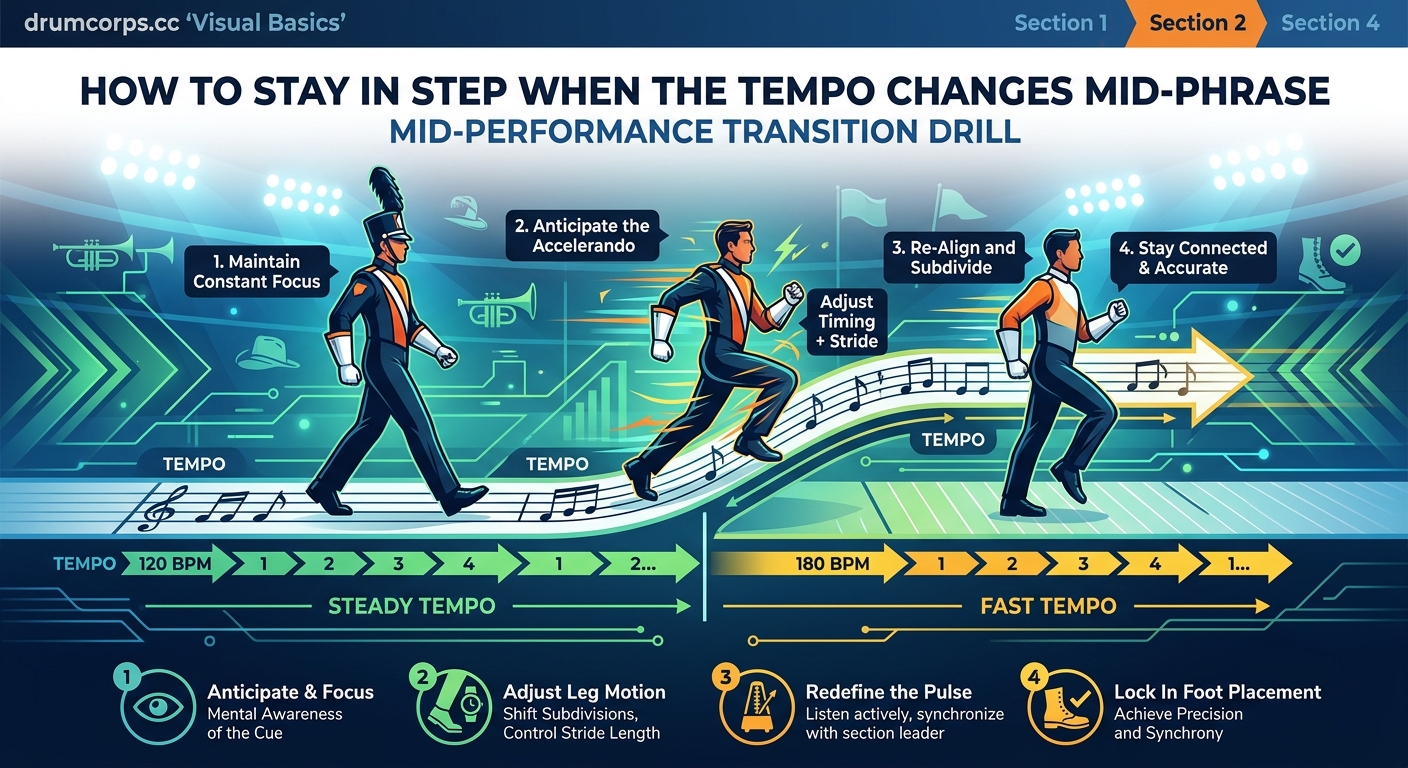
Professional musicians don’t just count beats. They subdivide constantly, even when the music doesn’t require it.
Subdivision means breaking each beat into smaller units. If you’re playing in 4/4 at 120 BPM, you’re not just thinking quarter notes. You’re feeling eighth notes, or even sixteenth notes, depending on the passage.
This internal subdivision acts as a safety net during tempo changes. When the tempo shifts, your subdivision adjusts proportionally. You’re not jumping from one tempo to another blindly. You’re smoothly transitioning through a continuum of smaller pulses.
Here’s how to develop this skill:
- Set your metronome to a comfortable tempo and play a simple exercise.
- Internally subdivide each beat into eighth notes while you play.
- Gradually increase the tempo while maintaining the same subdivision pattern.
- Practice feeling the subdivision without vocalizing or tapping it externally.
The goal is to make subdivision automatic. You should feel those smaller pulses without thinking about them consciously.
“The best way to navigate tempo changes is to never stop subdividing. Your internal metronome should be running at the smallest rhythmic value in the passage, adjusting smoothly as the tempo shifts.”
Practicing tempo transitions deliberately
Random tempo changes during a run-through won’t train your timing effectively. You need structured practice that isolates the transition points.
Start by identifying every tempo change in your music. Mark them clearly in your score or drill. Then practice each transition individually using this method:
- Play or march four measures before the tempo change at the original tempo.
- Execute the tempo change exactly as written.
- Continue for four measures at the new tempo.
- Stop and evaluate your accuracy.
Record yourself during these practice sessions. Listen back with the score and a metronome. You’ll hear where you’re rushing or dragging. Most musicians are surprised by how far off they are initially.
Pay special attention to these common problem areas:
- The beat immediately before the tempo change
- The first beat at the new tempo
- The second and third beats at the new tempo
- The phrase ending after the tempo change
Many performers nail the transition point but then drift in the measures that follow. Your timing needs to be rock solid for at least four measures after any tempo change.
If you’re working on marching technique alongside your musical skills, building a structured individual practice routine can help you allocate time for both tempo work and visual fundamentals.
Using technology to train tempo awareness
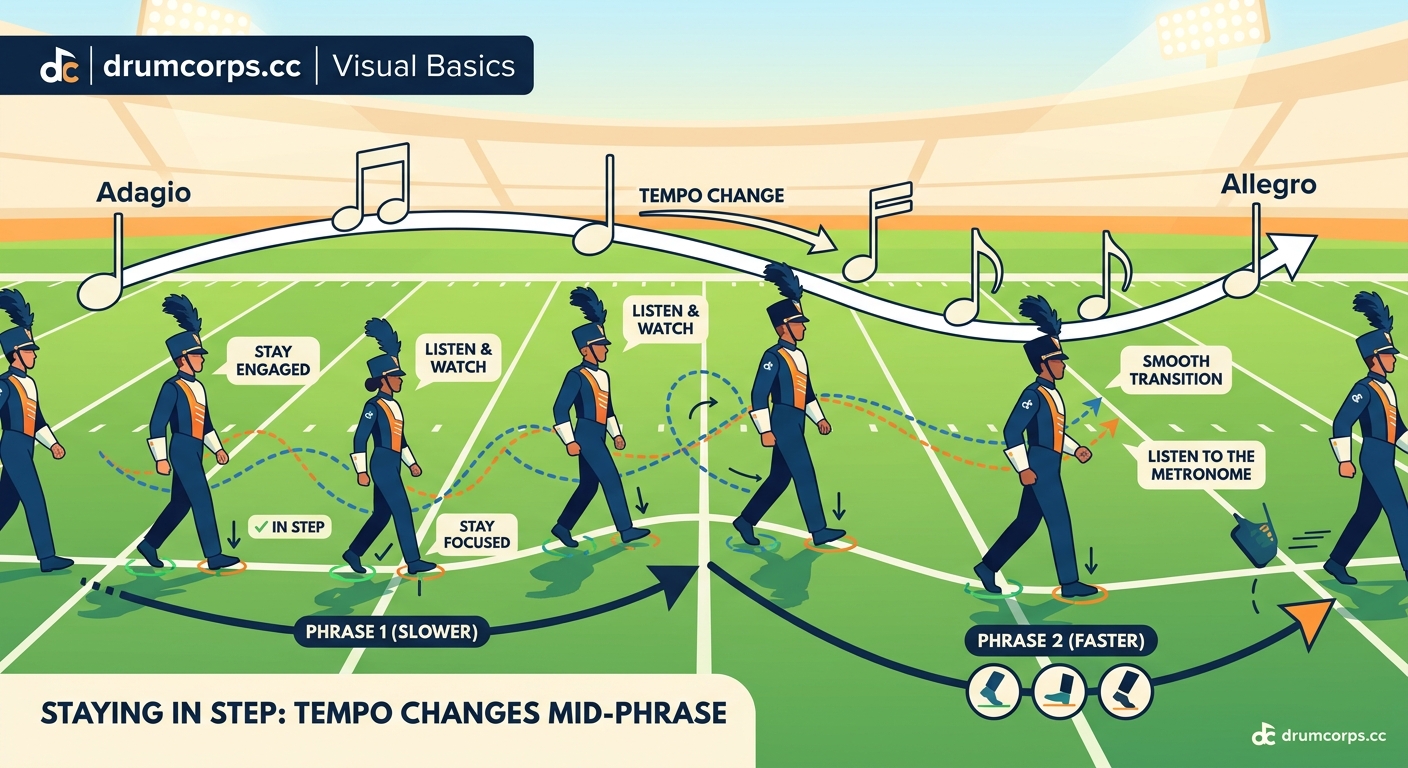
Modern practice tools make tempo training more effective than ever. Programmable metronomes let you create custom tempo maps that match your music exactly.
Here’s how to build a training track:
- Program your metronome with the exact tempo changes from your show or piece.
- Practice with the track at half speed first.
- Gradually increase the overall speed while maintaining the proportional tempo relationships.
- Eventually practice at full speed with the programmed tempo changes.
Some metronome apps let you create visual cues alongside the audio clicks. This helps if you’re a visual learner. You can see the tempo change coming before it happens.
Recording software offers another advantage. Record yourself playing or marching through tempo changes. Then use the software to display a visual waveform. You can literally see where you’re rushing or dragging compared to the grid.
Drum machines and digital audio workstations provide even more sophisticated training options. You can program a backing track that includes tempo changes, then practice staying locked in with that track. The more realistic your practice environment, the better your performance will be.
Many musicians find that consistent metronome practice builds a stronger internal sense of time that carries over into tempo change situations.
Breathing patterns and tempo changes
Brass players face a unique challenge with tempo changes. Your breathing pattern is tied directly to the tempo. When the tempo shifts, your breath rhythm needs to adjust immediately.
The problem is that breathing is largely automatic. You don’t think about every breath during a performance. Your body settles into a pattern based on the phrase structure and tempo. A sudden tempo change can leave you gasping or holding your breath at the wrong moment.
Train your breathing to be flexible:
- Practice breathing exercises at different tempos using the same phrase
- Mark breath points in your music that work at both the old and new tempos
- Develop the ability to take faster breaths without tension
- Learn to adjust breath support intensity based on the current tempo
Faster tempos require quicker, shallower breaths between phrases. Slower tempos allow for deeper, more relaxed breathing. Your breath support needs to match the energy level of each tempo.
If you notice tension creeping in during tempo changes, specific breathing exercises can help you maintain control and flexibility.
Common mistakes and how to fix them
Most timing problems during tempo changes fall into predictable patterns. Recognizing these mistakes in your own playing is the first step toward fixing them.
| Mistake | Why It Happens | How to Fix It |
|---|---|---|
| Rushing accelerandos | Anticipating the faster tempo too early | Practice the transition at half speed, focusing on gradual acceleration |
| Dragging ritardandos | Over-controlling the deceleration | Let the tempo decrease naturally, trust your subdivision |
| Losing the pulse | Stopping internal subdivision during the change | Maintain constant subdivision through the entire transition |
| Changing tempo too abruptly | Not preparing mentally for the shift | Practice four measures before the change to establish the approach |
| Drifting after the change | Failing to lock into the new tempo | Record yourself and check timing for eight measures after each change |
| Inconsistent transitions | Not practicing the same way every time | Develop a repeatable mental process for each tempo change |
The biggest mistake is practicing tempo changes at full speed before you’ve mastered them slowly. Slow practice builds the neural pathways you need for accurate timing. Speed comes later.
Another common error is practicing only the transition point. You need to practice the approach to the tempo change and the continuation after it. Context matters.
Physical coordination during tempo shifts
Marchers and percussionists face additional challenges because tempo changes affect their physical movements directly. Your stride length, arm swing, and body positioning all need to adjust when the tempo shifts.
Step size is the most obvious issue. Faster tempos require shorter steps. Slower tempos need longer strides. But the adjustment isn’t linear. Doubling the tempo doesn’t mean halving your step size. The relationship is more complex.
Practice these coordination drills:
- March in place at the original tempo for eight counts
- Smoothly transition to the new tempo over four counts
- Continue marching at the new tempo for eight counts
- Repeat until the transition feels natural
For percussionists, tempo changes affect stick height, stroke speed, and rebound control. Faster tempos often require lower stick heights and quicker strokes. Slower tempos allow for fuller strokes with more rebound time.
The key is maintaining consistent sound quality through the tempo change. Your tone shouldn’t change just because the tempo does. That requires careful attention to technique adjustments.
Body tension is another factor. Musicians often tense up during tempo changes because they’re concentrating harder. That tension affects your sound, your marching, and your ability to execute cleanly. Stay relaxed. Trust your preparation.
Mental preparation strategies
Your mindset during tempo changes matters as much as your physical technique. Anxiety about the upcoming shift can cause you to tense up or second-guess yourself.
Develop a mental routine for approaching tempo changes:
- Identify the tempo change four measures in advance
- Begin subdividing more consciously as you approach
- Take a full breath before the transition point
- Commit fully to the new tempo without hesitation
Visualization helps. Before rehearsal, sit with your score and mentally walk through each tempo change. Hear the music in your head at both tempos. Imagine yourself executing the transition smoothly. This mental rehearsal builds confidence.
Some performers benefit from associating each tempo with a specific feeling or image. The slower section might feel like walking through water. The faster section might feel like running uphill. These associations help your body understand what’s required.
Don’t underestimate the power of confidence. If you believe you’ll nail the tempo change, you’re more likely to succeed. If you approach it with doubt, you’ll probably struggle. Your mental state affects your physical execution.
Training with ensemble context
Solo practice builds the foundation, but tempo changes feel different in an ensemble setting. You have other players to listen to. You have visual cues from the conductor or drum major. You have the energy of the group.
Practice tempo changes with at least one other person whenever possible. Even a duet gives you the experience of staying locked in with someone else through the transition. You’ll learn to listen and adjust in real time.
Pay attention to who has the melody or the most prominent part during tempo changes. Those players often set the tempo for the ensemble. If you’re not in that role, listen to them and match their timing exactly.
Watch the conductor or drum major carefully during tempo changes. Their preparatory gestures will signal the upcoming shift. Learn to read those cues so you’re never surprised by a tempo change.
In drum corps specifically, the visual demand adds another layer of complexity. You’re not just playing or marching. You’re doing both simultaneously while maintaining exact spacing with your neighbors. Tempo changes affect all of those elements at once.
The fundamentals of body alignment become even more critical during tempo transitions, as any postural breakdown will amplify timing issues.
Progressive tempo change exercises
These exercises build your tempo change skills systematically. Start with the easiest and work your way up.
Exercise 1: Simple acceleration
Play a scale at 60 BPM for four measures. Accelerate to 80 BPM over two measures. Play at 80 BPM for four measures. Repeat until smooth.
Exercise 2: Simple deceleration
Play a scale at 120 BPM for four measures. Decelerate to 90 BPM over two measures. Play at 90 BPM for four measures. Repeat until smooth.
Exercise 3: Multiple tempo zones
Play a melody at 100 BPM for four measures. Shift to 120 BPM for four measures. Return to 100 BPM for four measures. Shift to 80 BPM for four measures. Return to 100 BPM for four measures.
Exercise 4: Gradual transitions
Play a passage starting at 60 BPM. Increase by 10 BPM every four measures until you reach 120 BPM. Then decrease by 10 BPM every four measures back to 60 BPM.
Exercise 5: Sudden shifts
Play at 80 BPM for eight measures. On beat one of measure nine, jump immediately to 140 BPM. Hold that tempo for eight measures. Jump back to 80 BPM.
Record every exercise. Listen for consistency and accuracy. Your timing should be as solid at the new tempo as it was at the original tempo.
Troubleshooting persistent timing issues
Some musicians struggle with specific types of tempo changes despite regular practice. If you’re consistently having trouble, try these diagnostic approaches.
First, determine whether your problem is physical or mental. Can you accurately sing or tap the tempo change without your instrument? If yes, the issue is physical. If no, you need more mental training.
For physical issues, slow down even more. If you can’t execute the tempo change cleanly at 50% speed, you won’t execute it at full speed. Build up gradually.
For mental issues, practice away from your instrument. Use body percussion, singing, or conducting to internalize the tempo change. Once it’s solid mentally, add your instrument back in.
Check your subdivision. Are you subdividing consistently through the tempo change? Many timing problems disappear when you focus on maintaining steady internal subdivision.
Consider whether tension is affecting your timing. Tension slows down your physical responses and makes smooth transitions harder. Work on staying relaxed through tempo changes.
If you’re still struggling, have a teacher or experienced musician watch you practice. They might spot technical issues you’re not aware of. Sometimes an outside perspective reveals the problem immediately.
Applying tempo change skills to performance
All this practice pays off when you step on the field or stage. But performance adds pressure that practice doesn’t include. Your adrenaline is higher. The stakes feel bigger. The environment is less controlled.
Build confidence through simulation. Practice with an audience, even if it’s just a few friends. Perform through tempo changes while people are watching. This trains you to execute under pressure.
During actual performances, trust your preparation. Don’t overthink tempo changes in the moment. Your body knows what to do if you’ve practiced enough. Overthinking causes hesitation and timing problems.
Stay present. Don’t worry about the tempo change coming up in 16 measures. Focus on the music you’re playing right now. When the tempo change arrives, you’ll be ready because you’ve practiced it hundreds of times.
If you do make a mistake during a tempo change, don’t dwell on it. Recover immediately and lock back in with the ensemble. One bad transition doesn’t ruin a performance unless you let it affect everything that follows.
Building long-term tempo awareness
Tempo change mastery isn’t a skill you develop once and forget about. It requires ongoing maintenance and development. Make tempo work a regular part of your practice routine.
Dedicate at least 10 minutes of every practice session to tempo-related exercises. This might include tempo changes, but it also includes steady tempo playing, subdivision work, and metronome training.
Challenge yourself with progressively harder tempo changes. Once you’ve mastered the tempo changes in your current music, find more difficult examples to practice. This keeps your skills sharp and expanding.
Listen to recordings of professional ensembles navigating tempo changes. Pay attention to how they maintain ensemble precision through transitions. Try to identify what makes their execution so clean.
Consider how tempo awareness connects to other musical skills. Strong rhythm, good intonation, and solid technique all support your ability to handle tempo changes effectively. Work on all aspects of musicianship, not just timing in isolation.
Many of the skills that help with tempo changes also improve other aspects of your playing. For example, the muscle memory training that helps with visual consistency also supports timing accuracy.
When tempo changes become second nature
The ultimate goal is to stop thinking about tempo changes as a special challenge. They should feel as natural as playing at a steady tempo. You should be able to execute them without conscious thought.
That level of mastery takes time. Don’t get frustrated if you’re not there yet. Every musician struggles with tempo changes at some point. The difference between good players and great players is how much deliberate practice they put into mastering these transitions.
Keep practicing with intention. Record yourself regularly. Celebrate small improvements. Stay patient with the process. Your timing will improve steadily if you put in consistent work.
Remember that tempo changes are a musical tool, not just a technical challenge. They create drama, tension, and emotional impact. When you can execute them cleanly, you’re not just staying in time. You’re contributing to the musical story your ensemble is telling.
Your ability to handle tempo changes confidently will make you a more valuable ensemble member. Directors notice musicians who can navigate difficult passages without breaking the ensemble sound. That reliability opens doors to featured parts and leadership opportunities.
Start today. Pick one tempo change from your current music. Practice it slowly and deliberately for 15 minutes. Record yourself. Listen back critically. Then practice it again tomorrow. Small, consistent efforts build major skills over time.