Paradiddles sound simple on paper. Right, left, right, right, left, right, left, left. But the moment you try to play them at speed, everything falls apart. Your doubles turn into triples. Your accents disappear. Your hands feel like they’re fighting each other instead of working together.
The good news? You don’t need years of experience to fix this. You need a clear practice method, patience with the fundamentals, and an understanding of what actually makes paradiddles work.
Practicing paradiddles effectively requires starting at a slow tempo with correct sticking patterns, isolating problem areas like weak doubles or inconsistent accents, using a metronome to track progress, and gradually building speed while maintaining clarity. Focus on hand height, wrist motion, and finger control to develop clean execution before attempting advanced variations or incorporating them into actual music.
Understanding What Makes Paradiddles Different
A paradiddle isn’t just a random combination of hits. It’s a hybrid rudiment that blends single strokes with double strokes, creating a pattern that naturally alternates your lead hand.
The basic single paradiddle follows this sticking: R L R R L R L L.
That pattern repeats endlessly. The first three notes are single strokes. The fourth note is the beginning of a double stroke on the same hand. Then you mirror the pattern starting with your left hand.
Most drummers rush through this explanation and jump straight to playing. That’s where the problems start.
Your brain needs to understand the architecture before your hands can execute it smoothly. Each paradiddle contains two singles followed by a double. That double stroke is where most people struggle because it requires a different motion than the singles before it.
The singles use alternating wrists. The double uses a controlled bounce or finger technique on one hand. Switching between these motions seamlessly takes deliberate practice.
Setting Up Your Practice Space Correctly
Before you play a single note, your setup matters more than you think.
Sit at a practice pad or drum with proper posture. Your back should be straight, shoulders relaxed, arms hanging naturally. The pad should be at a height where your forearms are roughly parallel to the floor when your sticks make contact.
Grip your sticks using matched grip. Your fulcrum sits between your thumb and first finger, about one third up from the butt of the stick. The stick should rest across your palm and fingers, not clenched in a death grip.
Tension is your enemy. If your forearms feel tight after 30 seconds of playing, you’re gripping too hard or using too much arm motion.
Get a metronome. Not the app you’ll ignore on your phone. A physical one or a dedicated metronome app that you actually open and use. Set it to 60 BPM to start. Yes, that slow.
The Foundation Practice Method That Actually Works
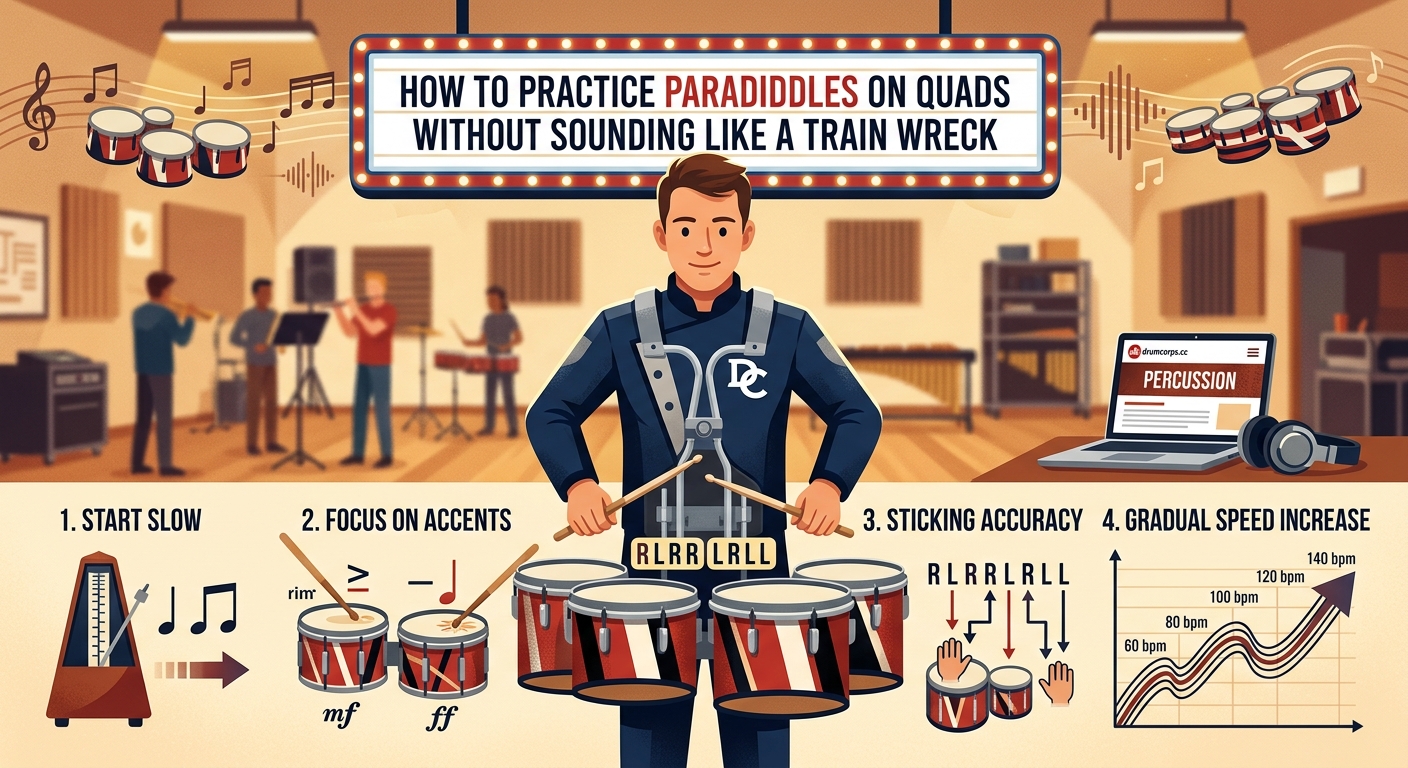
Start with single strokes at 60 BPM. Play eighth notes: R L R L R L R L. Make every stroke exactly the same height, roughly 6 inches off the pad. Match the volume. Match the timing. Match the stick height.
This sounds boring. It is boring. It’s also essential.
Once your singles feel consistent, add the paradiddle sticking at the same tempo. Play one note per click: R L R R L R L L. Don’t accent anything yet. Every note should sound identical.
Count out loud while you play. “One, two, three, four, one, two, three, four.” This connects your brain to the pattern.
Here’s the step by step method:
- Play the pattern for two minutes straight at 60 BPM with no mistakes.
- If you make an error, start the timer over. No cheating.
- Once you complete two minutes cleanly, increase the tempo by 5 BPM.
- Repeat the process at the new tempo.
- Stop when you can’t maintain clean doubles or when your accents blur together.
That final tempo is your current ceiling. Write it down. That’s your baseline for tomorrow’s practice.
Common Mistakes That Ruin Your Paradiddles
Most drummers make the same errors. Recognizing them is half the battle.
| Mistake | What It Sounds Like | How to Fix It |
|---|---|---|
| Crushed doubles | The RR or LL sounds like one mushy note | Slow down and exaggerate the space between double stroke notes |
| Uneven stick heights | Some notes are loud, others barely audible | Watch your sticks in a mirror and match heights exactly |
| Rushing the pattern | The tempo speeds up as you play | Record yourself or use a metronome with an accent on beat one |
| Weak lead hand | Your right hand sounds strong but left hand is quiet | Practice the pattern starting with your left hand for equal time |
| Tense grip | Your hands hurt after one minute | Relax your grip and use more fingers, less forearm |
The crushed double is the most common problem. It happens because you’re trying to play the double stroke too fast for your current skill level. The fix is simple but humbling. Slow down until you can clearly hear two separate notes in the double. Then gradually speed up over days and weeks, not minutes.
Adding Accents Without Losing Control
Once you can play paradiddles cleanly at 100 BPM, it’s time to add accents. This is where the rudiment becomes musical instead of just mechanical.
The standard accent pattern puts emphasis on the first note of each grouping: R L R R L R L L.
Accented notes should be roughly twice the height of unaccented notes. If your taps are 3 inches off the pad, your accents should be 6 inches. Not 12 inches. Not 2 feet. Control matters more than power.
“The difference between a good paradiddle and a great one isn’t speed. It’s the clarity of the accent pattern. If I can’t hear exactly where your accents fall, you’re not ready to play it faster.” — Advice from a veteran marching percussion instructor
Practice accents separately before combining them with speed. Play the pattern at 60 BPM with exaggerated accents. Make the difference between loud and soft almost comical. Your brain needs to internalize the motion difference between accented and unaccented strokes.
Then gradually reduce the exaggeration as you increase tempo. By the time you’re at 120 BPM, your accents should be clear but not overpowering.
Isolating Problem Areas With Targeted Drills
If your doubles are inconsistent, isolate them. Play just double strokes for two minutes: RR LL RR LL. Focus entirely on making both notes of each double match in volume and timing.
If your left hand is weaker, flip the pattern. Start every rep with your left hand: L R L L R L R R. This feels awkward at first. That awkwardness is exactly why you need to do it.
Here are focused drills that address specific weaknesses:
- Double stroke clarity drill: Play only RR LL at 60 BPM, four doubles per measure, for five minutes.
- Accent isolation drill: Play the pattern with only accents, no taps. Every note is loud. This builds the motion.
- Opposite hand lead drill: Start every rep with your weak hand for an entire practice session.
- Height control drill: Place a ruler 6 inches above your pad. Every tap must stay below it, every accent must touch it.
- Endurance test: Play the pattern at 80 BPM for ten minutes without stopping. Note where you start to break down.
These drills aren’t glamorous. They won’t impress anyone watching you practice. But they build the foundation that lets you play paradiddles confidently when it actually matters.
Building Speed Without Sacrificing Clarity
Speed comes from efficiency, not force. Trying to muscle your way to faster tempos just creates tension and sloppiness.
Instead, focus on eliminating wasted motion. Every stroke should travel the minimum distance necessary. No extra flourishes. No unnecessary wrist rotation. Just up and down.
Use the metronome to increase tempo gradually. Add 2 BPM per session, not 10. Yes, this means progress feels slow. That’s the point. Your muscle memory needs time to adapt.
When you hit a tempo where the pattern starts to fall apart, that’s your current limit. Don’t push past it. Instead, spend three practice sessions at that tempo until it feels comfortable. Then increase by 2 BPM.
If you’re incorporating this into how to build a perfect 30-minute individual practice routine, dedicate 10 minutes to paradiddles at the beginning when your hands are fresh.
Track your progress in a practice journal. Write down your top clean tempo for each session. Seeing the numbers increase over weeks provides motivation when progress feels invisible day to day.
Applying Paradiddles to Actual Music
Paradiddles aren’t just an exercise. They’re a tool for navigating musical passages that would be awkward with straight alternating sticking.
Start by finding simple drum beats that use paradiddle sticking. Many rock grooves incorporate the pattern naturally between the hi-hat and snare.
Practice applying the sticking to basic eighth note patterns around the kit. Play the paradiddle sticking but move your right hand to the ride cymbal and left hand to the snare. This creates a musical context instead of just hitting a pad.
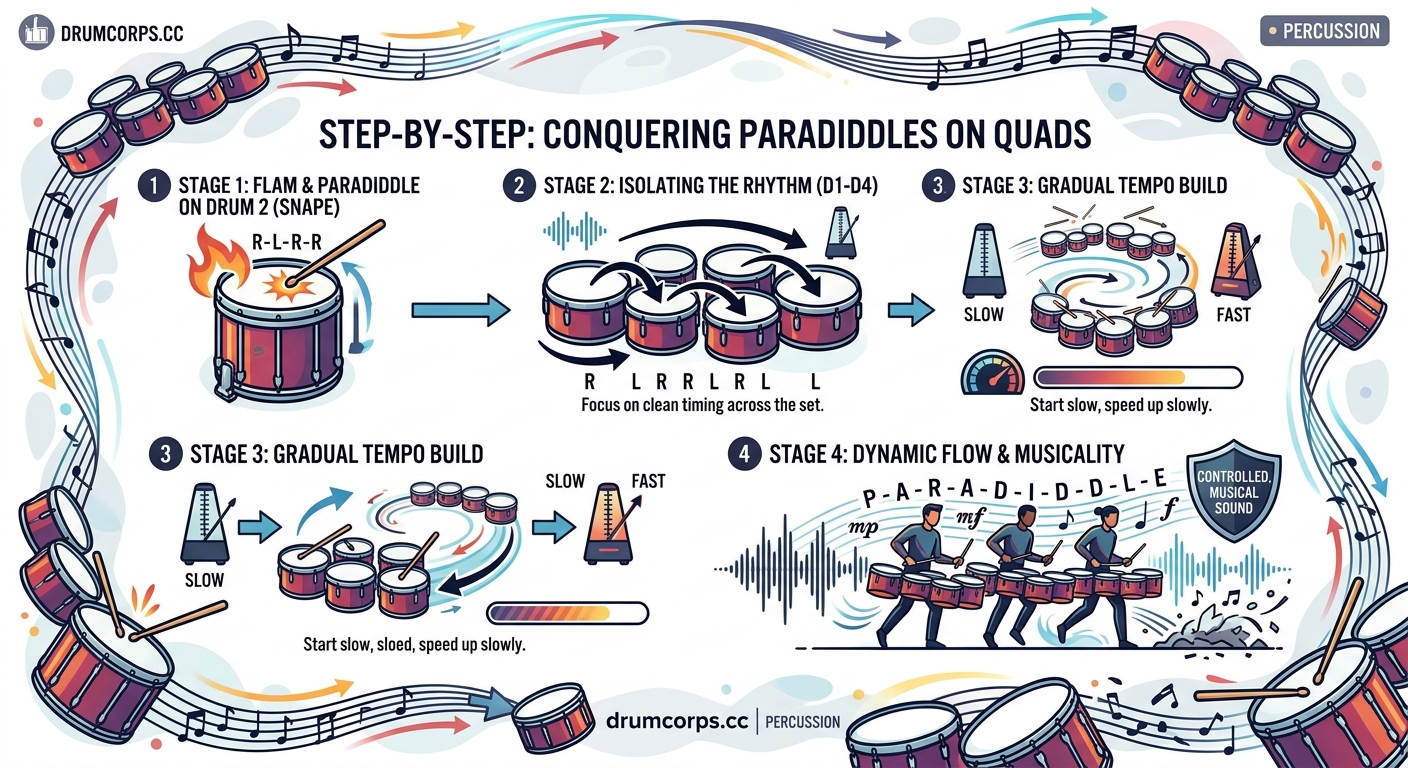
Then try orchestrating the pattern across multiple drums. If you’re working on quads, assign each note of the pattern to a different drum: R (drum 1) L (drum 2) R (drum 3) R (drum 4), then reverse it coming back.
This is where the rudiment transforms from a technical exercise into actual music. The sticking pattern that felt mechanical on a pad suddenly creates interesting sonic textures when spread across different drums.
Fixing Form Issues Before They Become Habits
Bad technique is easier to prevent than to fix. Watch yourself in a mirror or record video of your playing. Look for these red flags:
- Are your stick heights consistent? Both sticks should reach the same height on every stroke.
- Is your grip relaxed? You should be able to wiggle your fingers slightly even while holding the sticks.
- Are you using your wrists or your arms? Most of the motion should come from your wrists, not your forearms.
- Do your doubles bounce naturally or are you forcing them? A proper double stroke uses a controlled rebound.
If you notice tension creeping in, stop immediately. Shake out your hands. Take a 60-second break. Then start again at a slower tempo.
Many of the same principles that help with how to eliminate rim clicks and achieve clean snare articulation apply here. Clean technique prevents problems before they start.
Variations to Keep Practice Interesting
Once you’ve mastered the basic single paradiddle, there are variations that build on the same foundation.
The double paradiddle adds two more single strokes: R L R L R R L R L R L L. This creates a six-note pattern instead of four.
The triple paradiddle extends it further: R L R L R L R R L R L R L R L L. Now you’re working with an eight-note pattern.
Inverted paradiddles flip the accent structure. Instead of accenting the first note, you accent the double: R L R R L R L L.
Each variation challenges your hands in different ways. The longer patterns test your memory and endurance. The inverted accents force you to emphasize your weaker strokes.
Don’t rush into variations until your basic paradiddle is solid at 120 BPM with clear accents. Trying to learn advanced patterns before mastering the foundation just creates confusion.
Troubleshooting When Progress Stalls
Everyone hits plateaus. You’ll practice for a week and feel like you’re getting worse instead of better. This is normal.
When progress stalls, go back to basics. Drop your tempo by 20 BPM and focus on perfect execution. Often, you’ve been unconsciously letting small errors slide, and they’ve compounded into bigger problems.
Take a day off. Sometimes your hands need rest more than they need another hour of grinding through the same pattern.
Try a different practice surface. If you’ve been on a hard pad, switch to a softer one. If you’ve been on a drum, go back to a pad. The change in feel can reveal technique issues you’d stopped noticing.
Film yourself and compare it to videos of professionals playing the same rudiment. Look for differences in stick height, grip, and body position. Sometimes seeing the gap between your technique and correct technique is the wake-up call you need.
Making Paradiddles Feel Natural Instead of Mechanical
The goal isn’t just to play paradiddles correctly. It’s to play them without thinking about them.
That level of mastery comes from repetition over time. There’s no shortcut. But you can make the process more effective by practicing with intention.
Every rep should have a purpose. Don’t just mindlessly play the pattern while watching TV. Focus completely for shorter periods. Fifteen minutes of concentrated practice beats an hour of distracted playing.
Sing the sticking pattern out loud while you play. “Right left right right left right left left.” This connects your verbal brain to your motor skills and speeds up the learning process.
Practice in different contexts. Play paradiddles while standing. While walking. While sitting on the floor. The more varied your practice environment, the more deeply ingrained the pattern becomes.
Over time, the sticking becomes automatic. Your hands know what to do without conscious thought. That’s when paradiddles stop being a technical challenge and start being a musical tool you can use instinctively.
Why Consistent Practice Beats Marathon Sessions
Thirty minutes a day beats three hours on Sunday. Your brain learns motor patterns through consistent repetition, not through exhausting cram sessions.
Set a realistic practice schedule. If you can only manage 15 minutes a day, that’s fine. Do those 15 minutes every single day. Don’t skip. Don’t make excuses.
Use a practice log to track what you worked on and at what tempo. This creates accountability and lets you see long-term progress even when daily improvements feel invisible.
If you’re balancing multiple aspects of your playing, best drumsticks for marching snare can make a difference in how your paradiddles sound and feel, especially during long practice sessions.
Celebrate small wins. When you cleanly play paradiddles at 100 BPM for the first time, that’s worth acknowledging. Progress in drumming is incremental. Recognizing improvements keeps you motivated through the grind.
Turning Rudiments Into Musical Expression
Paradiddles aren’t an end goal. They’re a means to play more musically with better control and more sticking options.
Once the pattern is solid, start listening for places to use it in actual music. Many drum parts that look impossible with straight alternating sticking become manageable with paradiddles.
Experiment with orchestrating the pattern across your entire kit. Play the rights on toms and the lefts on cymbals. Play the accents on the snare and the taps on the hi-hat. The same sticking pattern creates completely different musical results depending on where you place it.
This is where technique transforms into artistry. You’re no longer just executing a rudiment. You’re using it as a tool to create sounds and textures that serve the music.
The hours you spent at 60 BPM making sure every double stroke was clean? That work pays off now. Your hands can execute complex patterns without your conscious mind managing every stroke. You’re free to think about musicality instead of mechanics.
That’s the real goal of practicing paradiddles. Not to play them perfectly in isolation, but to make them so natural that they disappear into your playing, serving the music without drawing attention to themselves.