
The Reading Buccaneers just claimed another championship title, but the real story lies in how the entire competitive landscape shifted beneath them. Scores tightened across the board. Traditional powerhouses stumbled. Dark horses surged forward. Every performance at the latest DCA Championships sent ripples through the standings that fans are still analyzing.
Recent DCA Championship results have dramatically altered all age corps rankings, with Reading Buccaneers defending their title while Minnesota Brass and Hawthorne Caballeros made significant gains. Mid-tier corps saw unprecedented movement, creating the most competitive field in years. Understanding these shifts helps fans predict next season’s landscape and reveals which programs are building sustainable momentum versus those experiencing temporary spikes.
Championship Night Changed Everything
The final scores tell only part of the story. Reading Buccaneers finished with 98.150, extending their winning streak to three consecutive years. But look closer at the margins.
Minnesota Brass finished just 1.2 points behind, their closest approach to the top spot in over a decade. That gap narrowed from 2.8 points the previous year. The trajectory matters more than the placement.
Hawthorne Caballeros jumped from fifth to third, leapfrogging two established programs with a 2.4 point improvement from their prelims score. That kind of championship night surge signals a corps hitting its peak at exactly the right moment.
White Sabers dropped from third to fourth despite improving their raw score. That’s the nature of competitive rankings when everyone elevates simultaneously.
Fusion Core entered the top six for the first time, displacing a corps that had held that position for seven straight years. New blood changes the conversation about who belongs in championship discussions.
How Scores Translate to Ranking Movement
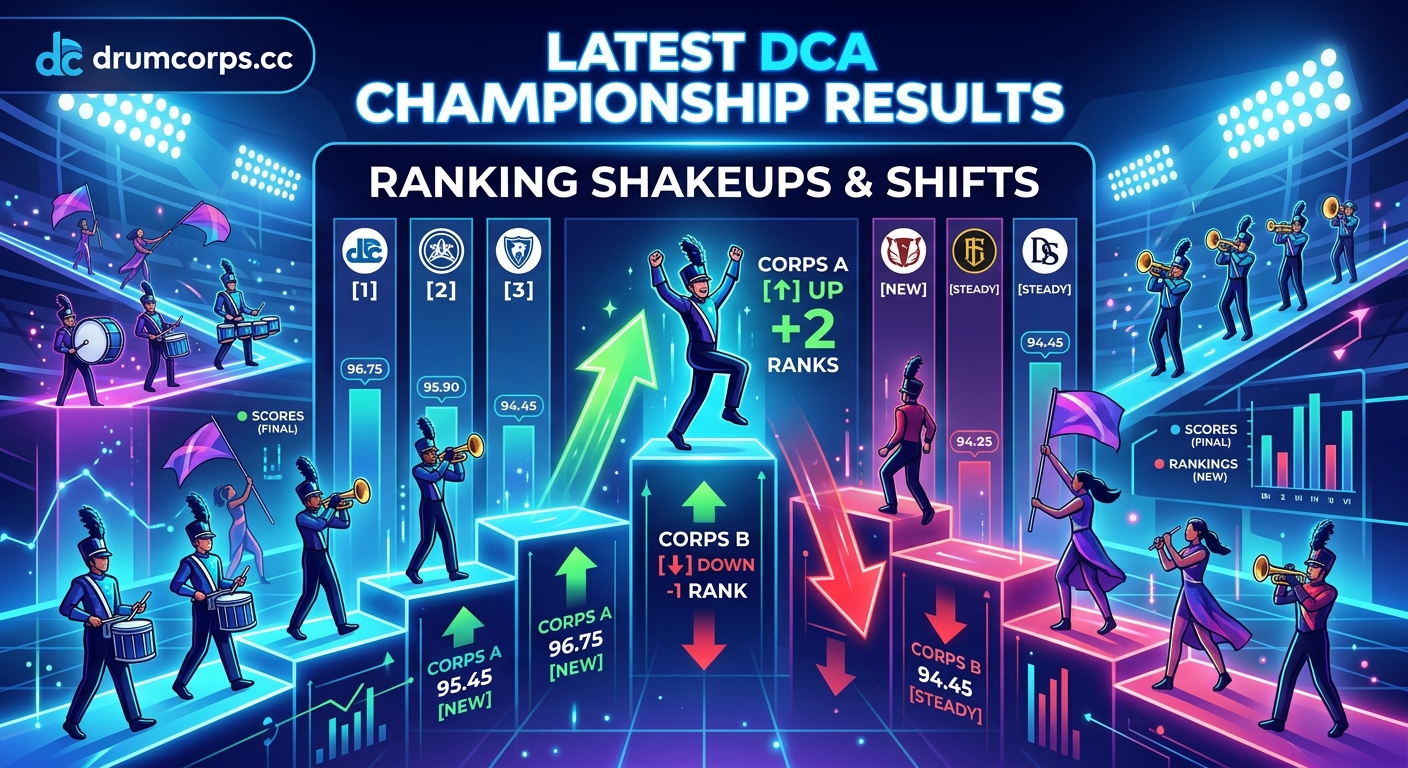
Understanding DCA all age corps rankings requires more than checking final placements. The scoring system rewards consistency, growth trajectory, and head-to-head performance throughout the season.
Here’s how the scoring breakdown affected rankings:
| Corps | Final Score | Prelims Score | Score Growth | Ranking Change |
|---|---|---|---|---|
| Reading Buccaneers | 98.150 | 97.825 | +0.325 | Held 1st |
| Minnesota Brass | 96.950 | 96.500 | +0.450 | Held 2nd |
| Hawthorne Caballeros | 95.700 | 93.300 | +2.400 | Up 2 spots |
| White Sabers | 95.400 | 95.100 | +0.300 | Down 1 spot |
| Bushwackers | 94.850 | 94.600 | +0.250 | Down 1 spot |
| Fusion Core | 93.900 | 92.800 | +1.100 | Up 3 spots |
Caption scores reveal where corps gained or lost ground. Hawthorne’s visual program jumped 3.2 points from prelims to finals, the largest single-caption improvement of the night. Their drill cleaning between performances showed a level of adaptability that judges reward.
Minnesota Brass dominated brass scores all season, maintaining a 0.8 point advantage over Reading in that caption even while losing overall. That specialization creates interesting strategic questions for next year.
“Rankings reflect more than one night’s performance. We look at seasonal trajectory, competitive depth, and how corps respond under championship pressure. A corps that improves 2.4 points in twelve hours demonstrates championship DNA.” – DCA adjudication coordinator
Three Ranking Tiers Emerged
The championship results crystallized three distinct competitive tiers that will shape next season’s expectations.
Championship Contenders (Top 3)
Reading Buccaneers, Minnesota Brass, and Hawthorne Caballeros now form an elite tier separated from the field by significant scoring gaps. All three broke 95.5, a threshold only two corps achieved the previous year.
These programs share common traits beyond scores. Multi-year staff stability. Year-round training programs. Budgets supporting national touring schedules. The gap between tier one and tier two reflects institutional advantages as much as performance quality.
Playoff Regulars (4th through 8th)
White Sabers, Bushwackers, Fusion Core, Skyliners, and Empire Statesmen occupy the competitive middle. Any of these corps could crack the top three on a given night, but consistency separates them from championship contention.
This tier saw the most movement. Fusion Core’s three-spot jump came at the expense of established programs. Skyliners dropped two positions despite improving their score. The margins are razor thin, with less than 1.5 points separating fourth from eighth.
Developing Programs (9th and below)
Corps ranked ninth and lower face different challenges. Most are rebuilding membership, establishing consistent training systems, or operating with limited resources. Several showed impressive growth trajectories that don’t yet reflect in competitive placement.
Govenaires improved 4.2 points from their season opener to championships, the largest seasonal growth of any corps. They finished 11th, but that improvement rate suggests future upward movement.
What Caused the Biggest Surprises
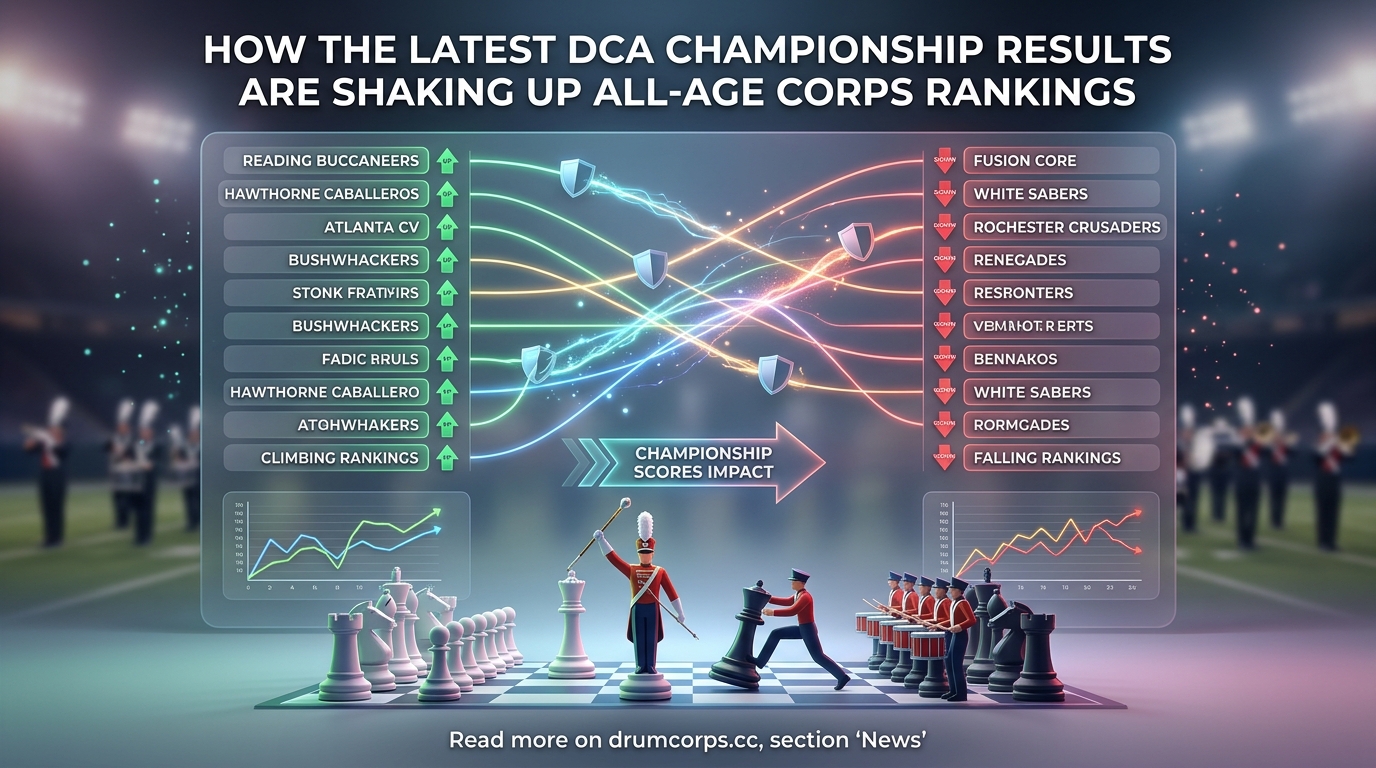
Several ranking shifts defied pre-championship predictions. Understanding why helps predict future movements.
Hawthorne’s Championship Night Surge
Their 2.4 point improvement between prelims and finals raised eyebrows. Digging into caption sheets reveals the cause.
Visual performance jumped from 31.2 to 34.4. That’s not normal championship cleaning. Hawthorne made actual drill changes between performances, simplifying two high-risk transitions that caused execution problems in prelims.
Most corps clean existing drill. Hawthorne redesigned problem sections entirely. Risky strategy, but it paid off with cleaner execution and higher achievement scores.
White Sabers’ Relative Decline
They didn’t perform poorly. Their 95.400 would have won championships in several recent years. But standing still while competitors surge forward drops you in rankings.
White Sabers ran essentially the same show design as the previous year, banking on superior execution. That worked when competitors were further behind. Now the field caught up in design sophistication, and execution alone doesn’t create separation.
Fusion Core Breaking Through
Their sixth-place finish came from nowhere by traditional metrics. They placed 12th two years ago and ninth last year. That’s not typical championship trajectory.
The difference? They hired a design team with World Class DCI experience. Their show concept, pacing, and musical demand jumped to match top-tier corps. Membership execution lagged slightly behind design ambition, but judges reward ambitious design that’s 90% clean over safe design that’s 100% clean.
Regional Competition Shaped National Rankings
DCA all age corps rankings don’t exist in a vacuum. Regional show results throughout the season established competitive relationships that championships confirmed or contradicted.
Corps that competed head-to-head multiple times showed remarkable consistency. Minnesota Brass beat White Sabers in all four regular season meetings by an average of 1.3 points. Championship results matched that pattern almost exactly.
Regional competition intensity varies dramatically. East Coast corps face tougher regular season schedules, often competing against three or four championship-tier corps at single shows. Midwest corps sometimes dominate regional events without facing comparable competition until championships.
That creates interesting ranking dynamics. A corps that wins every regional show might still finish fifth nationally because they never faced championship-level competition until finals night. Conversely, a corps with a losing regional record might place higher nationally because they’ve been battle-tested against stronger competition.
How to Track Rankings Between Championships
Following DCA all age corps rankings year-round requires understanding the competitive calendar and scoring patterns.
1. Monitor Regional Show Scores
Most regional competitions post scores within 24 hours. Compare corps that compete at the same shows to establish relative rankings. A corps that beats another by 2 points in June will likely maintain similar margins in August unless significant changes occur.
2. Watch for Mid-Season Design Changes
Corps that substantially revise shows mid-season signal either problems or ambition. Design additions usually indicate confidence and often precede ranking jumps. Design cuts suggest execution problems and often precede ranking drops.
3. Track Caption Trends
A corps improving brass scores while visual scores stagnate reveals where they’re investing resources. Caption-specific trends predict overall ranking movements before they appear in final placements. Programs like how to build rock-solid breath support for high brass endurance help individual members contribute to those caption improvements.
4. Follow Staff Changes
New caption heads often bring design philosophy shifts that take a season to implement fully. A corps hiring a new visual caption head in November likely won’t show results until the following August. Patient fans can predict ranking movements a year in advance by tracking staff announcements.
Common Ranking Misconceptions
Fans frequently misunderstand what rankings actually measure and predict.
Misconception: Higher Rank Always Means Better Show
Rankings measure competitive success within judging criteria, not artistic merit or entertainment value. A lower-ranked corps might present a more emotionally engaging program that resonates more with audiences. Judges evaluate technical achievement, design sophistication, and execution quality using specific rubrics that don’t always align with crowd favorites.
Misconception: Ranking Gaps Predict Future Results
A three-point gap in August doesn’t mean the same three-point gap in next year’s August. Corps lose members, hire new staff, and change design approaches. Minnesota Brass finished 2.8 points behind Reading one year and closed that gap to 1.2 points the next year. Gaps close and widen based on organizational decisions made months before shows begin.
Misconception: Prelims Rankings Don’t Matter
Some fans dismiss prelims as warmups for finals. But prelims scores affect seeding, performance order, and psychological momentum. A corps that places higher in prelims performs later in finals, giving them more time for last-minute cleaning. That advantage translates to better finals scores and higher final rankings.
What These Rankings Mean for Next Season
Current rankings create expectations and pressures that shape next season before it begins.
Reading Buccaneers face the challenge of maintaining excellence while competitors specifically design to beat them. Minnesota Brass likely studied every caption where they lost ground and will address those gaps. Hawthorne Caballeros must prove their championship night surge wasn’t a fluke.
Corps ranked fourth through eighth face different pressures. They’re close enough to championship contention that members and staff can taste it, creating motivation but also potential frustration if results don’t match effort.
Lower-ranked corps often experience the most freedom. Expectations are modest, allowing design risks and experimentation. Several current championship contenders spent years in the bottom half of rankings while building the systems that eventually propelled them upward.
Membership recruitment directly correlates with rankings. Top-ranked corps attract more auditionees, allowing them to be more selective and maintain higher performance standards. Lower-ranked corps struggle to fill holes, sometimes accepting members who need more development time. That creates a self-reinforcing cycle where rankings affect future competitive capacity.
Tracking Your Favorite Corps
Here’s a practical system for following your favorite corps’ ranking position throughout the year:
- Subscribe to score notification services that alert you when your corps competes
- Join corps-specific social media groups where members and alumni discuss performance details
- Watch recorded performances to understand judging commentary and identify improvement areas
- Compare caption scores across multiple shows to spot trends before they affect overall placement
- Follow staff social media for behind-the-scenes insights into design decisions and training focus
Many fans maintain personal spreadsheets tracking their favorite corps’ scores across multiple seasons. That historical perspective reveals patterns that single-season snapshots miss. A corps might finish seventh three years running but improve their raw score by 1.5 points each year. That upward trajectory predicts future ranking improvements even when current placement stays static.
Understanding competitive context helps too. Finishing seventh in a weak competitive year differs from finishing seventh when the top eight corps all break 94 points. Absolute score matters more than relative placement for predicting long-term ranking trends.
Design Philosophy Drives Ranking Changes
The biggest ranking movements often trace back to fundamental design philosophy shifts that take years to fully implement.
Hawthorne Caballeros’ recent surge began three years ago when they hired a design team emphasizing contemporary musical arrangements and asymmetrical drill forms. Their first year with that approach, they placed eighth. Second year, fifth. This year, third. The design philosophy stayed consistent while execution caught up to ambition.
White Sabers’ relative plateau reflects their commitment to traditional drum corps aesthetics. They’re not declining in absolute quality. But as other corps adopt more contemporary design approaches that judges reward, maintaining traditional approaches becomes competitively disadvantageous.
This creates tension in all age drum corps. Many members join specifically because they prefer traditional drum corps style. Shifting to contemporary design risks alienating the membership base that sustains the organization. But maintaining traditional approaches risks competitive irrelevance.
The most successful corps thread that needle by incorporating contemporary elements while preserving traditional foundations. Reading Buccaneers runs drill forms that would look at home in a 1985 show but with musical arrangements and visual effects that feel completely modern.
Why Small Ranking Changes Matter
Moving from seventh to sixth might seem insignificant, but those single-position shifts carry real consequences.
Performance order changes based on ranking. Higher-ranked corps perform later, giving them more warm-up time and letting them benefit from improved field conditions as evening temperatures moderate. That advantage translates to better scores and reinforces ranking positions.
Sponsorship and funding often tie to competitive success. A corps that moves from seventh to sixth demonstrates upward trajectory that attracts donors and sponsors. The opposite also holds true. Dropping from sixth to seventh might cost a corps sponsorship renewals that depend on maintaining top-six status.
Member retention correlates with competitive success. Members invest enormous time and money to participate. Seeing tangible ranking improvement validates that investment and encourages return the following year. Stagnant or declining rankings drive members to audition for higher-ranked corps, creating a talent drain that accelerates competitive decline.
Your Corps, Your Rankings Journey
Whether you’re tracking Reading’s quest for a fourth consecutive championship or cheering a developing corps fighting for their first top-ten finish, rankings tell stories beyond numbers.
They measure organizational health, design evolution, and competitive positioning. They predict future success and reveal present challenges. They create narratives that span seasons and decades.
The rankings shifted dramatically this championship season. They’ll shift again next year. Your favorite corps’ position in those rankings depends on decisions being made right now in staff meetings, design sessions, and practice rooms.
Stay connected to those stories. Track the scores. Watch the shows. Understand the context. The numbers matter, but the journey behind them matters more.