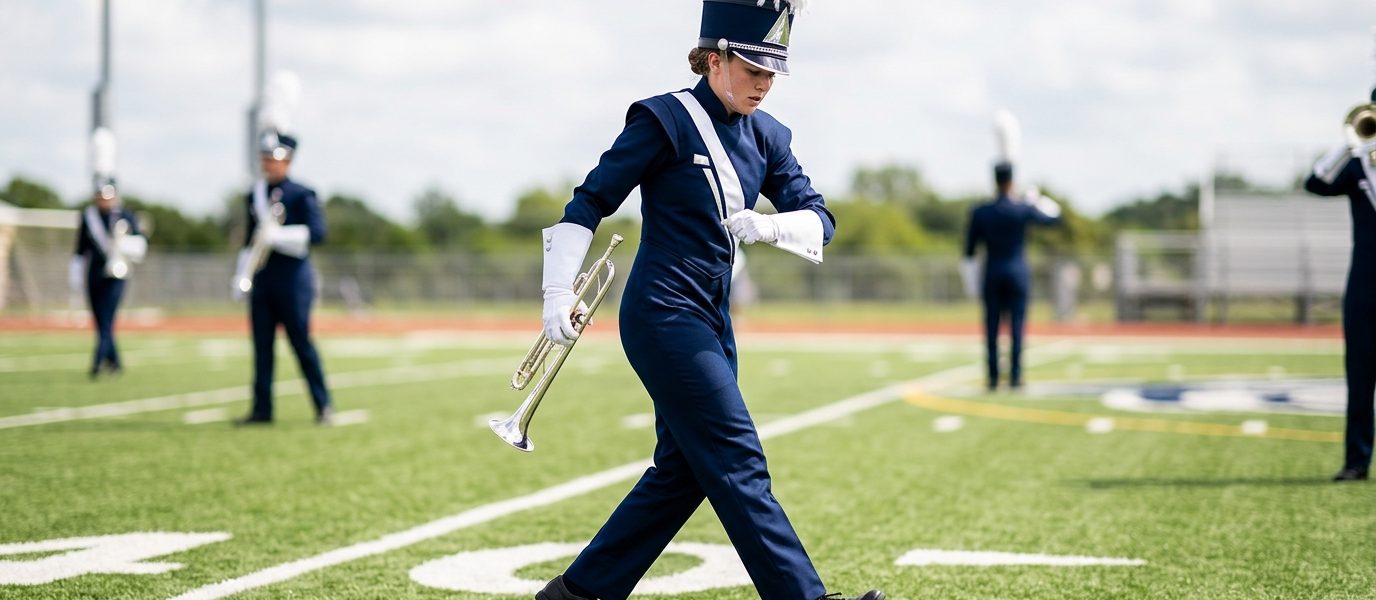
Backward diagonals look simple on paper. You’re moving at an angle, going in reverse, keeping your body aligned. But the moment you step onto the field, everything changes. Your shoulders twist. Your feet cross. Your spacing collapses. These aren’t random errors. They’re the three backward diagonals mistakes that trip up nearly every marcher, from rookies to veterans.
Backward diagonals fail when marchers twist their shoulders, cross their feet, or lose interval spacing. These mistakes create visual breaks and timing issues across the entire formation. Fixing them requires deliberate body positioning, controlled footwork, and constant awareness of your relationship to guide markers. Master these three corrections and your backward diagonals will transform from shaky to sharp.
Why Backward Diagonals Break Down So Easily
Moving backward already challenges your spatial awareness. You can’t see where you’re going. Your body naturally wants to turn and look. Add a diagonal angle to that equation and your brain starts making compromises.
Most marchers compensate by rotating their upper body. It feels safer. You get a better view of your destination. But that rotation destroys the clean lines judges are watching for.
The diagonal component adds another layer of complexity. You’re not just moving straight back. You’re traveling at a 45-degree angle, which means your feet need to work differently than they do in straight backward marching.
And here’s the thing: these mistakes compound. One twisted shoulder leads to crossed feet. Crossed feet throw off your spacing. Suddenly the entire diagonal looks messy, and it all started with one small compensation.
Mistake #1: Rotating Your Shoulders Instead of Staying Square
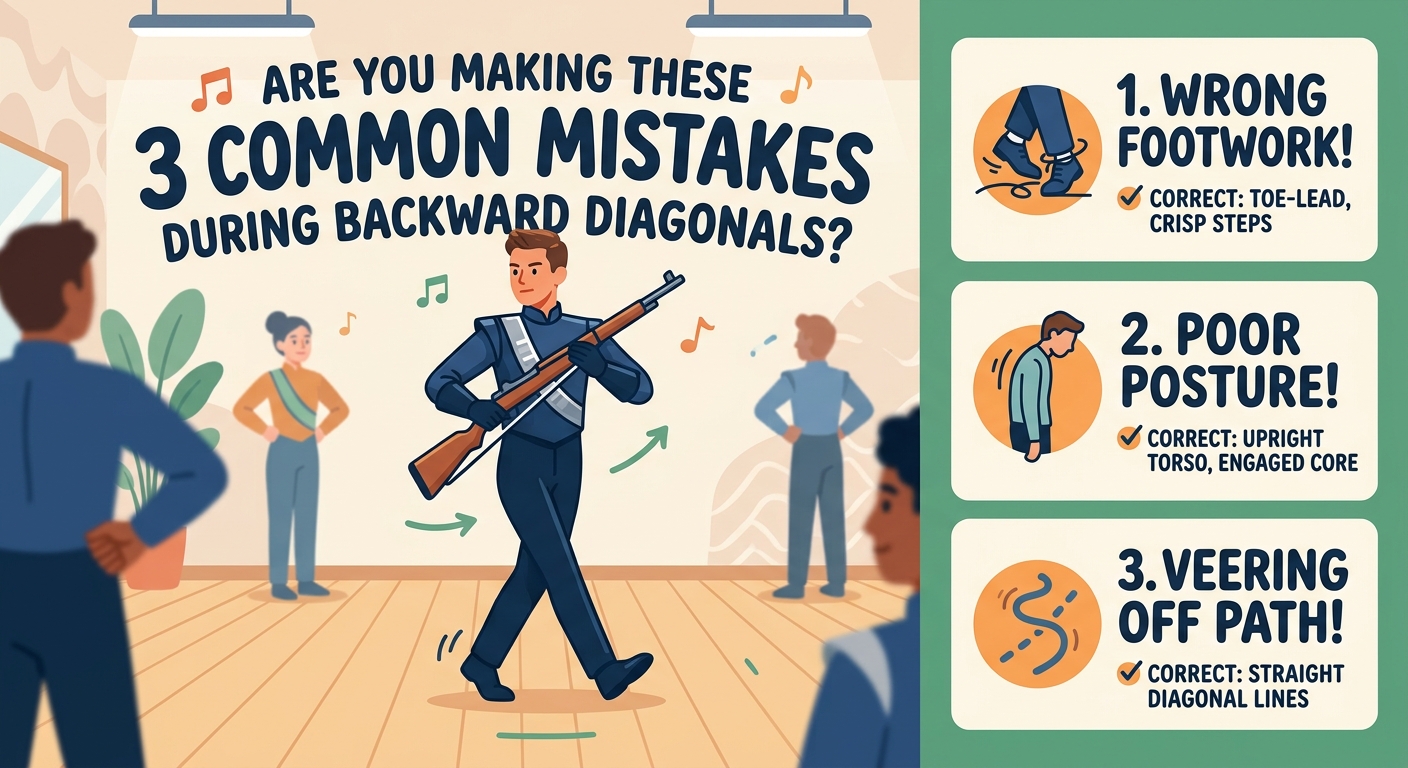
This is the big one. The mistake that creates a domino effect through your entire technique.
When you rotate your shoulders during backward diagonals, you’re trying to see where you’re going. It’s a natural instinct. But it wrecks your visual presentation and throws off your body mechanics.
Here’s what happens: your upper body twists, your hips follow, and suddenly you’re moving at a different angle than everyone else in your diagonal. The line gets wavy. Spacing becomes inconsistent. Judges see it immediately.
Your shoulders need to stay square to the front sideline. Period. Even when you’re moving backward and to the side, your chest faces forward. This maintains the uniform look across the entire formation.
How to Fix Shoulder Rotation
Start by practicing backward diagonals with your arms in playing position or carriage. This locks your shoulders in place and makes rotation much harder.
Pick a focal point on the front sideline. A press box window. A specific person. Anything that stays fixed. Keep your eyes on that point throughout the entire backward diagonal.
Have someone stand behind you during rehearsal. They should be able to see both of your shoulder blades equally. If one shoulder blade disappears from view, you’re rotating.
Film yourself from the front. Watch the playback. Your shoulders should stay parallel to the camera throughout the entire movement. Any twist will be obvious on video.
The fix takes conscious effort at first. Your brain will fight you. It wants that visual confirmation of where you’re going. But after a few rehearsals of forcing yourself to stay square, muscle memory takes over.
Mistake #2: Crossing Your Feet During the Diagonal Movement
Crossed feet are the second most common backward diagonals mistake. They happen when you try to change direction too aggressively or when you’re not clear about which foot leads the movement.
In a backward diagonal, one foot needs to consistently lead based on the direction you’re traveling. If you’re going back and to the left, your right foot crosses behind and to the side. If you’re going back and to the right, your left foot leads.
But many marchers switch their leading foot mid-movement. Or they bring their feet too close together, creating a crossing motion that looks sloppy and throws off their timing.
Crossed feet also create balance issues. You’re less stable. Your steps become uneven. And if you’re playing an instrument, that instability affects your sound quality too.
The Correct Foot Pattern for Backward Diagonals
Think of backward diagonals as a combination of two movements: stepping backward and stepping sideways. Your feet need to accomplish both simultaneously without interfering with each other.
For a backward diagonal to the left:
1. Step back with your right foot, placing it behind and slightly to the left of your starting position
2. Bring your left foot back to match, maintaining your step size
3. Repeat this pattern, with your right foot always leading
For a backward diagonal to the right, reverse this pattern. Your left foot leads, stepping back and to the right.
The key is maintaining consistent spacing between your feet. They should never get closer than your normal marching stance width. If they do, you’re crossing.
Practice this movement facing a mirror. Watch your feet. They should move in parallel paths, never converging or crossing. Each step should look identical in size and direction.
Here’s a table that breaks down the foot mechanics:
| Direction | Leading Foot | Trailing Foot | Common Error | Fix |
|---|---|---|---|---|
| Back-Left | Right foot steps back and left | Left foot follows parallel | Feet converge toward center | Keep stance width constant |
| Back-Right | Left foot steps back and right | Right foot follows parallel | Leading foot doesn’t angle enough | Emphasize the diagonal component |
| Both | Consistent leader throughout | Matches step size exactly | Switching lead foot mid-movement | Pick one foot and commit |
Mistake #3: Losing Interval and Destroying the Diagonal Line
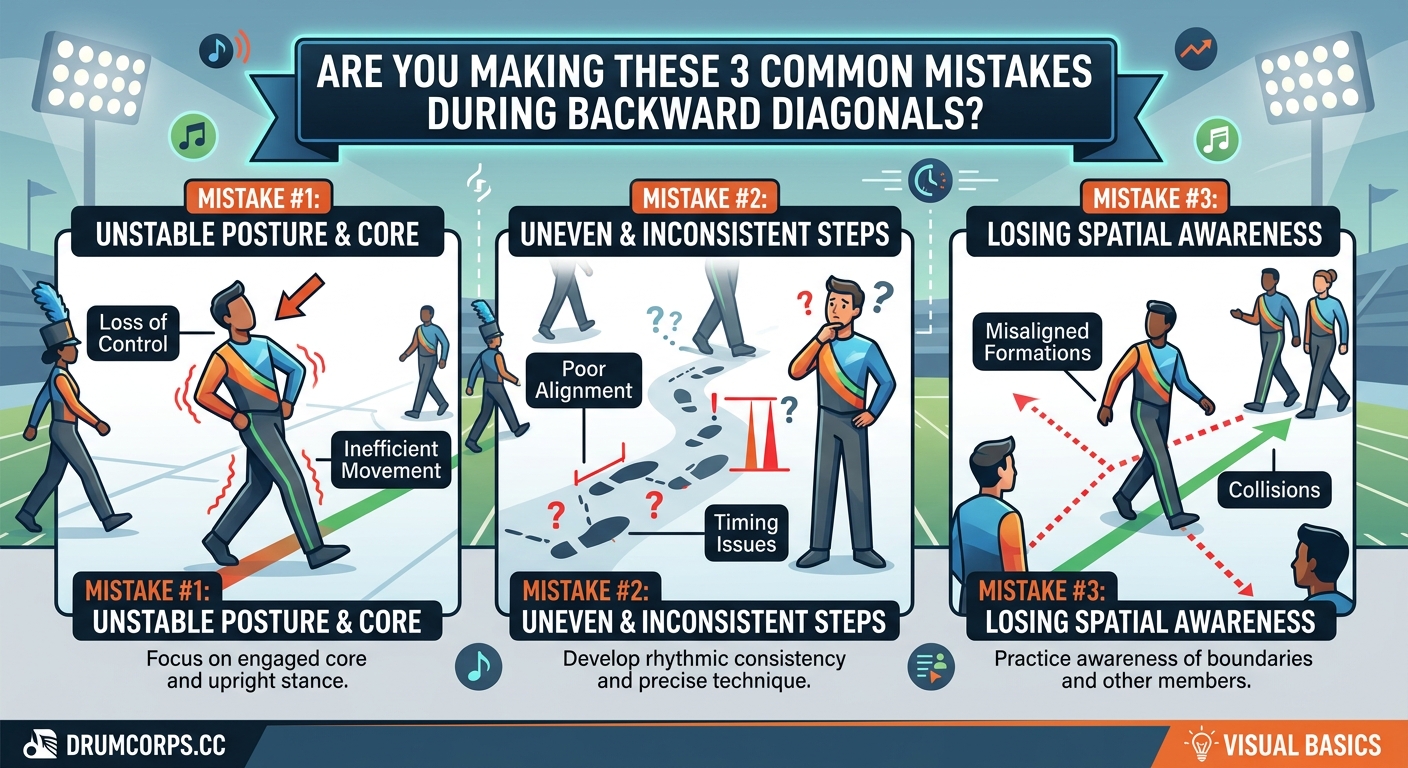
The third major backward diagonals mistake is spacing. You might have perfect shoulders and clean footwork, but if you’re not maintaining proper interval with your neighbors, the diagonal falls apart.
Interval refers to the spacing between you and the marchers on either side of you. In a diagonal, this spacing needs to stay consistent even as everyone moves backward and sideways simultaneously.
Most marchers focus so hard on their own technique that they forget to monitor their relationship to the people around them. They drift forward or backward relative to the line. They squeeze in too close or spread out too far.
This creates gaps or bunching in the diagonal. From the press box, it looks like a snake wiggling across the field instead of a clean, straight line moving at an angle.
Maintaining Spacing During Backward Movement
You need reference points. Not just where you’re going, but where you are relative to your neighbors right now.
Use peripheral vision constantly. You should be able to see the person to your left and the person to your right without turning your head. If you can’t, you’re either too far forward or too far back in the line.
The person in front of you in the diagonal is your primary guide. Match their speed. Mirror their step size. If they’re moving faster, you need to increase your tempo. If they’re slowing down, you adjust.
But here’s the tricky part: you also need to maintain your spot on the field. Backward diagonals often have specific start and end points. If you’re only following the person in front of you, you might end up in the wrong location even if your spacing looks good.
The best marchers develop what I call “dual awareness.” They’re simultaneously tracking their position relative to the formation and their absolute location on the field. It’s like playing chess while running. Your brain is processing multiple layers of spatial information at once.
This skill develops with practice. Start by mastering one layer at a time. First, nail your interval spacing. Then add in field awareness. Eventually, both become automatic.
How Body Positioning Affects Your Backward Diagonal Quality
Your core does more work during backward diagonals than you might realize. A strong, engaged core keeps your upper body stable while your legs do the complicated footwork.
Many marchers let their core go soft during backward movement. Their posture collapses. Their chest sinks. This makes everything harder and looks worse from the stands.
Keep your core tight. Imagine someone is about to punch you in the stomach and you’re bracing for impact. That level of engagement should be constant throughout the backward diagonal.
Your head position matters too. Keep your chin level, not tilted up or down. Tilting your head throws off your balance and changes how your body weight distributes across your feet.
Think about your center of gravity. In backward movement, there’s a tendency to lean forward at the waist. This feels safer because it shifts your weight over your feet. But it destroys your posture and makes you look tentative.
Instead, keep your weight centered. Your body should be vertical, not leaning in any direction. This takes confidence and practice, especially when you can’t see where you’re going.
The Practice Sequence That Fixes All Three Mistakes
Here’s a step-by-step process for cleaning up your backward diagonals. Do this sequence in every individual practice session until the corrections become automatic.
-
Start with stationary positioning. Stand in place, shoulders square, core engaged, proper posture. Hold this position for 30 seconds. This is your baseline.
-
Add backward movement only. No diagonal yet. March straight backward for eight counts, maintaining square shoulders and proper foot placement. Film yourself from the front. Check for any rotation or crossing.
-
Add the diagonal component. Now march backward and to the left for eight counts. Focus only on foot placement. Make sure your leading foot is consistent and your feet never cross.
-
Check your spacing. Have two other people form a diagonal with you. All three of you march backward diagonally together. The person in the middle should maintain equal distance from both outside marchers throughout the movement.
-
Add your instrument or equipment. Now repeat the entire sequence with whatever you carry during performance. Notice how the added weight affects your balance and make adjustments.
-
Increase the distance. Instead of eight counts, do 16 or 24. Longer diagonals reveal mistakes that shorter ones hide. Your technique needs to stay consistent from the first step to the last.
-
Practice both directions. Most people have a stronger side. Don’t just rehearse your comfortable direction. Spend extra time on the diagonal that feels awkward.
This sequence addresses all three major backward diagonals mistakes systematically. You can’t fix everything at once. Break it down, master each component, then put it all together.
The approach mirrors how building a perfect practice routine works for any marching skill. Isolation, repetition, and gradual complexity.
Visual Alignment Tools That Make Backward Diagonals Easier
Use the field itself as a guide. Most fields have yard lines, hash marks, and sideline markers. These create a grid you can reference during backward diagonals.
If your diagonal crosses a specific yard line at a specific count, use that as a checkpoint. Did you hit that intersection point when you were supposed to? If not, adjust your step size or tempo.
Hash marks are particularly useful for maintaining straightness in your diagonal. If your path should keep you between two hash marks, check periodically to make sure you haven’t drifted outside that channel.
Some corps use what they call “guide markers.” These are specific points on the field where certain positions should be at certain counts. If you’re supposed to be on the 45-yard line at count 32, and you’re only at the 47, you know you need to increase your backward speed.
Here are the most useful visual references for backward diagonals:
- Yard line numbers: Track your progress across the field
- Hash marks: Maintain your left-right positioning
- Sideline markers: Check your angle relative to the field edges
- Press box or other fixed structures: Keep your shoulders square
- Front ensemble or props: Use as spatial reference points
The more reference points you incorporate into your awareness, the more accurate your backward diagonals become.
Common Variations and How They Change the Technique
Not all backward diagonals are created equal. The technique adjustments you need depend on the specific variation your show uses.
Some shows have backward diagonals with changing intervals. You start close together and gradually spread apart, or vice versa. This requires constant adjustment of your step size while maintaining the diagonal angle.
Other shows combine backward diagonals with form changes. You might be moving from a block to a curve while going backward diagonally. Now you’re managing three things simultaneously: backward movement, diagonal angle, and form transformation.
Fast backward diagonals require shorter steps and higher tempo. Slow backward diagonals need longer steps and more controlled weight transfer. Both use the same fundamental technique, but the execution feels completely different.
Sometimes backward diagonals happen during high-demand musical moments. You’re playing a difficult passage while executing this challenging visual. The mental load is intense. This is where solid technique becomes crucial because you can’t think your way through every step.
How Backward Marching Fundamentals Apply to Diagonals
If your basic backward marching is shaky, your backward diagonals will be worse. The diagonal movement amplifies any existing technique problems.
Clean backward marching requires toe-first foot placement, controlled weight transfer, and maintaining your upper body carriage. All of these fundamentals carry over to diagonal movement.
The main difference is the angle. In straight backward marching, both feet move along parallel paths directly behind you. In diagonal backward marching, those paths angle to the side.
But the mechanics of each individual step stay the same. Your toe touches first. You roll through your foot. Your weight transfers smoothly. Your posture stays vertical.
If you’re struggling with backward diagonals, spend time working on fixing your backward marching fundamentals first. Get comfortable moving in reverse before you add the complexity of diagonal angles.
What Judges Actually See When You Make These Mistakes
Understanding the judge’s perspective helps you prioritize which mistakes to fix first.
Shoulder rotation is visible from 50 yards away. It breaks the uniform line of the formation. Judges see it immediately, and it affects your entire section’s score.
Crossed feet are harder to spot from the press box but become obvious in closer views or on video. They also create timing inconsistencies that judges can hear in the music.
Spacing errors affect the overall visual impact. A diagonal with inconsistent intervals looks amateur. It suggests the group hasn’t rehearsed enough or doesn’t have strong visual technique.
Judges also notice recovery. If you make a mistake but correct it within a count or two, that’s better than letting the error persist. They’re looking for consistency and awareness, not perfection on every single step.
The goal isn’t to be flawless. It’s to minimize obvious errors and maintain strong technique most of the time. Clean backward diagonals show judges that your corps has attention to detail and strong fundamentals.
Putting It All Together on the Field
Theory is one thing. Execution during a full run-through is something else entirely.
You’re tired. You’re playing or spinning. You’re thinking about the next set. And you need to execute a clean backward diagonal in the middle of all that chaos.
This is where preparation pays off. If you’ve drilled the corrections until they’re automatic, your body executes them even when your brain is occupied with other things.
Mental rehearsal helps too. Before the run-through, visualize yourself doing the backward diagonal correctly. See your shoulders staying square. Feel your feet moving in the right pattern. Imagine maintaining perfect spacing with your neighbors.
During the actual run, trust your preparation. Don’t overthink. Let muscle memory handle the technique while your conscious mind focuses on musicality and overall awareness.
After the run, review what worked and what didn’t. Did you maintain square shoulders? Were your feet clean? Was your spacing consistent? Identify one specific thing to improve for the next rep.
Why These Mistakes Matter Beyond Just Looking Good
Clean backward diagonals aren’t just about visual aesthetics. They affect the entire performance in ways you might not expect.
When your technique is solid, you’re more stable. That stability improves your sound quality if you’re playing a brass or woodwind instrument. It makes your stick heights more consistent if you’re in the battery. It gives you better control if you’re spinning in the color guard.
Good technique also reduces injury risk. Crossed feet and twisted posture put stress on your knees, ankles, and lower back. Clean mechanics distribute the physical load more evenly across your body.
There’s a confidence factor too. When you know your backward diagonals are clean, you perform with more authority. That confidence is visible to the audience and judges. It elevates the entire show.
And here’s something most people don’t think about: clean technique makes the activity more enjoyable. You’re not fighting your own body. You’re not constantly worried about messing up. You can focus on the artistry and the experience of performing.
Making Backward Diagonals Your Strength Instead of Your Weakness
Most marchers treat backward diagonals as something to survive. A challenging section of the show that they just need to get through without major errors.
But what if you flipped that mindset? What if backward diagonals became the moment where you showcased your technical skill?
The difference is preparation and attention to detail. When you deliberately practice the corrections we’ve covered, when you film yourself and honestly assess your technique, when you put in the reps to make it automatic, backward diagonals transform.
They go from being a weakness to being a strength. From being something you dread to being something you look forward to. From being a section where you hope not to mess up to being a moment where you know you’ll nail it.
That transformation doesn’t happen overnight. It takes consistent work. But every rehearsal where you focus on keeping your shoulders square, maintaining clean footwork, and preserving your spacing is a rehearsal that moves you closer to mastery.
The three backward diagonals mistakes we’ve covered are common because they’re natural compensations your body wants to make. Fighting those instincts requires conscious effort and deliberate practice. But once you’ve retrained your muscle memory, clean backward diagonals become second nature. Your formations stay sharp, your spacing stays consistent, and your overall performance quality takes a noticeable jump forward.