The Blue Devils didn’t just win championships in the 1970s. They rewrote the rules of what a drum corps could be, sound like, and achieve on the field.
Before the Blue Devils emerged as a powerhouse, drum corps followed predictable patterns. Military precision ruled everything. Shows looked similar from one corps to another. Then a group from Concord, California started experimenting with jazz arrangements, asymmetrical drill formations, and a level of musical sophistication that caught everyone off guard.
The Blue Devils transformed drum corps during the 1970s by introducing jazz-influenced arrangements, innovative visual design, and unprecedented musical complexity. Their approach shifted the activity from rigid military tradition toward artistic expression, establishing standards that define modern competitive drum corps. Their influence extended beyond trophies to reshape how every corps designs shows, trains members, and approaches performance.
The Early Years and Formation
The Blue Devils began in 1957 as a small community youth organization in Concord, California. For over a decade, they competed regionally without making significant waves nationally.
Everything changed when David Loeb took over as director in the early 1970s. Loeb brought a background in music education and a vision that challenged conventional wisdom. He believed drum corps could be more than marching bands without woodwinds.
The corps struggled initially. Finishing in the middle of the pack became routine. But Loeb kept pushing boundaries, hiring arrangers who understood jazz and contemporary music theory.
By 1973, the Blue Devils started placing higher at regional competitions. Their sound stood out. Instead of traditional march-heavy repertoires, they performed arrangements with sophisticated harmonies and rhythmic complexity.
Musical Innovation That Set New Standards
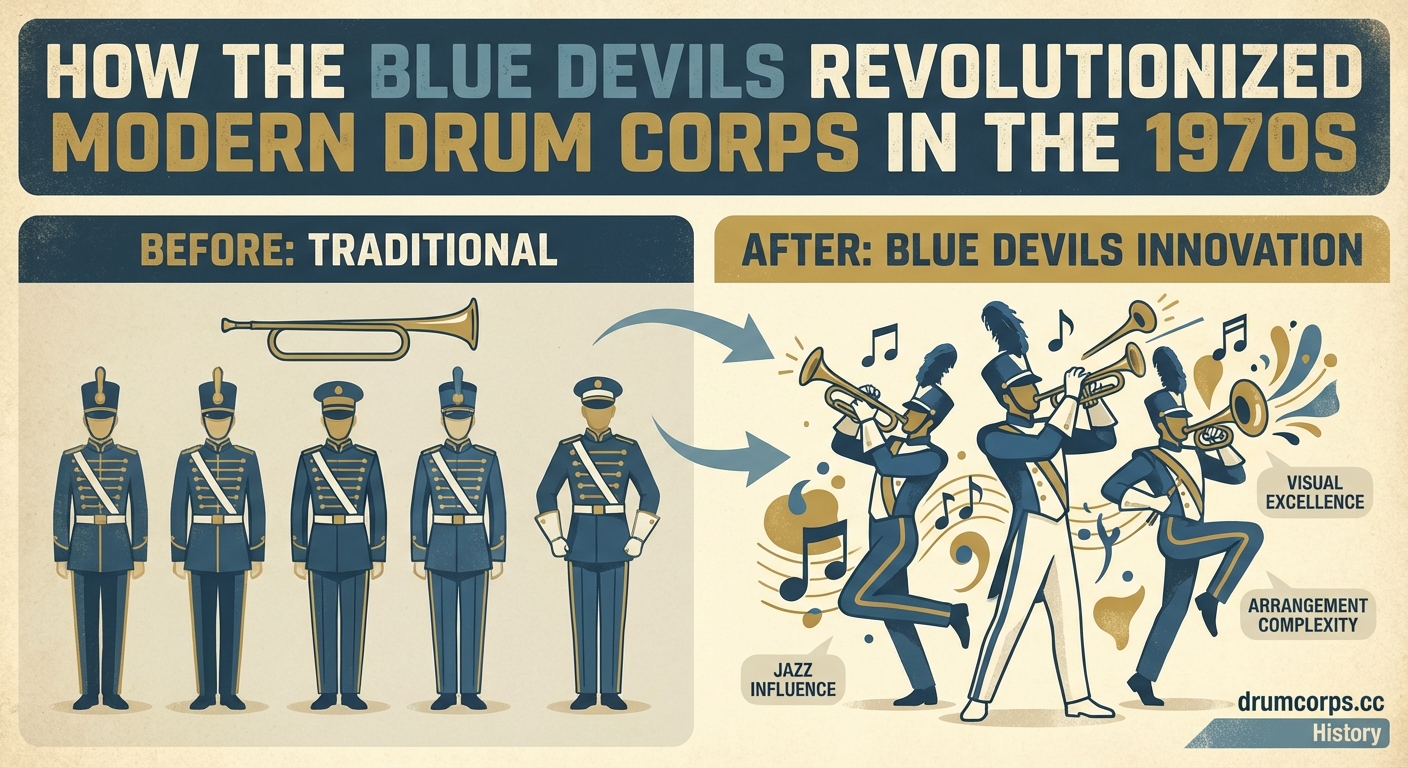
The Blue Devils’ most significant contribution was their approach to brass arranging. Traditional corps relied heavily on block scoring, where sections played in unison or simple harmonies.
The Blue Devils introduced:
- Contrapuntal writing where multiple melodic lines interweaved
- Jazz chord voicings that added color and tension
- Rhythmic independence between sections
- Contemporary music selections beyond military marches
Their 1976 show featured arrangements that sounded more like a professional jazz ensemble than a traditional drum and bugle corps. Judges initially didn’t know how to score it. Audiences loved it.
The brass line developed a signature sound. Clean, warm, and blended. Other corps had loud sections. The Blue Devils had a unified voice where every player served the musical phrase.
“The Blue Devils proved you could be musically sophisticated and still be incredibly exciting to watch. They didn’t sacrifice one for the other.” – Hall of Fame instructor reflecting on the 1970s era
Their percussion section also broke new ground. Instead of relying solely on traditional rudiments, they incorporated concert percussion techniques. Timpani parts became melodic elements. Cymbal lines added textural layers beyond simple crashes.
Visual Design Philosophy
While music grabbed headlines, the Blue Devils’ visual program was equally revolutionary. Traditional drill design followed symmetrical patterns. Corps formed company fronts, moved in straight lines, and created geometric shapes.
The Blue Devils experimented with asymmetry. They created pictures that looked unbalanced but felt dynamic. Members moved in curved paths. Formations flowed rather than snapped into place.
Their 1977 show featured a drill sequence where the corps spiraled into a tight cluster, then exploded outward in different directions. It looked chaotic at first glance but revealed intricate patterns when you understood the design.
This approach required different rehearsal techniques:
- Members learned to trust spatial relationships rather than relying on straight lines
- Visual instructors taught flow and momentum instead of just hitting dots
- The corps developed a unified movement vocabulary that emphasized musicality
The color guard also evolved under this philosophy. Instead of military-style rifle and flag work, the Blue Devils incorporated dance elements and expressive movement. Guards became integral to the visual storytelling rather than decorative additions.
Training Methods and Member Development
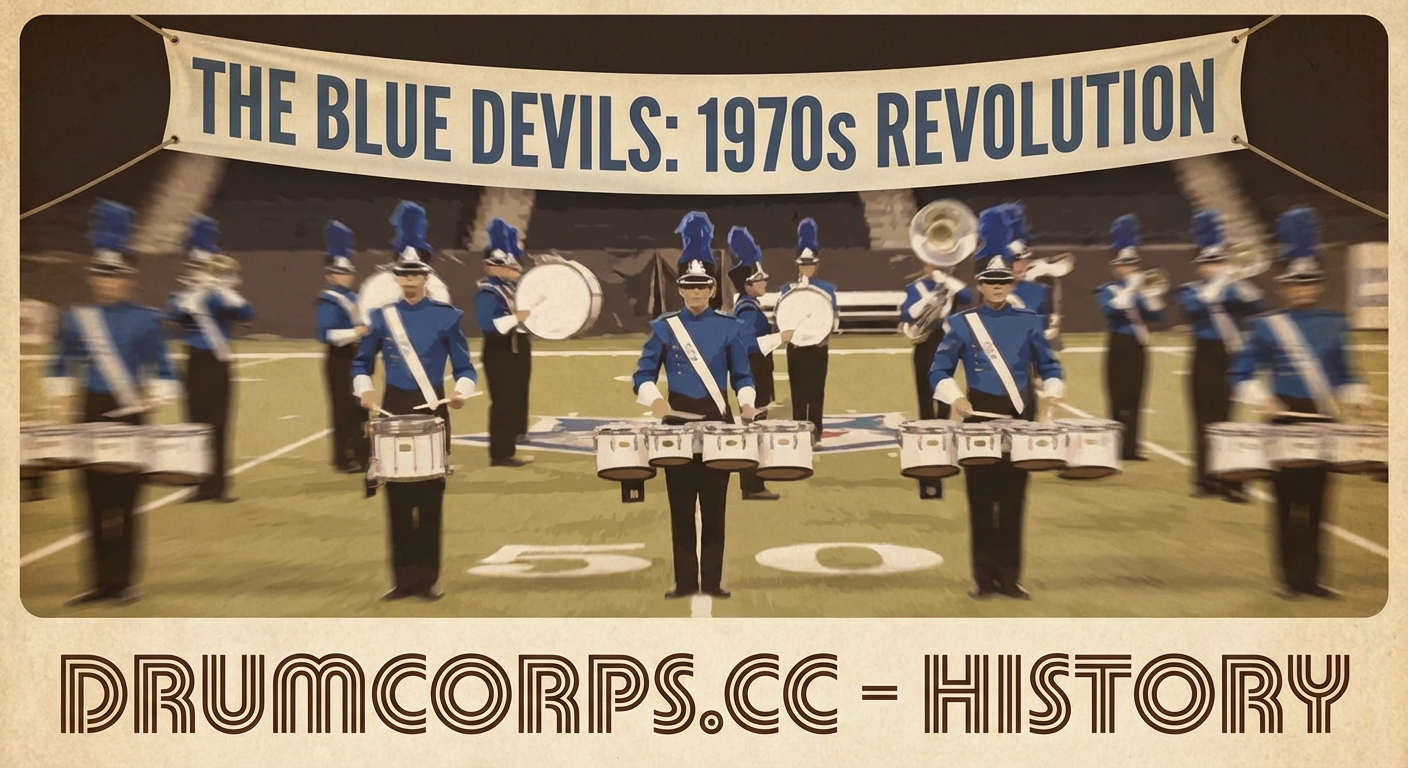
The Blue Devils built a reputation for technical excellence through systematic training. They developed methods that other corps eventually adopted.
Their brass pedagogy focused on sound production fundamentals. Every member spent significant time on mouthpiece buzzing, long tones, and blend exercises. Individual chops mattered less than collective sound quality.
The percussion section used a building-block approach:
- Master basic strokes and stick heights
- Apply techniques to rudiments and exercises
- Integrate patterns into musical contexts
- Perform with musical expression and dynamics
This created drummers who could execute complex parts while maintaining musical sensitivity. Their drum breaks became legendary, not just for speed but for clarity and musicality.
Visual training emphasized body awareness. Members learned to move efficiently, maintaining posture while executing demanding drill. The corps brought in movement specialists who taught breathing techniques and body mechanics.
| Training Element | Traditional Approach | Blue Devils Innovation |
|---|---|---|
| Brass technique | Volume and power focus | Blend and tone quality priority |
| Drill design | Geometric symmetry | Asymmetrical flow patterns |
| Music selection | Military marches | Jazz and contemporary pieces |
| Rehearsal time | Heavy repetition | Targeted fundamentals work |
| Member development | Section-based training | Holistic performer education |
Championship Success and Growing Influence
The Blue Devils won their first Drum Corps International championship in 1976. That victory validated their approach and sent shockwaves through the activity.
They didn’t just win. They dominated with scores that separated them from the field. Judges recognized the sophistication of their programs even as they adjusted to new evaluation criteria.
The 1976 show featured Gershwin arrangements that showcased their jazz sensibility. The brass line navigated complex chord changes with ease. The visual program complemented the music rather than competing with it.
Their 1977 championship cemented their status. Other corps started copying elements of their approach. Arrangers began writing more sophisticated brass parts. Visual designers experimented with asymmetry.
By 1978, the Blue Devils had established themselves as the standard. Corps that wanted to compete at the highest level needed to match their musical and visual sophistication.
Impact on Judging and Competition Standards
The Blue Devils forced drum corps judging to evolve. Traditional sheets emphasized execution and effect separately. The Blue Devils’ shows blurred those lines.
How do you judge a show where the visual design enhances musical expression? What happens when brass parts are so sophisticated that traditional execution criteria don’t fully capture their difficulty?
Drum Corps International revised judging criteria multiple times during the late 1970s. Many changes directly responded to innovations the Blue Devils introduced.
The general effect caption became more important. Judges needed to evaluate overall program impact, not just technical execution. This shift opened doors for creative risk-taking across the activity.
Other corps adapted their programs to remain competitive:
- The Cavaliers developed their own distinctive sound and visual style
- Santa Clara Vanguard pushed boundaries with avant-garde music selections
- The Cadets emphasized precision and power in response
The entire activity elevated. What seemed revolutionary in 1976 became baseline expectations by 1980.
Common Misconceptions About Their Approach
Many people misunderstand what made the Blue Devils special during this era. Let’s clear up some confusion.
Misconception 1: They sacrificed power for finesse
False. The Blue Devils played loud when appropriate. They simply had better dynamic control. Their pianissimo passages were genuine, and their fortissimo moments had impact.
Misconception 2: Their success came from superior talent recruitment
Partially true, but incomplete. Yes, they attracted talented members. But their training methods developed that talent more effectively than raw ability alone could achieve.
Misconception 3: Other corps didn’t innovate
Wrong. Many corps experimented during the 1970s. The Blue Devils succeeded by integrating innovations into cohesive programs rather than using gimmicks.
The Legacy Beyond the 1970s
The Blue Devils’ 1970s innovations created a foundation that persists today. Modern drum corps shows trace their DNA back to concepts this corps introduced.
Contemporary brass arranging uses the harmonic sophistication the Blue Devils normalized. Visual design embraces asymmetry and flow as standard tools. Training methods across the activity incorporate their systematic approach to member development.
They also established a culture of excellence that extended beyond competition. The Blue Devils became synonymous with professionalism, organization, and continuous improvement.
Their influence spread internationally. Corps in Europe and Asia studied Blue Devils shows when developing their own programs. The activity’s global growth owes much to the standards they set.
Why This History Still Matters
Understanding Blue Devils drum corps history isn’t just about nostalgia. It reveals how innovation happens in competitive performing arts.
The Blue Devils succeeded because they questioned assumptions. Why should drum corps sound like military bands? Why must drill be symmetrical? What if we prioritized musical expression over pure volume?
These questions led to experiments. Some failed. Others worked brilliantly. The willingness to risk failure in pursuit of excellence defined their approach.
Current and former members carry these lessons forward. Blue Devils alumni populate instruction staffs across the activity. They spread the philosophy that technical excellence serves artistic expression.
For drum corps enthusiasts today, studying this era provides context for modern shows. The complexity you see on the field in current seasons builds on foundations laid in the 1970s.
Lessons for Today’s Performers
Modern drum corps members can learn from how the Blue Devils approached innovation during the 1970s.
First, fundamentals matter more than flashy tricks. The Blue Devils never sacrificed sound quality or movement technique for visual excitement. Their shows impressed because the basics were rock solid.
Second, cohesion beats individual brilliance. They built programs where every element supported a unified vision. A talented soloist who doesn’t blend hurts the ensemble.
Third, innovation requires patience. The Blue Devils didn’t win immediately. They refined their approach through seasons of experimentation and adjustment.
Fourth, respect tradition while pushing boundaries. They didn’t reject drum corps heritage. They built on it, adding new dimensions while honoring what came before.
These principles apply whether you’re marching your first season or instructing a world-class corps.
The Continuing Evolution
The Blue Devils didn’t stop innovating after the 1970s. They continued pushing boundaries in subsequent decades, winning numerous additional championships.
But the 1970s remain special in their history. That decade established their identity and transformed the activity. Everything that followed built on that foundation.
Other corps developed their own innovations. The activity never stopped evolving. But the Blue Devils’ 1970s contributions created a turning point that separated the modern era from what came before.
Their shows from this period still hold up. Watch recordings from 1976 or 1977, and you’ll see ideas that feel contemporary. The musical sophistication and visual creativity transcend their era.
How One Corps Changed Everything
The Blue Devils proved that drum corps could be artistically ambitious while remaining accessible and exciting. They showed that musical sophistication and crowd appeal weren’t mutually exclusive.
Their success inspired countless young musicians to join drum corps. The activity grew during the late 1970s partly because the Blue Devils demonstrated its potential.
More importantly, they raised expectations for everyone. Corps that wanted to compete at the highest level needed complete programs with musical depth, visual creativity, and technical excellence.
That legacy continues every summer when corps take the field. The standards they set still define what excellence looks like in this activity.
For anyone passionate about drum corps, understanding this history enriches your appreciation of every show you watch. You’re seeing the evolution of ideas that the Blue Devils helped plant decades ago, growing in new and unexpected directions with each passing season.