
Your hands feel tight. Your rolls sound uneven. You practice for hours, but your speed never seems to improve.
The problem isn’t your work ethic. It’s probably your grip.
Most intermediate and advanced snare drummers struggle with speed because they’ve locked in subtle grip problems that compound over time. These aren’t obvious flaws. They’re small inefficiencies that create tension, limit rebound, and cap your maximum tempo before you even realize what’s happening.
Seven common snare drum grip mistakes prevent drummers from reaching their speed potential. These include death gripping the sticks, incorrect fulcrum placement, misaligned finger positioning, wrist angle problems, inconsistent stick heights, thumb pressure issues, and neglecting rebound mechanics. Each mistake creates tension that limits velocity and endurance. Fixing these technical problems requires specific diagnostic tests and deliberate correction exercises that rebuild proper muscle memory.
The death grip problem
Squeezing your sticks too hard is the single most common speed killer.
When you clench your fingers around the stick, you create muscular tension that travels up your forearm. That tension slows down every stroke. It also fatigues your muscles faster, which means your speed deteriorates as you play.
The stick needs room to move. Your grip should be firm enough to control the stick but loose enough to let it vibrate naturally after each stroke.
Here’s a simple test. Play a single stroke roll at a moderate tempo. Now consciously loosen your grip by about 30%. If your tone improves and your hands feel lighter, you were gripping too hard.
Many drummers develop this habit during early training when they’re afraid of dropping the stick. That fear never goes away, so the tension becomes permanent.
The fix requires conscious attention during every practice session. Before you play any exercise, take three seconds to check your grip pressure. Your fingers should feel engaged but not strained.
Fulcrum placement errors
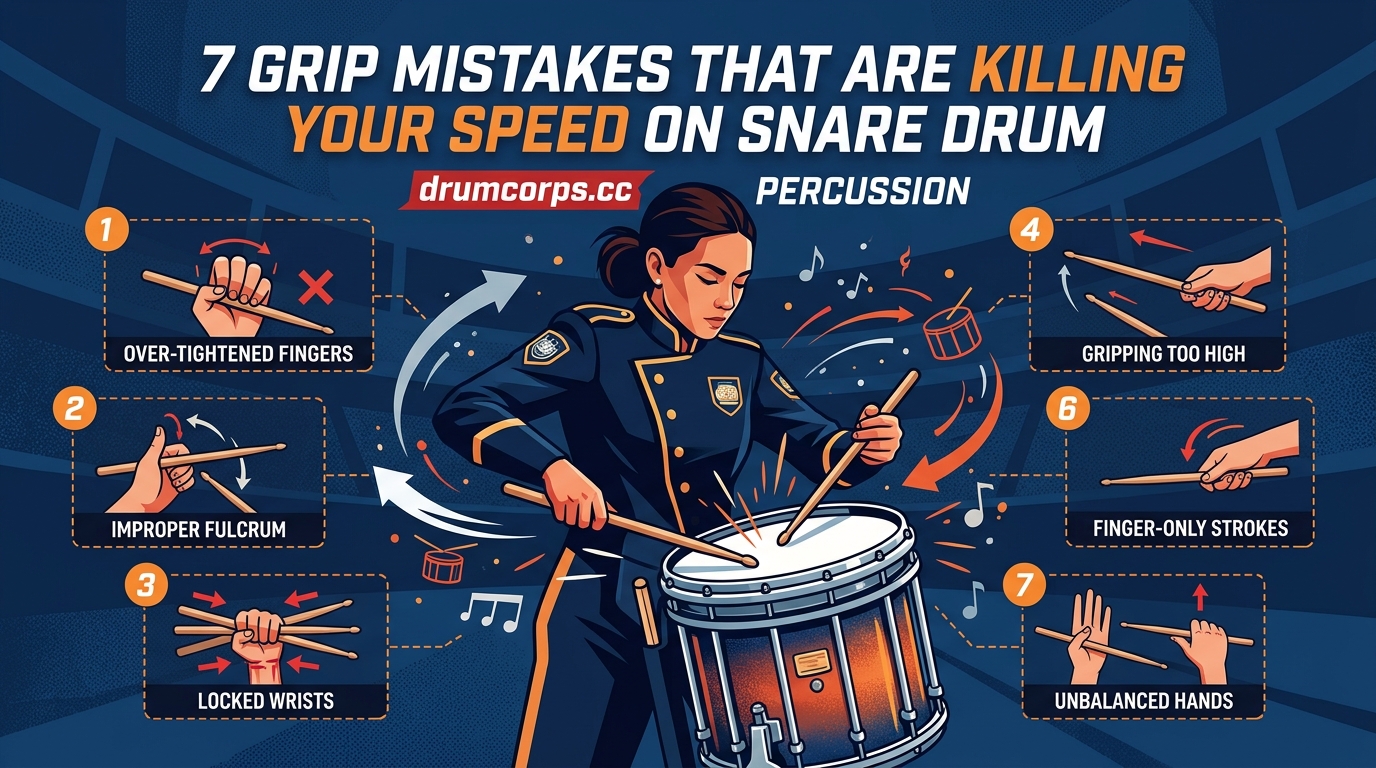
Your fulcrum is the pivot point where the stick balances between your thumb and index finger.
Place it too far forward, and you lose leverage. Place it too far back, and you sacrifice control. Either position will limit your maximum speed.
The optimal fulcrum sits about one-third of the way up the stick from the butt end. This varies slightly based on stick weight and your hand size, but it’s a reliable starting point.
Many drummers slide their fulcrum forward when playing soft passages, then forget to adjust it back for louder sections. This inconsistency creates different rebound characteristics that your brain has to constantly recalibrate.
| Fulcrum Position | Rebound Quality | Control Level | Speed Potential |
|---|---|---|---|
| Too far forward | Weak, inconsistent | High | Low |
| Optimal (1/3 up) | Strong, predictable | Moderate | High |
| Too far back | Excessive, uncontrolled | Low | Moderate |
Mark your optimal fulcrum position with a small piece of tape during practice. This visual reference helps you maintain consistency across different dynamic levels and playing contexts.
Finger positioning mistakes
Your back three fingers do more work than you think.
Many drummers let these fingers go completely limp or lock them into a rigid position. Both approaches kill speed.
Your middle, ring, and pinky fingers should rest gently against the stick, ready to engage when needed. They act as shock absorbers during the rebound phase and provide subtle control adjustments during fast passages.
The middle finger does the heaviest lifting. It should maintain light contact with the stick throughout the stroke cycle. When playing at high speeds, this finger helps guide the stick back into position for the next stroke.
Your ring and pinky fingers play a supporting role. They shouldn’t squeeze, but they shouldn’t float away from the stick either. Think of them as stabilizers that prevent the stick from wobbling laterally.
Here’s a diagnostic exercise. Play a slow single stroke roll while focusing only on your back three fingers. Can you feel them making contact with the stick? If not, you’re relying too heavily on your thumb and index finger, which limits your speed ceiling.
Wrist angle problems
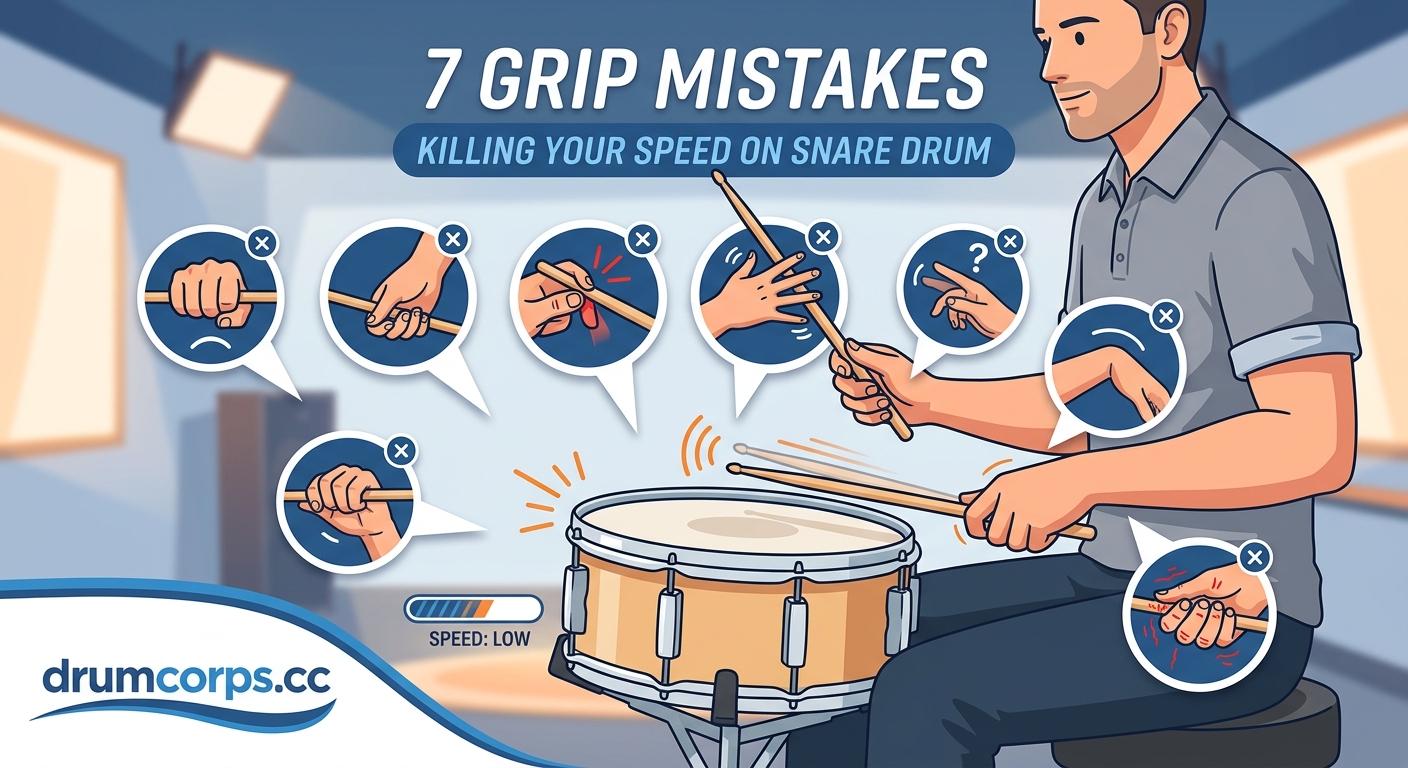
Your wrist should stay relatively neutral, not cocked up or dropped down.
When your wrist bends too far in either direction, you lose mechanical efficiency. The tendons that control your fingers have to work at awkward angles, which slows down your stroke rate and increases injury risk.
The ideal wrist position keeps your forearm and hand roughly aligned. There should be a slight natural curve, but nothing extreme.
Many marching percussionists develop wrist angle problems because of the way the drum sits on their carrier. If your snare tilts too far forward or back, you’ll compensate by adjusting your wrist angle. That compensation becomes habitual even when you’re playing on a practice pad.
Check your wrist position in a mirror. Your hand should look like a natural extension of your forearm, not like it’s bent at a sharp angle.
If you notice consistent wrist deviation, adjust your drum angle first. Then retrain your stroke mechanics with the corrected setup. This process takes time because you’re overwriting years of muscle memory, but it’s worth the effort.
“The fastest drummers in the world all share one trait: minimal tension in their grip. They let the stick do the work instead of forcing every stroke. That efficiency comes from years of deliberate attention to grip mechanics, not from raw talent.” – Anonymous DCI percussion instructor
Inconsistent stick heights
Your stick height directly affects your speed potential.
Playing with stick heights that are too high forces you to travel more distance per stroke. That extra distance takes time, which limits your maximum tempo.
But playing too low creates its own problems. You sacrifice volume and tone quality, and you often compensate by gripping harder to maintain control.
The solution isn’t picking one height and sticking with it. Different musical contexts require different heights. The problem is inconsistency within a given dynamic level.
If you’re playing at a mezzo-forte dynamic, your stick height should remain relatively constant from stroke to stroke. Variation creates timing inconsistencies that sound sloppy and feel awkward.
Practice with a mirror positioned to show your stick heights from the side. Play a sustained roll at a moderate dynamic and watch for fluctuations. Your sticks should trace nearly identical paths through the air.
When you spot inconsistencies, slow down the tempo until you can maintain uniform heights. Then gradually increase the speed while preserving that consistency. This approach builds the motor control you need for clean, fast playing.
Thumb pressure issues
Your thumb does less work than you think it should.
Many drummers press down hard with their thumb, thinking it provides control. That pressure actually restricts the stick’s natural motion and creates tension in your hand.
The thumb’s job is to create the fulcrum, not to clamp down on the stick. It should apply just enough pressure to keep the stick from slipping, nothing more.
Here’s a test. Play a roll while gradually reducing thumb pressure until the stick almost falls out of your hand. Then add back just enough pressure to maintain control. That’s your target pressure level.
You’ll probably be surprised by how light it feels. Most drummers use two or three times more thumb pressure than necessary.
Excessive thumb pressure is particularly problematic during fast passages. It prevents the stick from pivoting freely at the fulcrum point, which means you’re fighting against the stick’s natural motion instead of working with it.
Building a perfect 30-minute individual practice routine should include specific time dedicated to grip pressure awareness. Spend five minutes at the start of each session checking your thumb pressure and making adjustments.
Neglecting rebound mechanics
The stick wants to bounce. Your job is to let it.
Many drummers actively fight against the natural rebound by stopping the stick’s upward motion or by forcing it back down before it’s ready. Both habits destroy speed potential.
After each stroke, the stick rebounds off the drumhead. That rebound provides free energy that you can channel into the next stroke. When you interrupt this natural motion, you have to generate all the energy for the next stroke from scratch.
Learning to work with rebound rather than against it requires a shift in thinking. You’re not playing individual strokes. You’re managing a continuous cycle of motion where each stroke feeds into the next.
Start by playing very slow single strokes with maximum rebound. Let the stick bounce as high as it wants after each stroke. Don’t control it. Just observe how it moves.
Then gradually increase the tempo while maintaining that same rebound feel. You’ll notice that at faster tempos, the stick doesn’t bounce as high because there isn’t time. But the feeling of allowing the rebound should remain constant.
This is where many drummers go wrong. They think faster playing requires more force. It doesn’t. It requires better timing and more efficient use of the natural rebound cycle.
The 7 drumline exercises that build speed and accuracy fast all incorporate rebound awareness as a core component. These exercises teach your hands to work with the stick’s natural motion instead of fighting against it.
Diagnostic checklist for grip problems
Use this checklist during practice to identify which mistakes you’re making.
- Record yourself playing a sustained roll at 180 BPM for 30 seconds.
- Watch the video and evaluate each element of your grip separately.
- Note any tension in your forearms, shoulders, or neck.
- Check for visible inconsistencies in stick height or angle.
- Listen for tone quality problems that might indicate grip issues.
Most drummers have multiple grip problems, not just one. That’s normal. The goal isn’t perfection. It’s progressive improvement.
Focus on fixing one problem at a time. Spend two weeks working exclusively on thumb pressure, then move to finger positioning, then tackle wrist angles. This sequential approach prevents overwhelm and produces lasting results.
The biggest mistake is trying to fix everything at once. Your brain can’t manage that many simultaneous changes. You’ll end up frustrated and probably revert to your old habits.
Common grip variations and their speed implications
Different grip styles affect speed potential in different ways.
Traditional grip places the left hand in an underhand position. This grip was developed for tilted drums and offers excellent control for certain techniques. But it typically limits left-hand speed compared to matched grip.
Matched grip positions both hands identically, with palms facing down. This symmetry makes it easier to develop equal facility in both hands. Most modern marching percussion programs use matched grip exclusively.
Within matched grip, there are two main variants: German and French. German grip orients the palms more downward and emphasizes forearm rotation. French grip turns the palms more inward and emphasizes finger control.
For maximum speed, French grip typically offers an advantage because it allows more finger involvement. The fingers move faster than the wrists, so techniques that maximize finger contribution tend to produce higher top speeds.
However, German grip often feels more natural for players transitioning from traditional grip or those with larger hands. The choice depends on your physical characteristics and musical goals.
- German grip: Better for power, more forearm involvement
- French grip: Better for speed, more finger involvement
- American grip: Blend of both, versatile for varied musical demands
Many advanced players use a hybrid approach, adjusting their grip angle based on the specific passage they’re playing. This adaptability requires strong technical foundations and careful attention to grip mechanics.
Building new grip habits
Changing your grip feels wrong at first. That’s expected.
Your current grip, even if it’s technically flawed, is deeply ingrained. Your hands have executed thousands of strokes using that pattern. Changing it means rebuilding those neural pathways from scratch.
The process takes consistent work over several months. You can’t rush it.
Start by spending the first ten minutes of every practice session working on grip fundamentals. Play simple exercises at slow tempos while focusing exclusively on proper mechanics. Don’t worry about musicality or expression during this time. You’re programming new movement patterns.
As the new grip starts to feel more natural, gradually increase the tempo and complexity of your exercises. But return to slow, deliberate practice regularly. This reinforcement prevents regression to old habits.
Many drummers make the mistake of only practicing their new grip during dedicated technique time. Then they revert to old habits when playing actual music. This split approach doesn’t work. You need to use your corrected grip during all playing, even if it means simplifying parts temporarily.
If you’re working on eliminating rim clicks and achieving clean snare articulation, proper grip mechanics are foundational. You can’t fix articulation problems without first addressing the grip issues that cause them.
Speed development exercises
Once you’ve corrected your grip problems, you need exercises that specifically target speed development.
Single stroke rolls at gradually increasing tempos are the foundation. Start at a comfortable speed where you can maintain perfect technique. Play for 30 seconds, then increase the metronome by 4 BPM. Repeat until your technique breaks down.
Note the tempo where your grip starts to fail. That’s your current technical ceiling. Over time, this ceiling will rise as your corrected grip becomes more automatic.
Double stroke rolls reveal different grip problems than single strokes. The second stroke of each double requires precise rebound control. If your grip is too tight or your finger positioning is off, the second stroke will sound weak or uneven.
Paradiddles and other hybrid rudiments test your ability to maintain consistent grip mechanics across different sticking patterns. These exercises expose weaknesses that might not appear during simple single or double strokes.
Incorporate dynamic changes into your speed exercises. Playing softly at high speeds requires exceptional grip control. If you can play clean, even rolls at 200 BPM and pianissimo dynamics, your grip mechanics are solid.
The best stick height for maximum power without sacrificing control varies based on the specific technique you’re executing. Understanding this relationship helps you make informed decisions during practice.
Maintaining progress over time
Grip problems tend to creep back in when you’re not paying attention.
Stress, fatigue, and musical pressure all push you toward old habits. You might nail your grip mechanics during morning practice, then revert to death gripping during an intense evening rehearsal.
This is normal. Progress isn’t linear.
The solution is regular maintenance work. Even after you’ve corrected your grip problems, dedicate time each week to grip fundamentals. Think of it like stretching or conditioning. You don’t stop doing it once you’re flexible or strong.
Record yourself periodically and review the footage for signs of regression. It’s much easier to catch problems early than to let them become entrenched again.
Many advanced players work with instructors or coaches who can provide external feedback. It’s hard to self-diagnose grip problems because you can’t see or feel them the way an observer can. Having someone point out subtle issues saves time and prevents frustration.
If you practice with a metronome regularly, as discussed in should you practice with a metronome every day, use it to track your speed progress objectively. Numbers don’t lie. If your top speed isn’t improving over time, grip problems are probably still limiting you.
Your grip determines your ceiling
Speed isn’t magic. It’s mechanics.
The fastest players in the world don’t have special genetics or superhuman reflexes. They have exceptionally efficient technique that eliminates wasted motion and unnecessary tension.
Your grip is where that efficiency begins. Every other aspect of your playing builds on this foundation. If your grip creates tension or restricts natural motion, no amount of practice will get you past a certain speed threshold.
But when you fix these seven common mistakes, you remove the barriers that have been holding you back. Your practice time becomes more productive. Your speed increases. Your endurance improves. And your playing starts to feel effortless instead of forced.
Take the time to diagnose which problems affect your playing. Then work through them systematically, one at a time. The process requires patience, but the results are worth it.
Your hands are capable of more speed than you think. You just need to get out of their way.