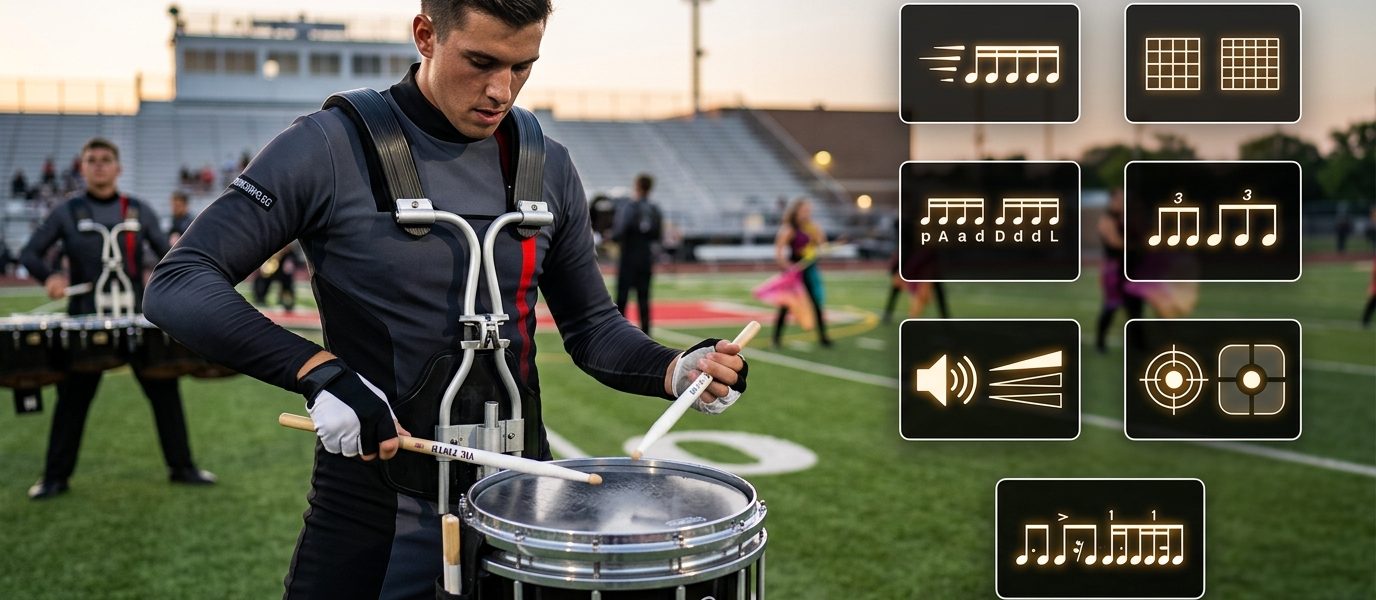
Speed separates good drumlines from great ones. You can have perfect technique and solid fundamentals, but if your hands can’t keep up with the tempo, you’ll struggle when the music demands more. The good news? Speed isn’t just a gift you’re born with. It’s a skill you build through deliberate, focused practice using the right exercises.
Building drumline speed requires progressive exercises that target finger control, wrist development, and muscle memory. Start with slow, controlled repetitions at 60 BPM, gradually increase tempo by 4 BPM increments weekly, and practice with a metronome daily. Focus on relaxation over force, maintain proper stick heights, and dedicate 15-20 minutes to speed-specific exercises within your regular practice routine for measurable improvement in 4-6 weeks.
Understanding the Foundation of Speed Development
Speed doesn’t come from playing faster. It comes from playing relaxed at slower tempos until your muscles memorize the motion perfectly.
Most drummers make the mistake of pushing tempo before their technique can support it. They tense up, grip harder, and force their hands to move faster. This creates bad habits that actually slow you down in the long run.
The real secret? Muscle memory built through repetition at controlled speeds.
Your brain needs time to hardwire the exact motion of each stroke. When you practice slowly with perfect form, you’re teaching your nervous system the most efficient path from stick up to stick down. Once that path becomes automatic, speed follows naturally.
Think of it like learning to type. You don’t start by trying to type 100 words per minute. You learn where each key sits, practice the finger movements slowly, and gradually build speed as the motions become second nature.
Single Stroke Speed Builder
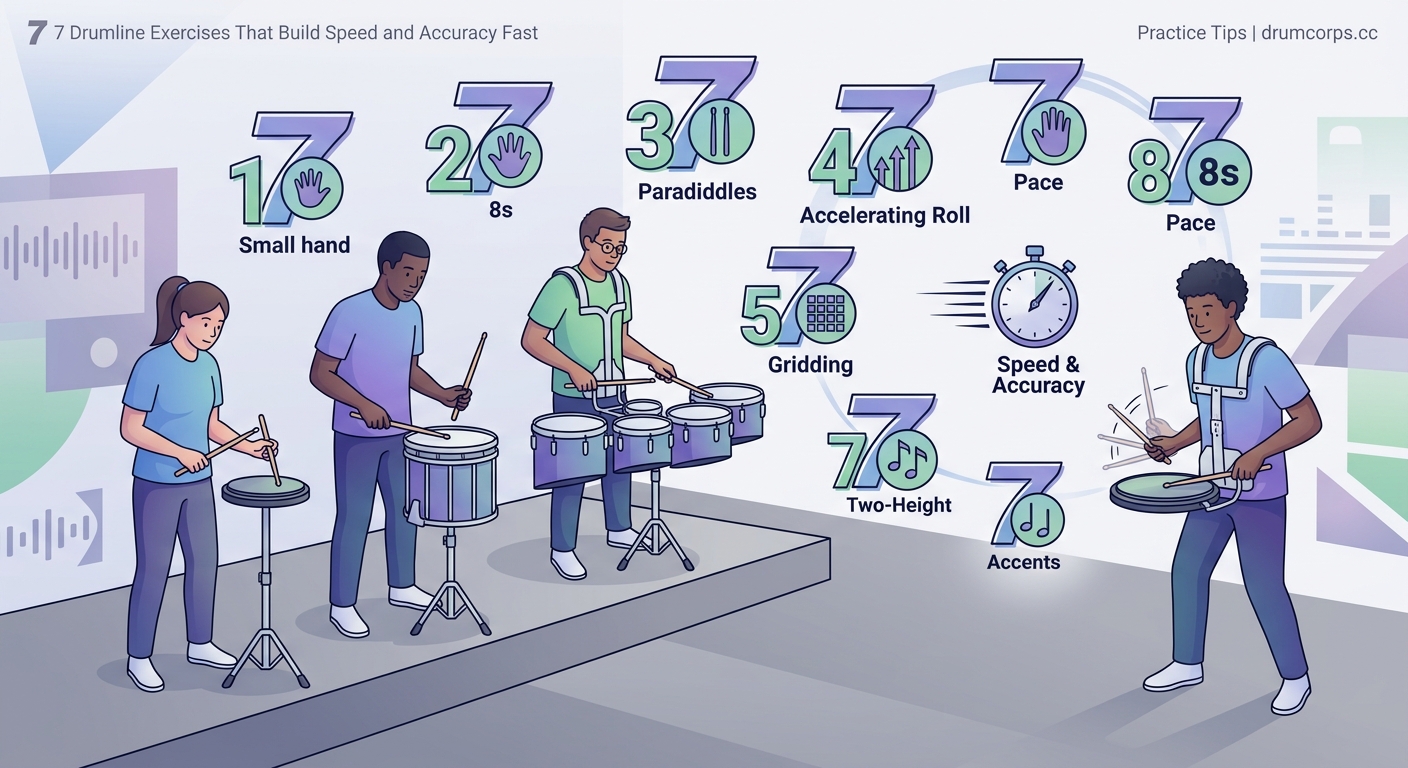
This exercise forms the backbone of all drumline speed work. It’s simple, but it works.
- Set your metronome to 60 BPM
- Play 16th notes with perfect alternating strokes (R L R L)
- Focus on keeping every stroke exactly the same height and volume
- Practice for 2 minutes without stopping
- Increase tempo by 4 BPM only when you can play the current tempo perfectly relaxed
Here’s what perfect execution looks like:
- Sticks rebound to exactly 6 inches after each stroke
- No tension in your forearms or shoulders
- Each note sounds identical in volume and tone
- Your grip stays loose enough that the stick could slip if you opened your fingers
Record yourself playing this exercise. Watch for any visible tension in your arms or inconsistent stick heights. Those are the spots where speed breaks down.
Most students can start seeing real improvement after practicing this exercise for 15 minutes daily over 3-4 weeks. The tempo increase might feel slow at first, but consistency matters more than rushing.
Double Stroke Acceleration Drill
Double strokes demand a different kind of speed control. The challenge isn’t just moving fast, it’s making both strokes sound clean and even.
Start at 60 BPM playing 16th notes with a double stroke pattern (RR LL RR LL). The first stroke uses wrist motion. The second stroke uses finger control to catch the rebound.
Common problems and fixes:
| Problem | What It Sounds Like | The Fix |
|---|---|---|
| Second stroke too quiet | “LOUD soft LOUD soft” | Let the stick rebound higher, use more finger pressure on second stroke |
| Second stroke too late | Triplet feel instead of even 16ths | Catch the rebound earlier with fingers, don’t let stick bounce freely |
| Tension in forearms | Strokes get louder and harsher as you play | Reset grip, shake out arms between reps, drop tempo 10 BPM |
Practice this pattern for 5 minutes, then immediately switch back to single strokes at the same tempo. Notice how much easier singles feel? That contrast helps your brain understand the difference between the two motions.
Paradiddle Velocity Training
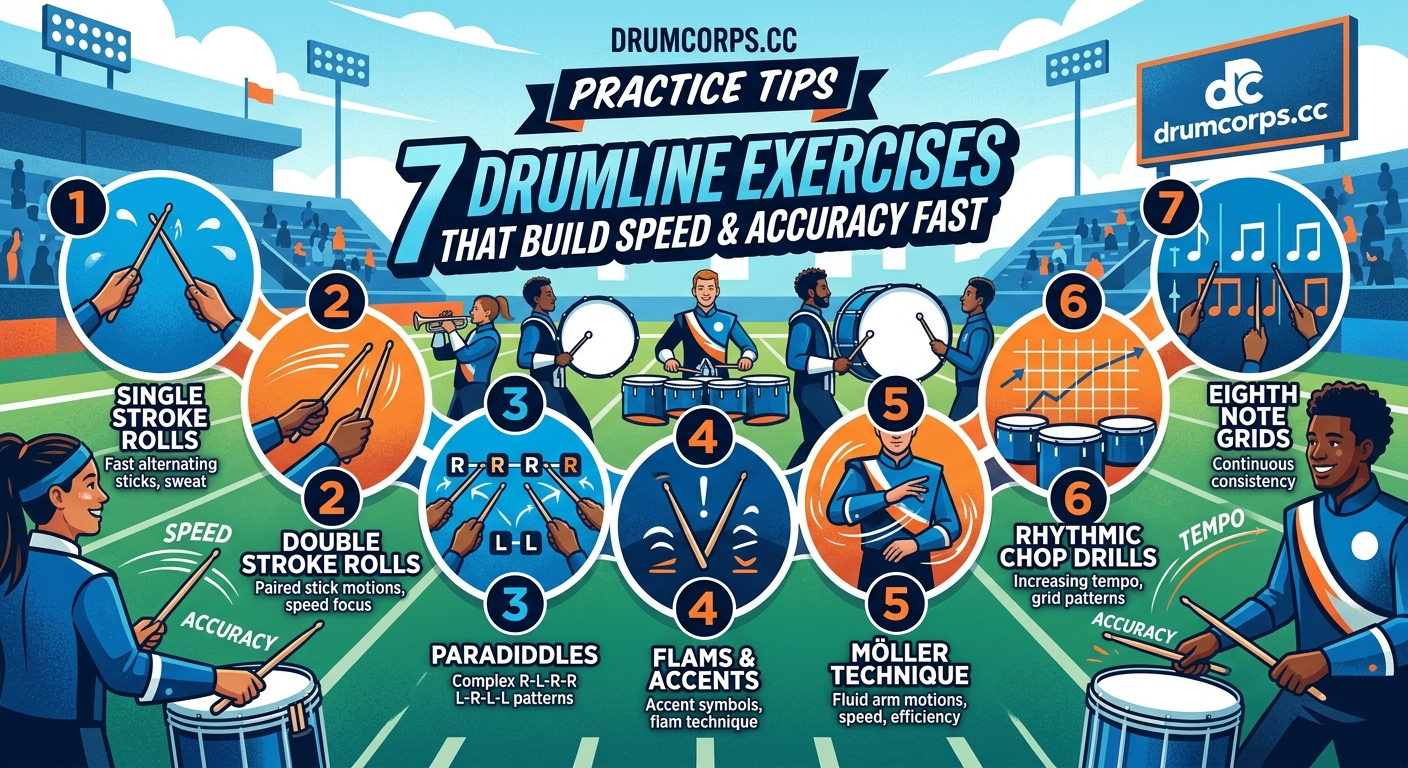
Paradiddles combine singles and doubles in one pattern, making them perfect for building overall hand speed and coordination.
The basic paradiddle (R L R R L R L L) teaches your hands to switch seamlessly between different stroke types without losing tempo or clarity.
Here’s your practice sequence:
- Week 1: 60-72 BPM, focus on making doubles clean
- Week 2: 76-88 BPM, work on smooth transitions between hands
- Week 3: 92-104 BPM, eliminate any volume differences between strokes
- Week 4: 108-120 BPM, maintain relaxation at higher speeds
The paradiddle reveals weaknesses in your technique faster than almost any other exercise. If your doubles are sloppy, you’ll hear it immediately. If one hand is weaker, the pattern will sound uneven.
Pay special attention to the transition from the double stroke to the single stroke. That’s where most drummers lose clarity. The stick needs to rebound at exactly the right height to set up the next stroke cleanly.
“Speed is a byproduct of control. If you can’t play it perfectly at 80 BPM, you definitely can’t play it at 160 BPM. Slow down, fix the problem, then build back up.” — Veteran DCI snare tech
Accent Pattern Speed Work
Adding accents while maintaining speed separates intermediate players from advanced ones. Your hands need to produce different volumes at the same tempo without changing the stroke motion.
Practice this 8-note pattern: Accent tap tap tap Accent tap tap tap
Start at 60 BPM with 16th notes. Accents should be twice as loud as taps, but both strokes should look identical in height and motion. The volume difference comes from stick velocity, not stick height.
This exercise builds the finger control necessary for clean playing at high speeds. When you can accent accurately at 140+ BPM, your hands have developed the fine motor control needed for advanced drumline music.
Integrating this work with how to build a perfect 30-minute individual practice routine helps you structure these exercises into a sustainable daily schedule.
Grid Pattern for Finger Independence
This exercise targets the fingers specifically, building the control needed for lightning-fast double strokes and rolls.
Play continuous 16th notes at 80 BPM, but change which fingers do the work:
- Fulcrum only (thumb and index finger), other fingers relaxed
- Fulcrum plus middle finger
- All four fingers engaged
- Back to fulcrum only
Each variation should last 30 seconds. The stick should rebound identically regardless of which fingers you’re using.
This drill teaches you how to adjust finger pressure on the fly, which becomes critical when playing fast passages that require dynamic control. You’ll notice certain fingers feel weaker. That’s normal. Focus extra practice time on those fingers until they match the strength of your dominant fingers.
Triplet Subdivision Builder
Triplets force your brain to process rhythm differently than straight 16th notes. Training both subdivision types makes you faster overall.
Set your metronome to 60 BPM and play 16th note triplets (6 notes per beat). Use alternating sticking (R L R L R L).
The rhythm should feel like: “trip-o-let trip-o-let”
After 2 minutes, switch to 16th notes at the same tempo without stopping. Your brain has to shift gears instantly. This mental flexibility translates directly to better speed control in real music.
Increase tempo gradually, but never sacrifice the clarity of the triplet subdivision. Each note needs to land precisely on its subdivision of the beat.
Many drummers find triplets harder than straight 16ths because the rhythm doesn’t align with the natural pulse of the metronome click. That discomfort is exactly what makes the exercise valuable. You’re training your internal clock to handle complex rhythms at speed.
Roll Speed Development
Rolls aren’t just about playing fast. They’re about creating an even, sustained sound where individual strokes blur together.
Start with a 5-stroke roll at 60 BPM (RR LL R). Play it as slowly as you need to make every stroke perfectly even in volume and spacing.
Gradually increase tempo in 4 BPM increments. As you get faster, the individual strokes should become less distinct until they create a smooth, continuous sound.
The transition from distinct doubles to a true roll happens somewhere between 140-160 BPM for most players. Below that tempo, you should hear clear doubles. Above it, the sound should blur into a sustained tone.
Common roll problems:
- Uneven buzz: One hand plays more strokes than the other. Fix by slowing down and counting strokes in each hand.
- Choppy sound: Sticks aren’t rebounding enough. Loosen grip and let sticks bounce more freely.
- Inconsistent volume: Tension is creeping in. Reset your grip and shake out your arms.
Building solid rolls requires the same finger control you develop in double stroke exercises. If your doubles are clean and even, your rolls will improve naturally as you increase tempo.
For players working on broader technical development, understanding what’s the best stick height for maximum power without sacrificing control provides crucial context for these speed exercises.
Creating Your Weekly Speed Practice Schedule
Consistency beats intensity when building speed. A focused 20-minute session every day produces better results than a 2-hour marathon once a week.
Here’s a proven weekly structure:
Monday: Single strokes (8 min) + Doubles (7 min) + Cool down with slow paradiddles (5 min)
Tuesday: Accent patterns (10 min) + Grid exercise (10 min)
Wednesday: Triplet subdivisions (8 min) + Roll development (12 min)
Thursday: Paradiddles at increasing tempos (15 min) + Singles at max comfortable tempo (5 min)
Friday: Combine all exercises in 3-minute blocks, record yourself, identify weakest area
Saturday: Focus exclusively on your weakest exercise from Friday’s recording (20 min)
Sunday: Rest or light review of fundamentals at comfortable tempos
Track your maximum comfortable tempo for each exercise weekly. Write it down. Seeing measurable progress keeps you motivated when improvement feels slow.
Remember that speed development isn’t linear. Some weeks you’ll jump 8-10 BPM. Other weeks you’ll plateau. That’s normal. Your muscles and nervous system need time to consolidate new movement patterns.
Avoiding the Speed Development Traps
Most drummers sabotage their own progress without realizing it. These mistakes feel productive in the moment but actually slow down your development.
Pushing tempo too fast: Adding 10-20 BPM jumps might feel like progress, but you’re building sloppy technique. Stick to 4 BPM increases. It feels slow, but it works.
Practicing only at fast tempos: If you only practice at 140+ BPM, you never give your brain time to refine the motion. Spend 60% of your practice time at medium tempos where you can focus on perfect technique.
Gripping harder when struggling: Tension is the enemy of speed. When an exercise gets difficult, your instinct is to grip tighter and force it. Instead, drop the tempo 10 BPM and focus on staying relaxed.
Skipping the metronome: Playing without a metronome lets you rush through easy parts and slow down on hard parts. You’re not actually building speed, you’re building inconsistency.
Ignoring one hand: Right-handed players often have a stronger right hand (and vice versa). This creates uneven playing at speed. Dedicate extra time to your weak hand with single-stroke exercises.
The connection between physical technique and mental preparation matters too. Players who integrate the 10-minute mental practice routine that top corps members swear by often see faster progress because they’re training their brain alongside their hands.
Measuring Real Progress Beyond the Metronome
Tempo numbers tell part of the story, but they don’t capture everything. Real speed development shows up in multiple ways.
Watch for these signs that your training is working:
- You can play faster tempos with less physical effort
- Your hands feel loose and relaxed even at high speeds
- You can maintain perfect stick heights at tempos that used to make you tense up
- Fast passages in actual music feel easier than they did a month ago
- You can play long runs at speed without your forearms burning
Record yourself monthly playing the same exercise at your maximum comfortable tempo. Compare recordings from different months. You should see smoother motion, more consistent stick heights, and less visible tension in your arms and shoulders.
Speed without control is just noise. The goal isn’t to play as fast as possible. It’s to play fast with the same clarity and precision you have at slower tempos.
Integrating Speed Work With Full Ensemble Practice
Individual speed development only matters if you can apply it in ensemble settings. The transition from solo practice to section playing requires adjustment.
When playing with your section, you’ll notice that maintaining speed while listening to others, watching a conductor, and executing visuals simultaneously is harder than playing alone in a practice room.
Start by practicing your section’s most technically demanding passages at 70% of performance tempo. Focus on staying perfectly in time with the metronome while executing all the musical details: dynamics, accents, and articulation.
Gradually increase tempo in the same 4 BPM increments you use for individual exercises. Don’t move faster until the entire section can play the passage cleanly at the current tempo.
This approach feels slow, but it prevents the common problem where sections can “get through” a fast passage at full tempo but can’t actually play it cleanly. Clean at 80% tempo is better than sloppy at 100% tempo.
Equipment Considerations for Speed Training
Your sticks, practice pad, and drum setup all affect how quickly you can develop speed.
For speed work specifically, choose sticks that match your performance sticks exactly. Don’t practice with heavy sticks hoping it will make your performance sticks feel lighter. That approach often creates tension habits that transfer to your regular playing.
Practice pads should have moderate rebound. Too much rebound and you’re not building the finger control needed for actual drums. Too little rebound and you’ll develop tension trying to force the stick to bounce.
If you’re working on marching snare specifically, how to eliminate rim clicks and achieve clean snare articulation addresses common technique issues that become more noticeable at higher speeds.
When Speed Plateaus Hit
Every drummer hits speed plateaus. You’ll practice consistently, follow all the right steps, and still feel stuck at the same tempo for weeks.
This usually means one of three things:
Technical issue: There’s a flaw in your technique that only becomes visible at higher speeds. Record yourself in slow motion and watch for tension, inconsistent stick heights, or timing issues.
Muscle fatigue: You might be practicing too much without enough recovery. Speed development requires rest days for your muscles to adapt. If your forearms feel constantly tired, take 2-3 days off from speed work.
Mental barrier: Sometimes you’ve convinced yourself you can’t play faster than a certain tempo. The physical capability is there, but your brain won’t let you access it. Try playing the exercise at the “impossible” tempo for just 10 seconds. Often you’ll discover you can do it, you just couldn’t sustain it yet.
Plateaus are normal. They’re not signs of failure. They’re your body’s way of consolidating the progress you’ve already made before pushing to the next level.
Speed Work for Different Instruments
While these exercises work for all drumline instruments, each section has specific considerations.
Snare drummers: Focus heavily on finger control exercises and accent patterns. Your parts demand the most dynamic range at speed.
Tenor drummers: Add sweeps and crossovers to your speed work. Practice the exercises while moving between drums to build the spatial awareness needed for fast tenor passages.
Bass drummers: Speed work should emphasize timing precision more than raw velocity. Practice exercises with a recording of your full bass line to work on speed while maintaining perfect unison splits.
Cymbal players: Adapt these exercises to crash technique. Work on the speed of your preparation motion and recovery, not just the crash itself.
Building Speed Into Your Season Timeline
Speed development works best when aligned with your competitive season schedule.
Off-season (Summer after finals): This is prime time for aggressive speed development. You have no performance pressure, so you can focus on technique refinement and gradual tempo increases.
Pre-season (Fall/Winter): Maintain the speed you built during off-season while learning new music. Don’t try to push maximum tempos when you’re also learning new material.
Competition season (Spring/Summer): Focus on consistency at performance tempos. Individual speed work should maintain what you’ve built, not push for new personal records.
Post-season: Take 2-3 weeks completely off from speed work. Let your body recover before starting the next development cycle.
This cyclical approach prevents burnout and overuse injuries while ensuring you peak at the right time in your competitive season.
Your Speed Development Starts Now
Speed isn’t magic. It’s not a talent some drummers have and others don’t. It’s a skill you build through consistent, focused practice using proven exercises.
Start with single strokes at a comfortable tempo. Practice for 15 minutes today. Then do it again tomorrow. And the day after that. Track your progress weekly. Celebrate small improvements.
In six weeks, you’ll be playing passages that feel impossible right now. In six months, you’ll wonder why speed ever seemed difficult. The exercises work. You just have to trust the process and put in the consistent practice time.
Your hands are capable of more speed than you think. You just need to train them properly to access it.