You’re two minutes into the opener, your lips are still fresh, and your tone is solid. Then the drill hits that backward diagonal section with the sustained fortissimo chord. Suddenly, you’re gasping. Your sound thins out. Your shoulders creep up toward your ears.
That’s not a chops problem. That’s a breathing problem.
Most brass players in drum corps and marching band focus obsessively on embouchure, articulation, and range. But the foundation of every great performance is breath control. Without it, nothing else works. Your tone suffers. Your endurance tanks. Your confidence disappears right when you need it most.
Effective breathing techniques for brass players center on diaphragmatic breathing, proper inhalation timing, and maintaining airflow consistency during physically demanding drill movements. Mastering these fundamentals prevents common issues like shallow breathing, tension-induced air restriction, and premature fatigue that sabotage field performance quality. Consistent practice of targeted breathing exercises transforms endurance and tonal stability.
Understanding diaphragmatic breathing for marching brass
Your diaphragm is a dome-shaped muscle sitting below your lungs. When it contracts, it flattens downward, creating space for your lungs to expand. This is how you’re supposed to breathe.
Most brass players don’t.
Instead, they lift their shoulders and expand their chest. This shallow breathing pattern uses secondary muscles that weren’t designed for the job. It creates tension. It limits air capacity. It makes you work harder for less air.
Here’s how to feel the difference:
- Place one hand on your chest and one on your stomach, just below your ribcage.
- Breathe normally and notice which hand moves more.
- If your chest hand is doing most of the moving, you’re breathing shallow.
Now try this:
- Keep your hands in the same position.
- Breathe in slowly through your nose, focusing on pushing your stomach hand outward.
- Your chest should barely move. Your belly should expand like a balloon.
- Exhale slowly and feel your stomach hand move back in.
That’s diaphragmatic breathing. It feels weird at first if you’ve been a chest breather your whole life. But this is the foundation of everything else.
The timing problem most brass players ignore
You can have perfect diaphragmatic breathing and still run out of air on the field. Why? Because you’re breathing at the wrong times.
Marching drill doesn’t care about your musical phrases. You might have a perfect breath mark in the music, but if you’re in the middle of a high step or a spin, that breath becomes useless. You can’t get enough air. You compensate with shallow chest breathing. Your tone suffers.
The solution is breath mapping.
Grab your drill coordinate sheets and your music. Go through every phrase and mark where you can actually take a full breath without compromising your visual performance. Look for moments when you’re:
- Holding a static position
- Moving forward in a straight line
- Between visual responsibilities
Sometimes the ideal musical breath mark doesn’t line up with these moments. That’s fine. You need to find the closest opportunity before you run out of air, even if it means breathing a measure earlier than the arranger intended.
Write these breath points directly on your music. Make them visible. Treat them like visual checkpoints.
How physical tension destroys your air support
Your core needs to stay engaged for proper breath support. But tension in your shoulders, neck, and upper chest actively works against you.
Here’s what happens: You’re marching. Your upper body is tight from holding your horn at the correct angle. That tension creeps into your breathing muscles. Your intercostal muscles (the ones between your ribs) can’t expand properly. Your diaphragm can’t descend fully.
Result? Less air capacity and more effort required.
The fix requires conscious relaxation while maintaining proper posture. Before every rehearsal, spend two minutes on this sequence:
- Stand in playing position without your horn.
- Roll your shoulders backward three times, then forward three times.
- Tilt your head gently to each side, feeling the stretch in your neck.
- Take a full diaphragmatic breath and release it with a sigh, letting your shoulders drop naturally.
Now add your horn and repeat the breathing step. Your shoulders should stay in that relaxed, dropped position. Your neck should feel long, not scrunched.
If you find tension creeping back during rehearsal, use your water breaks to reset. Two good breaths with conscious shoulder relaxation can make a massive difference in the next rep.
The exhale matters as much as the inhale
Most breathing advice focuses on getting air in. But how you use that air determines everything about your sound and endurance.
Your air stream needs to be steady and controlled. Too much air too fast, and you’ll blow out your sound and run out of breath before the phrase ends. Too little air, and your tone goes thin and sharp.
Think of your air like water through a hose. You want consistent pressure, not bursts and trickles.
Try this exercise at home:
- Take a full diaphragmatic breath.
- Exhale slowly through slightly parted lips, making a “sss” sound.
- Keep the sound consistent in volume from start to finish.
- Time yourself. Aim for 20 seconds minimum.
If the sound gets quieter or shakier, your air support is collapsing. Your diaphragm should stay engaged throughout the entire exhale, controlling the release of air rather than just letting it all rush out.
Now do the same thing with your instrument:
- Take a full breath.
- Play a comfortable middle register note at mezzo-forte.
- Sustain it for as long as possible while maintaining consistent volume and tone quality.
- Time it.
If you can do 20 seconds on the “sss” but only 12 on your horn, you’re using too much air. You need to find the minimum air speed that produces a good sound, then maintain that speed consistently.
Breathing while moving changes everything
Standing still and playing? Easy. Backward marching at 180 beats per minute while playing a fortissimo high note? That’s where most brass players fall apart.
Movement creates competing demands on your core muscles. Your diaphragm and abdominals need to support your air stream, but they also need to stabilize your body during complex drill movements.
The key is training your body to maintain breath support independent of your leg movements. This takes specific practice.
Here’s a progressive drill sequence:
- Play a sustained note while marching in place. Focus on keeping your air stream steady.
- Play the same note while marching forward. Notice if your air pulses with each step.
- Play while marching backward. This is harder. Your core engagement changes.
- Play while executing a turn or diagonal. These create the most disruption to your breathing.
For each step, the goal is the same: keep your air stream as steady as if you were standing still. Your lower body moves. Your upper body stays stable. Your breathing remains independent.
This doesn’t happen overnight. But 10 minutes of this drill before each rehearsal will transform your field performance within two weeks.
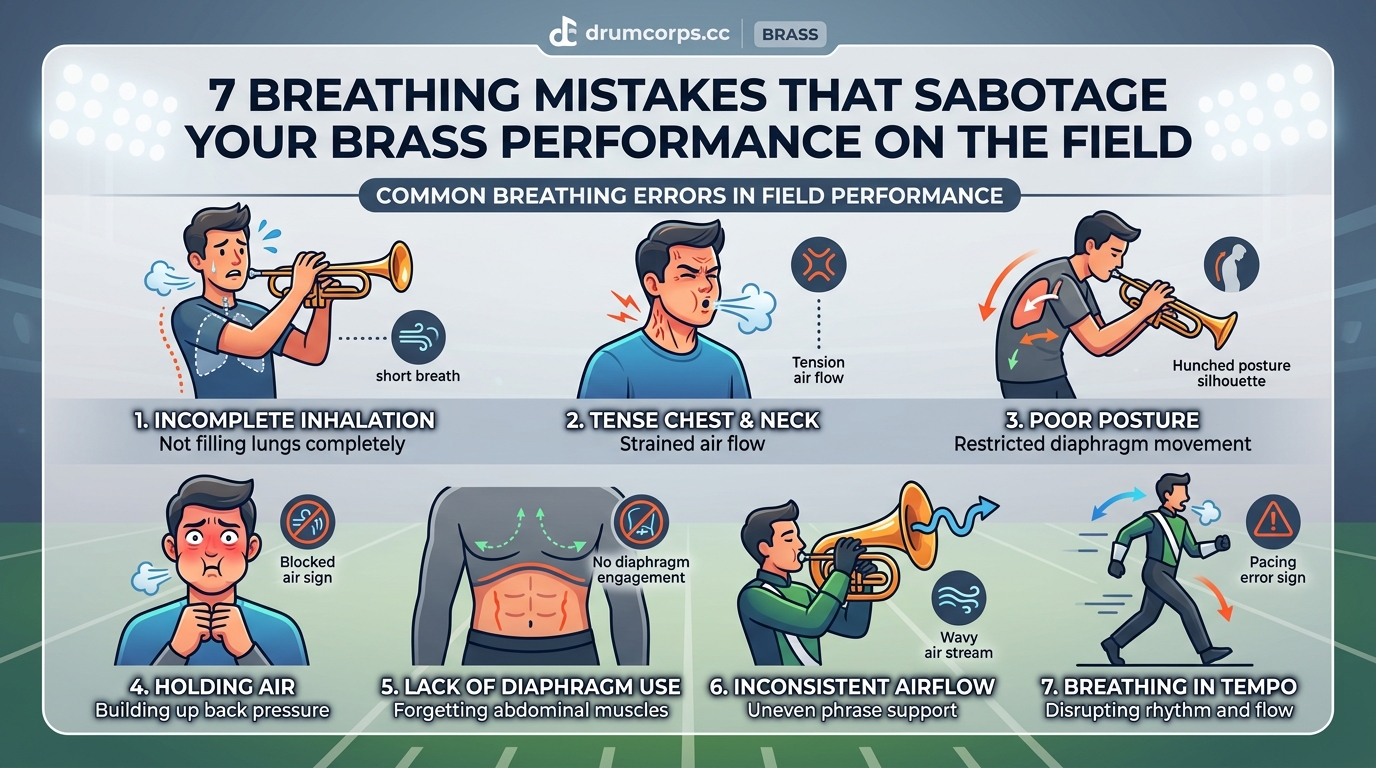
Common breathing mistakes and how to fix them
| Mistake | What It Looks Like | The Fix |
|---|---|---|
| Shoulder breathing | Shoulders rise with each breath; chest expands more than stomach | Practice diaphragmatic breathing daily; use hand placement checks |
| Holding residual air | Never fully exhaling before the next breath; feeling “stuffed” | Exhale completely between phrases; practice breath resets |
| Gasping breaths | Loud, desperate inhales that disrupt the ensemble sound | Take earlier, smaller breaths; plan breath points in advance |
| Locked core | Abs stay rigid, preventing diaphragm movement | Release tension; engage core without rigidity; practice flexible support |
| Breathing too late | Waiting until you’re out of air to breathe | Map breaths ahead of time; breathe before you think you need to |
Each of these mistakes compounds under the physical demands of marching. The longer you wait to address them, the more they become ingrained habits.
“The difference between a good brass player and a great one often comes down to breathing. You can have incredible chops and perfect technique, but if you can’t sustain your air support through an entire show, none of that matters on the field.”
Building breathing endurance for long shows
A 12-minute show demands serious breathing endurance. You can’t just practice breathing during music rehearsal and expect it to hold up under performance conditions.
You need dedicated breathing workouts, separate from your regular practice routine.
Here’s a simple but effective protocol:
Week 1-2: Foundation building
– 5 minutes of diaphragmatic breathing practice daily
– 3 sets of sustained tones (30 seconds each) on your instrument
– Focus on consistency, not duration
Week 3-4: Endurance extension
– 3 sets of sustained tones (45 seconds each)
– Add marching in place during sustained tones
– Practice breath mapping on your show music
Week 5-6: Performance simulation
– Run full show sections while focusing only on breathing
– Practice breathing through visual demands
– Time your breath recovery between phrases
Week 7+: Maintenance and refinement
– Continue daily breathing exercises
– Focus on trouble spots in your show
– Maintain awareness during full ensemble rehearsals
The beauty of breathing work is that it doesn’t require your instrument. You can practice diaphragmatic breathing anywhere: in the car, before bed, during class breaks.
Many brass players benefit from incorporating 5 essential breathing exercises every brass player should master into their regular routine for more structured development.
Breathing strategies for different brass instruments
Not all brass instruments have the same breathing demands. A tuba player needs to move significantly more air than a trumpet player. A mellophone player deals with different resistance than a trombone player.
High brass (trumpet, mellophone):
– Faster air speed required
– More frequent breathing opportunities
– Focus on efficient, complete breaths rather than maximum capacity
– Watch for tension from trying to push too much air
Low brass (trombone, baritone, tuba):
– Larger air capacity needed
– Fewer but longer breaths
– Emphasis on deep diaphragmatic breathing
– Practice maintaining consistent air pressure over extended phrases
All instruments:
– Coordinate breathing with drill movements
– Plan breath points during drill writing, not as an afterthought
– Practice breathing under physical exertion (run in place, then play)
Your section should work together on breathing strategy. If everyone breathes at different times, the sound becomes unstable. Coordinated breathing creates a unified, powerful ensemble sound that doesn’t drop in intensity.
Integrating breathing work into your practice routine
Breathing practice shouldn’t be separate from your regular practice. It should be woven throughout.
Start every practice session with breathing awareness:
- Three minutes of diaphragmatic breathing without your instrument
- Breathing buzzing on your mouthpiece (focus on steady air)
- Long tones with breath awareness
- Then move into your regular warmup
During your practice session, maintain breathing awareness:
- Before each exercise, take one conscious, full breath
- Notice when you hold tension
- Reset your breathing posture between repetitions
- Practice breathing at the same points you’ll use in the show
If you’re building a perfect 30-minute individual practice routine, dedicate at least five minutes specifically to breathing fundamentals.
End your practice with a breathing check:
- Play through a challenging section of your show
- Focus entirely on maintaining good breathing technique
- Notice where you struggled
- Mark those spots for focused work next time
This integration ensures breathing technique becomes automatic, not something you have to think about consciously during performance.
Breathing and performance anxiety
Your breathing changes when you’re nervous. It gets shallow. It speeds up. You might even hold your breath without realizing it.
This creates a vicious cycle. Poor breathing increases physical tension. Physical tension increases anxiety. Anxiety further disrupts breathing.
Breaking this cycle requires deliberate breathing control before and during performance.
Pre-performance breathing protocol:
30 minutes before: Practice normal diaphragmatic breathing for 3 minutes. Just breathe. Don’t think about the show.
15 minutes before: Do three breath cycles: Inhale for 4 counts, hold for 4, exhale for 6. The longer exhale activates your parasympathetic nervous system, reducing anxiety.
5 minutes before: Return to normal breathing. Focus on the physical sensation of breathing rather than your thoughts.
During performance:
If you feel panic rising, use your next planned breath as a reset. Take it slightly deeper than normal. Release any shoulder tension. Return to your breathing fundamentals.
Your breathing is the one thing you can always control, even when everything else feels chaotic.
Breathing in extreme weather conditions
Summer drum corps means performing in brutal heat. Your breathing changes in extreme conditions.
Hot weather challenges:
– Air feels thinner and less satisfying
– Dehydration affects mucous membranes
– Physical fatigue increases faster
– Heat stress can cause irregular breathing patterns
Solutions:
– Hydrate aggressively before, during, and after rehearsals
– Take slightly more frequent, smaller breaths rather than fewer large ones
– Focus on nose breathing during breaks to humidify and cool incoming air
– Monitor for heat-related breathing difficulties and communicate with staff
Cold weather challenges:
– Cold air can cause bronchial constriction
– Condensation in your instrument affects resistance
– Chest muscles tighten from cold
Solutions:
– Warm up your breathing muscles before touching your horn
– Take slightly shallower initial breaths until your airways adjust
– Cover your mouth with your hand during breathing breaks to pre-warm air
– Keep your core warm to maintain diaphragm flexibility
Weather shouldn’t be an excuse for poor breathing, but it does require awareness and adjustment.
Breathing techniques transform everything else
Fix your breathing and everything else gets easier. Your endurance improves. Your tone gets richer. Your range expands. Your confidence grows.
But breathing technique isn’t something you master once and forget about. It requires constant attention, especially under the physical and mental demands of drum corps and marching band.
The brass players who make it look effortless aren’t more talented. They’ve just done the work to make proper breathing automatic. They’ve practiced breathing as seriously as they’ve practiced their scales and articulation exercises.
Start with one thing. Pick the breathing issue that’s causing you the most problems right now. Maybe it’s shoulder breathing. Maybe it’s running out of air during the closer. Maybe it’s breathing while marching backward.
Work on that one thing for two weeks. Make it your focus during every practice session. Track your progress. Notice the improvements in your playing.
Then move to the next thing.
Your breathing is either working for you or against you. There’s no middle ground. Make it work for you, and you’ll be amazed at how much better everything else becomes.