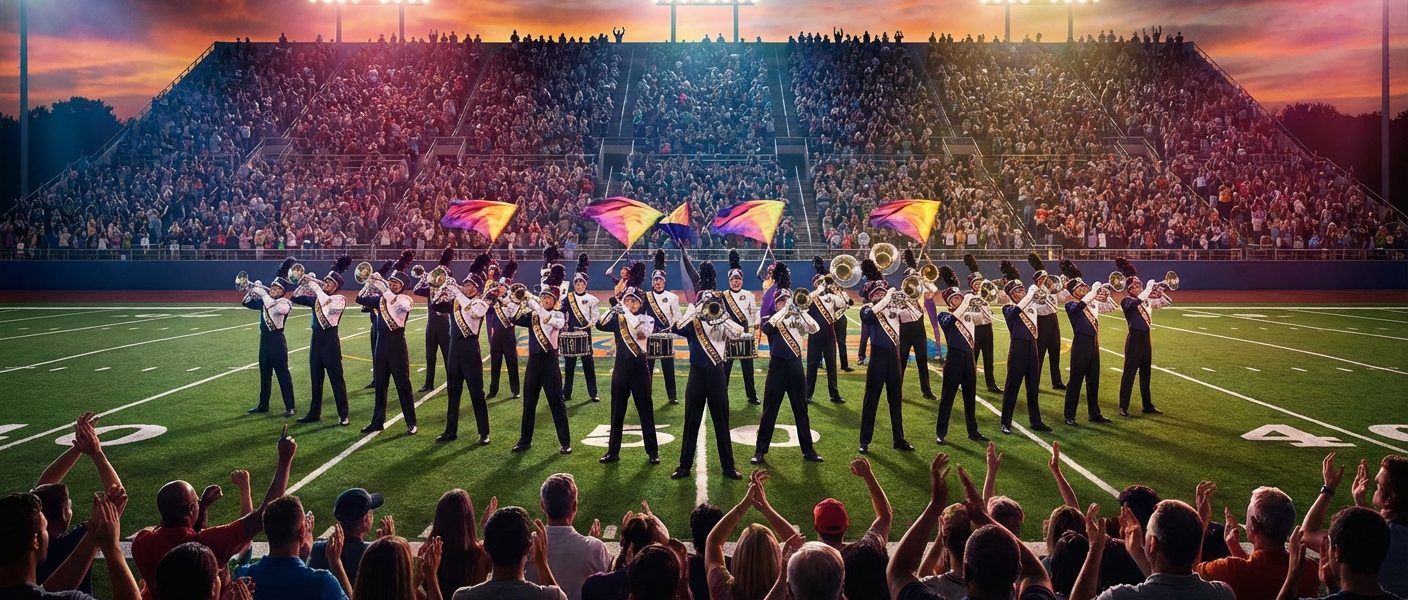
Wait, you’re looking for the best moments from The Closer TV show, but you landed on a drum corps website?
Here’s what happened: you’re probably thinking of show-stopping finale performances in drum corps competitions, which fans call “closers.” These are the breathtaking final movements that bring audiences to their feet at venues like Lucas Oil Stadium or the Rose Bowl. The confusion is understandable because both use the same term, but they’re completely different worlds.
This article clarifies the difference between TV drama scenes and drum corps closers, then focuses on what makes a memorable closer in marching arts. You’ll learn about iconic finale moments from groups like the Bluecoats, Carolina Crown, and Santa Clara Vanguard that created unforgettable emotional peaks through music, movement, and theatrical storytelling on the football field.
What Makes a Closer Unforgettable in Drum Corps
A closer in drum corps is the final three to five minutes of a competitive show. Everything builds to this moment.
The tempo usually accelerates. The volume swells. Every performer on the field commits to maximum intensity. Flags spin faster. Brass players push their chops to the limit. The battery percussion section unleashes rhythmic fury.
Great closers combine these elements:
- Musical crescendo that feels inevitable
- Visual formations that create “wow” moments
- Emotional payoff after 11 minutes of storytelling
- Synchronization so tight it looks impossible
- A final hit that lands like a thunderclap
The best ones make you forget you’re watching a competition. You’re just experiencing something powerful.
Five Finale Moments That Defined an Era
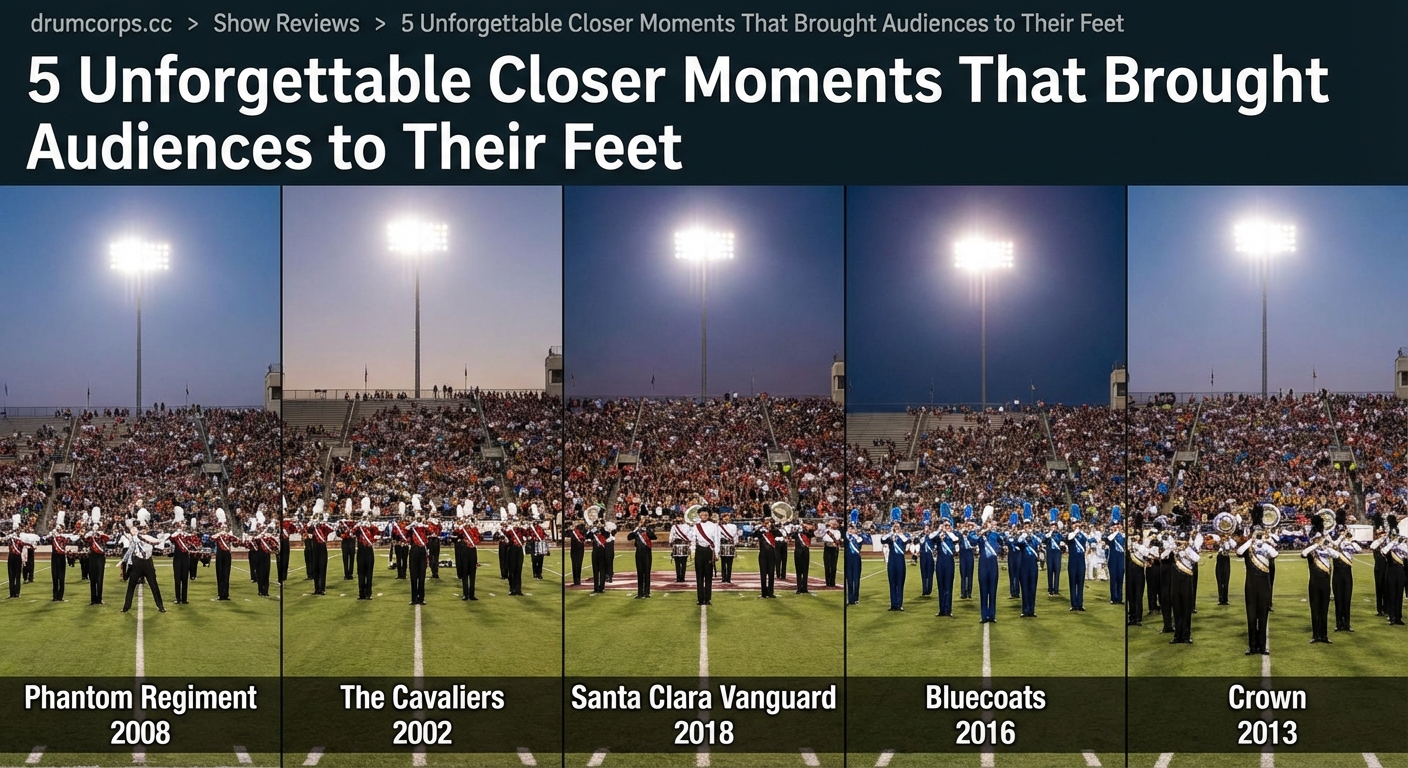
1. Bluecoats 2014: “Tilt” Final Push
The Bluecoats took a risk with asymmetry and jazz vocabulary. Their closer threw out the rulebook.
Instead of traditional drum corps power chords, they built tension through repetition. The brass line played a hypnotic pattern that grew louder with each cycle. Meanwhile, the drill created visual chaos that somehow felt organized.
The final 30 seconds featured the entire corps tilting their bodies at impossible angles while maintaining perfect sound quality. When they snapped to attention for the final chord, Lucas Oil Stadium erupted.
This moment proved that innovation could win championships. The judges awarded them their first DCI World Championship title.
2. Carolina Crown 2013: “E=mc²” Collision
Crown’s space-themed show built toward a cosmic collision. The closer represented matter and antimatter meeting.
Two massive blocks of performers marched directly at each other from opposite ends of the field. The music accelerated. The gap closed. Audience members literally held their breath.
At the moment of impact, the forms passed through each other in a carefully choreographed weave. The brass hit a massive chord. Sparks flew from props onstage. The energy release felt physical.
“When we rehearsed that closer, we knew we had something special. But feeling 15,000 people react to it in finals week was surreal.” (Crown brass caption head, 2013 season)
3. Santa Clara Vanguard 1989: “Phantom of the Opera” Finale
Before modern electronics and elaborate props, Vanguard created magic with pure performance.
Their arrangement of Andrew Lloyd Webber’s score built to a frenetic pace. The drill moved constantly. No one stood still for more than two counts.
The closer featured a signature Vanguard move: the entire brass line executing a company front while playing at fortissimo. They marched forward in a perfect line, 60 horn bells aligned, creating a wall of sound.
The final chord lasted eight counts. The resonance in the stadium felt endless. This performance set a standard that corps still reference today.
4. The Cavaliers 2002: “Frameworks” Precision Explosion
The Cavaliers built their reputation on clean execution. Their 2002 closer showcased why.
The music shifted between multiple time signatures. The drill required split-second timing. One missed step would create visible chaos.
They nailed it.
The closer featured rapid formation changes that looked computer-generated. Circles became squares. Squares became diamonds. Diamonds exploded into scattered forms that suddenly snapped into perfect arcs.
The final formation spelled out their founding year in the endzone. The crowd gave them a standing ovation before the last note finished resonating.
5. Blue Devils 2017: “Metamorph” Transformation
The Devils told a story about transformation throughout their show. The closer delivered the payoff.
Performers shed costume pieces during the final movement. The color guard revealed bright costumes hidden under neutral layers. The visual effect created the impression of butterflies emerging.
The music built through multiple false peaks. Each time you thought the show would end, it pushed higher. The actual final hit came from an unexpected place, a quiet moment that suddenly exploded into full corps power.
The artistic risk paid off. They won their 18th championship.
Breaking Down What These Moments Share
Let’s look at the common elements in a table format:
| Element | How It Works | Why It Matters |
|---|---|---|
| Musical arc | Builds tension through dynamics and tempo | Creates anticipation that demands release |
| Visual payoff | Delivers formations teased earlier in show | Rewards audience attention throughout |
| Emotional peak | Connects music and movement to human feeling | Makes the performance memorable beyond technique |
| Technical difficulty | Pushes performers to their absolute limit | Demonstrates months of dedicated preparation |
| Timing precision | Requires every performer hitting exact marks | Creates moments that feel impossible |
The technical execution matters, but emotion makes these moments last. You can watch recordings decades later and still feel the impact.
How Corps Build Toward These Moments
Creating an unforgettable closer takes strategic planning from January rehearsals through August finals.
- Design teams map the emotional journey before writing a single note
- Musical arrangers craft the closer to be performable at maximum intensity for five straight minutes
- Drill designers create formations that build in visual complexity
- Instructors break down each eight-count section into teachable chunks
- Performers rehearse the closer hundreds of times until muscle memory takes over
- Staff makes constant adjustments based on what works in performance
The process mirrors how television writers build toward season finales. You need setup, development, and payoff. Rush any step and the ending falls flat.
Why Audiences Remember These Specific Moments
Neuroscience offers clues about why certain performances stick in memory.
Peak-end rule suggests we remember experiences based on their most intense moment and their conclusion. Drum corps closers literally engineer both elements into the same five minutes.
The physical nature of live performance adds another layer. You feel the bass drums in your chest. You see 150 performers moving as one organism. Your mirror neurons fire as you unconsciously empathize with their effort.
These aren’t passive viewing experiences. Your body participates even while sitting in the stands.
Common Mistakes That Weaken Closers
Not every closer lands with impact. Here are pitfalls that diminish the effect:
- Starting too loud with nowhere to build
- Overcomplicating drill so performers can’t maintain sound quality
- Copying what worked for another corps without understanding why
- Sacrificing musicality for visual gimmicks
- Ignoring the story told in earlier movements
- Mistiming the final impact moment
The strongest closers feel inevitable. Weaker ones feel tacked on.
How to Experience These Moments Yourself
Want to feel what makes these performances special? Here’s how to access them:
Watch finals recordings: DCI releases multi-camera recordings of championship performances. The production quality captures both wide field views and close-up performer reactions.
Attend live shows: Nothing replaces being in the stadium. The sound system at Lucas Oil or a quality outdoor venue creates physical sensations recordings can’t match.
Follow corps on social media: Many groups share rehearsal footage that shows how they build these moments from scratch.
Listen to audio recordings: Sometimes removing the visual element helps you appreciate the musical architecture.
Start with championship-winning performances from the past decade. Then work backward to see how the activity evolved.
The Anatomy of a Perfect Final Chord
That last moment before silence matters more than you might think.
A great final chord requires:
- Brass players maintaining air support through the cutoff
- Percussion hitting the final note with perfect timing across the entire battery
- Color guard completing their final toss or pose exactly on the hit
- Wind players sustaining until the conductor’s release
- Every performer maintaining character until the drum major salutes
The silence after matters too. Professional performers hold their final pose for three full seconds before relaxing. This allows the emotional moment to breathe before applause begins.
Why These Moments Matter Beyond Competition
Drum corps closers teach lessons that extend past the football field.
They demonstrate what’s possible when groups commit to a shared vision. They show how technical precision and emotional expression can coexist. They prove that months of unglamorous repetition can create transcendent moments.
Performers carry these lessons into careers as educators, musicians, and leaders in other fields. Audience members remember that feeling of collective joy when thousands of strangers simultaneously react to beauty.
These aren’t just entertaining performances. They’re proof that humans can create something extraordinary together.
Where the Art Form Goes Next
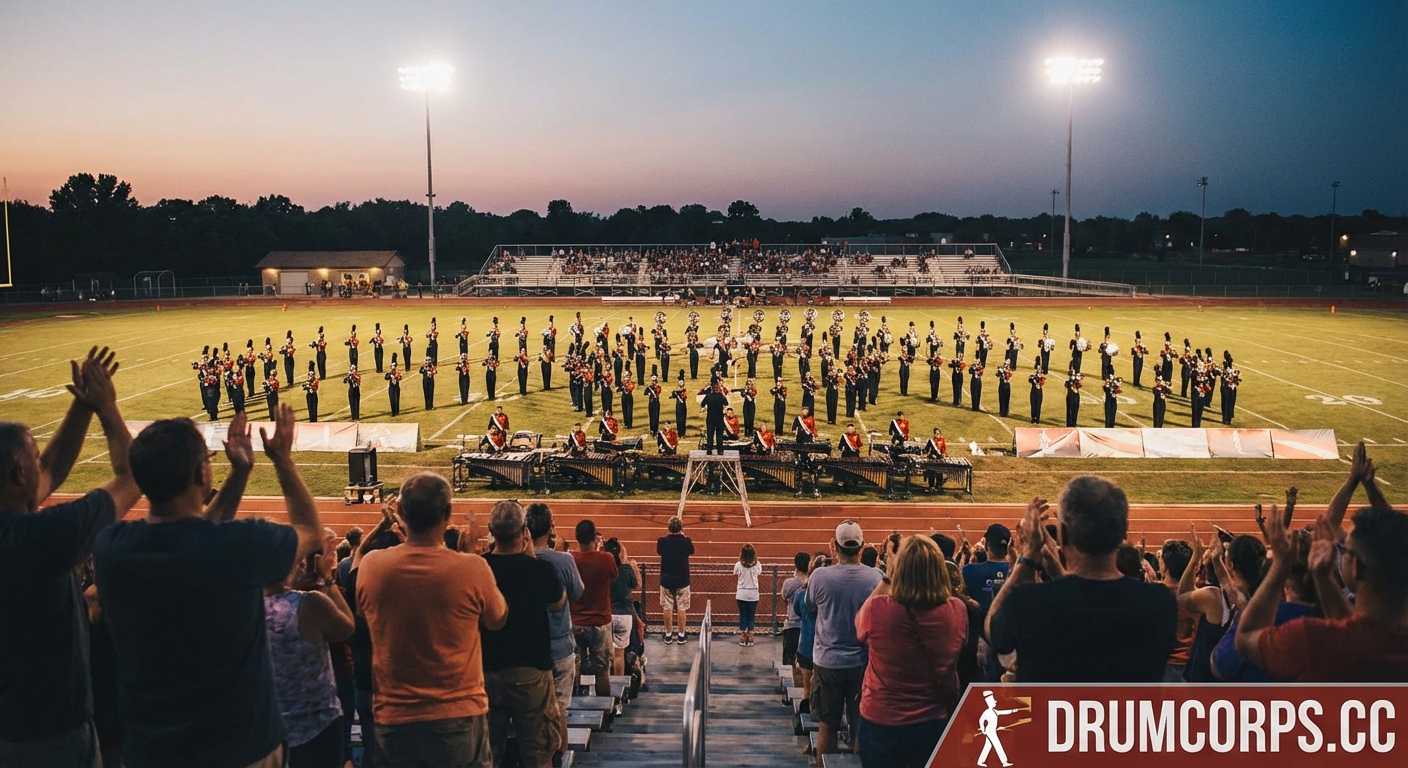
Contemporary corps continue pushing boundaries. Recent trends include:
- Integrating theatrical elements borrowed from Broadway
- Using electronics to create soundscapes impossible with acoustic instruments
- Designing shows around social themes rather than abstract concepts
- Incorporating dance vocabulary from multiple traditions
- Creating moments of intimate quiet within loud shows
The next generation of unforgettable closers will likely surprise us. That’s part of what makes following the activity exciting.
Finding Your Own Connection to These Performances
Maybe you marched in high school. Maybe you stumbled onto a DCI broadcast late one night. Maybe someone shared a video that caught your attention.
However you found drum corps, these closer moments offer a way back into that feeling. They’re concentrated doses of what makes the marching arts special.
You don’t need musical training to appreciate them. You just need to be open to experiencing something that combines athleticism, artistry, and human connection in a unique package.
When Performance Becomes Memory
The best moments from any art form become part of our personal history. We remember where we were sitting. Who we attended with. How we felt when that final chord hit.
Drum corps closers create these memories reliably because they’re designed to generate peak experiences. Every element works toward making you feel something powerful.
Years later, you can watch the same performance and feel echoes of that original reaction. The goosebumps return. The emotional response triggers again.
That’s the mark of something truly unforgettable.
Experiencing the Power of a Great Closer


If you came here looking for TV drama, you found something different but potentially just as compelling. Drum corps offers its own kind of storytelling, one told through brass, percussion, movement, and shared human effort.
The next time you have 12 minutes, watch one of the performances mentioned here. Let yourself react without overthinking it. Notice what you feel during those final intense minutes.
You might just understand why tens of thousands of people pack stadiums every summer to experience these moments together. There’s something irreplaceable about watching 150 performers leave everything on the field, building toward a finale that makes the entire journey worthwhile.