You don’t need hours to make real progress. Thirty minutes of focused, structured practice can outperform two hours of wandering through exercises without a plan. The secret isn’t more time. It’s better structure.
A 30 minute practice routine works best when divided into four focused blocks: warmup (5 minutes), fundamentals (10 minutes), challenge work (10 minutes), and cooldown (5 minutes). This structure builds skills efficiently while preventing burnout. Consistency matters more than duration, and a well-designed short session beats a long, unfocused one every time.
Why 30 minutes works better than you think
Most people assume longer practice sessions automatically mean better results. That’s not how skill development works.
Your brain can only maintain peak focus for limited windows. After about 20 to 30 minutes of intense concentration, attention starts to drift. Mistakes creep in. You stop noticing what you’re doing wrong.
Short sessions force you to prioritize. You can’t waste five minutes scrolling your phone or noodling around aimlessly. Every minute has a job.
This approach also fits real life. You might not have two hours free, but almost everyone can carve out 30 minutes before work, during lunch, or after dinner. Practicing six days a week for 30 minutes beats practicing twice a week for 90 minutes. Repetition builds neural pathways. Gaps between sessions let those pathways weaken.
The four-block framework
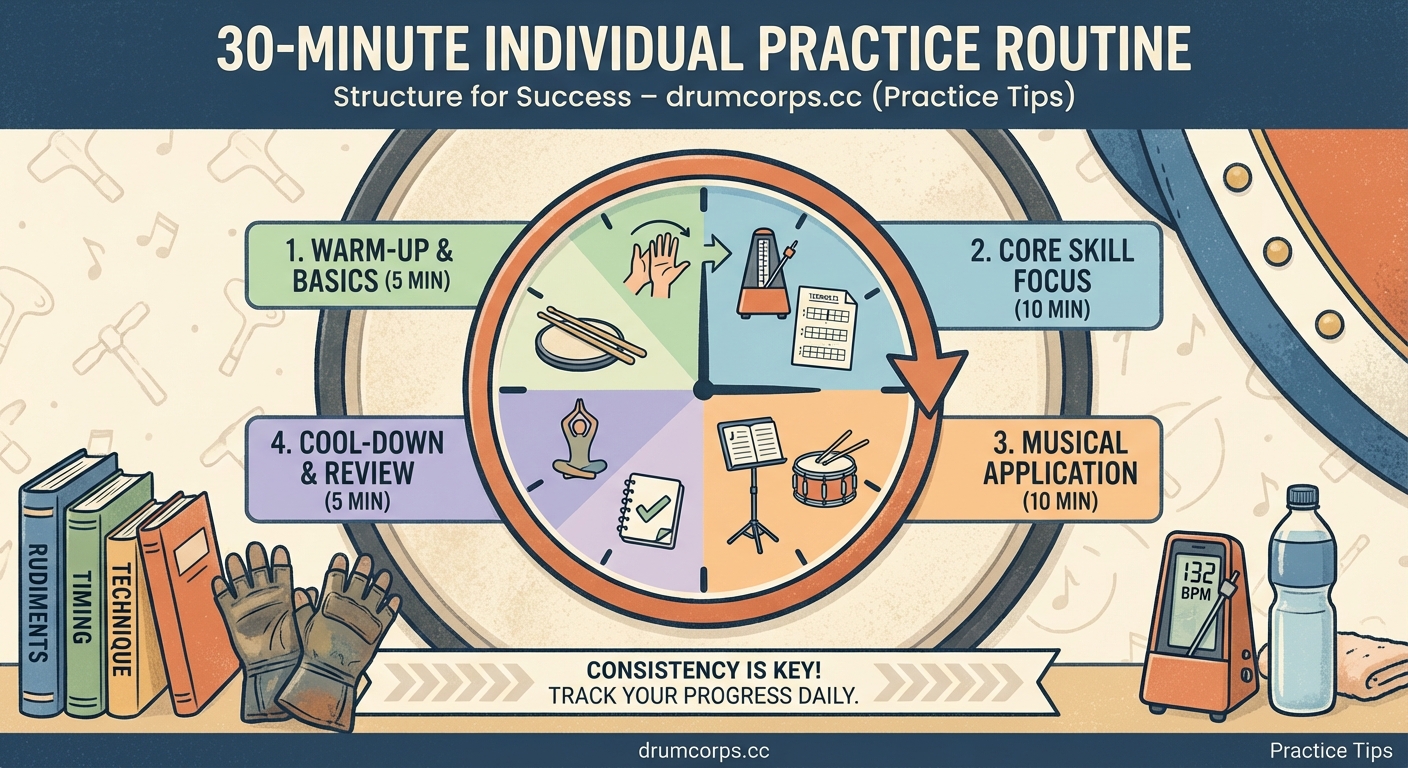
Breaking your session into distinct blocks creates natural momentum. Each section has a clear purpose, and you move through them knowing exactly what comes next.
Here’s the basic structure:
| Block | Duration | Purpose | Example Activities |
|---|---|---|---|
| Warmup | 5 minutes | Prepare body and mind | Breathing exercises, light stretching, simple scales |
| Fundamentals | 10 minutes | Reinforce core technique | Rudiments, tone production, posture drills |
| Challenge work | 10 minutes | Push current limits | New repertoire, difficult passages, speed building |
| Cooldown | 5 minutes | Consolidate and reflect | Play something familiar, write notes, plan tomorrow |
This framework adapts to almost any skill. Drummers, brass players, woodwinds, dancers, even visual artists can use the same basic structure.
Setting up your warmup block
Start slow and simple. Your warmup isn’t the place to impress anyone.
The goal here is to wake up your muscle memory and get your mind focused. If you play a brass instrument, long tones work perfectly. Percussionists can run through basic stroke patterns on a pad. Dancers might do gentle stretches and balance work.
Keep the difficulty low. You should feel comfortable and relaxed. This isn’t about pushing limits yet.
Some people skip warmups because they feel like wasted time. That’s backwards thinking. A good warmup makes the rest of your session more productive. Cold muscles make more mistakes. A scattered mind retains less information.
Set a timer for five minutes. When it goes off, move on. Don’t let your warmup bleed into the next block.
Building your fundamentals block
This is where you build the foundation that supports everything else.
Fundamentals are the techniques you need every single time you perform. For brass players, that’s tone quality, articulation, and breath control. For drummers, it’s stick control, timing, and dynamics. For dancers, it’s posture, alignment, and basic positions.
Pick two or three fundamental skills to work on during this block. Rotate them throughout the week so you’re not drilling the same thing every day.
Here’s a sample rotation for a snare drummer:
- Monday: Single strokes and doubles
- Tuesday: Paradiddles and flam patterns
- Wednesday: Dynamics and accents
- Thursday: Timing with a metronome
- Friday: Buzz rolls and sustained sounds
- Saturday: Mixed rudiments at various tempos
Notice how each day focuses on specific elements. This prevents you from trying to fix everything at once, which usually means fixing nothing.
Use a metronome during this block. Start at a comfortable tempo where you can play cleanly. Gradually increase speed only when you can maintain perfect technique.
“The fundamentals block is where championships are won. You can’t fake good basics under pressure. Build them when the stakes are low so they hold up when the stakes are high.” – Caption head instructor
Ten minutes feels short, but it’s enough to make measurable progress if you stay focused. Track your metronome speeds in a notebook. Seeing those numbers climb over weeks and months proves you’re improving.
Tackling your challenge work
Now you get to work on the hard stuff.
This block is for material that currently sits just beyond your comfortable skill level. Maybe it’s a difficult excerpt from your show music. Maybe it’s a technique you haven’t mastered yet. Maybe it’s playing something familiar at a faster tempo than you’ve managed before.
The key word is “challenge,” not “impossible.” If you’re failing 90% of the time, the material is too hard. Scale it back. If you’re succeeding 90% of the time, it’s too easy. Push harder.
Aim for a success rate around 60 to 70%. You should feel like you’re stretching, but not breaking.
Break difficult passages into smaller chunks. Don’t try to run the whole thing at full speed right away. Isolate the trickiest two measures. Loop them slowly. Gradually increase tempo. Only when those two measures feel solid should you add the measures before and after.
This is also where you can experiment. Try different sticking patterns. Test alternate fingerings. See what happens if you change your breathing or your grip. You won’t know what works best until you test options.
Keep a practice journal nearby. When you figure out a breakthrough technique or notice a recurring mistake, write it down. Your future self will thank you.
Cooling down the right way
Most people quit the moment their timer hits 30 minutes. That’s a mistake.
Your cooldown serves two purposes. First, it lets your body and mind transition out of intense focus mode. Second, it helps consolidate what you just learned.
Play something you already know well. Something that feels good. This isn’t about improvement. It’s about ending on a positive note.
Finishing with success puts you in the right mindset for your next session. If you end frustrated and exhausted, you’ll dread coming back tomorrow. If you end feeling confident, you’ll look forward to it.
Spend the last minute or two reflecting. What went well today? What needs more attention tomorrow? What specific goal will you tackle next time?
Write those thoughts down. They become your roadmap for the next session.
Common mistakes that wreck 30 minute sessions
Even with a solid structure, certain habits will sabotage your progress.
Starting without a plan. Walking into your practice space without knowing what you’ll work on wastes precious minutes. Decide your focus areas the night before.
Skipping the timer. You think you’ll just “feel” when five minutes is up. You won’t. Blocks will expand and contract randomly. Use your phone timer or a dedicated practice app.
Practicing mistakes. If you keep playing something wrong, you’re teaching your muscles to do it wrong. Slow down until you can play it correctly, then gradually speed up.
Ignoring rest days. Your body needs recovery time. Practicing seven days a week often leads to injury or burnout. Six days with one rest day works better for most people.
Multitasking during practice. Put your phone in another room. Close the laptop. Tell your roommate you’re unavailable. Distraction turns a 30 minute session into a 50 minute session with 30 minutes of actual work.
Adapting the framework for different skills
The four-block structure works across disciplines, but the details change based on what you’re practicing.
For brass players:
– Warmup: Long tones, lip slurs, breathing exercises
– Fundamentals: Scales, articulation patterns, range building
– Challenge: Difficult excerpts, high/low register work, new repertoire
– Cooldown: Favorite melody, light playing, equipment care
For battery percussion:
– Warmup: Stroke patterns on a pad, wrist stretches
– Fundamentals: Rudiments with metronome, stick heights, timing grids
– Challenge: Show music, speed building, complex sticking patterns
– Cooldown: Favorite groove, equipment check, stick twirling if that’s your thing
For color guard:
– Warmup: Stretching, basic tosses, footwork review
– Fundamentals: Drop spins, body work, equipment control
– Challenge: New choreography, difficult tosses, speed cleaning
– Cooldown: Run-through of clean work, flexibility, visualization
The percentages stay roughly the same. Adjust the specific activities to match your instrument or discipline.
Tracking progress without obsessing
You need some way to measure improvement, or you’ll lose motivation. But tracking can become its own time sink if you’re not careful.
Keep it simple. A basic notebook works fine. Each day, jot down:
- Date and time of practice
- What you worked on in each block
- One win (something that improved)
- One focus for next time
That’s it. Four lines. Takes 30 seconds to write.
Every two weeks, flip back through your notes. You’ll spot patterns. Maybe your fundamentals block always feels rushed. Maybe Tuesdays are consistently better than Thursdays. Maybe you’ve been avoiding a particular technique.
These patterns tell you what to adjust. Don’t wait for someone else to point out your weak spots. Your practice journal will show you.
Making it stick long term
The hardest part isn’t designing a good 30 minute practice routine. It’s showing up consistently.
Pick the same time every day. Your brain likes patterns. If you practice at 7pm every evening, it becomes automatic. You don’t have to decide whether to practice or negotiate with yourself about when. The time arrives, you practice.
Prepare your space the night before. Lay out your sticks, music stand, metronome, and notebook. When practice time comes, everything is ready. No excuses about needing to find your tuner or dig out your music.
Tell someone your schedule. Accountability helps. Text a friend after each session. Join an online community where people post their practice logs. Knowing someone might ask keeps you honest.
Forgive missed days without spiraling. You’ll skip sometimes. Life happens. One missed session doesn’t ruin your progress. But letting one missed day become three, then five, then a whole week will set you back. Get back on schedule the next day.
Your next 30 minutes
You now have a complete framework. Four blocks, clear purposes, specific activities. You know what mistakes to avoid and how to track progress.
The structure works because it matches how your brain actually learns. Short, focused bursts with clear goals. Repetition spread over time. Immediate feedback. Gradual difficulty increases.
You don’t need a coach standing over you. You don’t need a three-hour block of free time. You need 30 minutes, a timer, and a plan.
Set up your first session tonight. Write down what you’ll work on in each block. Set out your equipment. Pick your practice time for tomorrow.
Then show up and run the routine. Just once. See how it feels.
After a week, you’ll notice sharper focus. After a month, you’ll see measurable skill improvements. After three months, this structure will feel as natural as breathing.
The perfect 30 minute practice routine isn’t about perfection. It’s about showing up, following a system, and trusting the process to build your skills one focused session at a time.
Leave a Reply